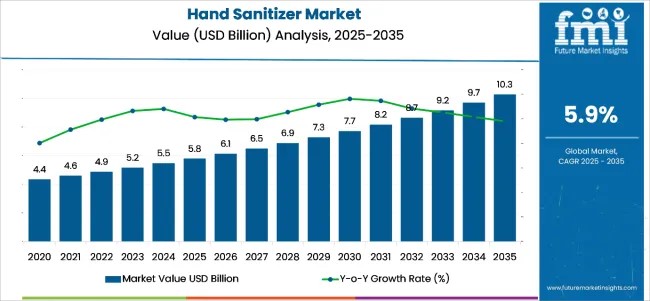
The global hand sanitizer market is undergoing a dynamic transformation as it transitions from a pandemic-driven necessity to an indispensable component of daily hygiene routines worldwide. Valued at USD 5.8 billion in 2025, the market is forecast to soar to USD 10.3 billion by 2035, registering a steady compound annual growth rate (CAGR) of 5.9%. This growth trajectory reflects rising consumer hygiene awareness, stringent health and safety regulations, and ongoing innovations by both established and new manufacturers eager to expand their footprint in this thriving sector.
Subscribe for Year-Round Insights → Stay ahead with quarterly and annual data updates – https://www.futuremarketinsights.com/reports/sample/rep-gb-707
Established Players and New Entrants Fuel Innovation and Market Expansion
- The market landscape is predominantly shaped by leading global manufacturers such as GOJO Industries Inc. (maker of Purell), Reckitt Benckiser Group PLC (Dettol), Procter & Gamble (Safeguard), Unilever PLC (Lifebuoy), and Vi-Jon Laboratories (Germ-X). Together, these top five players control approximately 55-65% of the global market, leveraging deep institutional penetration, innovative product lines, and trusted brand equity.
- However, the industry is witnessing vibrant activity from emerging and niche players who are carving out space through product differentiation and technology integration. Companies like The Himalaya Drug Company, Saraya Co. Ltd., Seatex Ltd., and Kutol Products Company are focusing on organic, Ayurvedic, and hypoallergenic sanitizers, meeting growing consumer demand for clean-label and natural ingredient-based solutions.
- Technological advancements, such as AI-powered touchless dispensers and subscription-based hygiene models, are revolutionizing product delivery and user convenience. Manufacturers are increasingly prioritizing sustainable innovations — including biodegradable packaging, refillable containers, and zero-waste product formats — to align with environmental responsibilities and evolving consumer preferences.
Key Market Segments:
The comprehensive report highlights the following critical segments fueling market growth:
- Product Types:
- Gel-based sanitizers dominate with a 43% market share, favored for their ease of use, longer-lasting coverage, and skin-friendly moisturizing properties.
- Other formats include liquid sanitizers, foam sanitizers, spray sanitizers, and wipes & tissues, each catering to diverse consumer needs and usage scenarios.
- Active Ingredients:
- Alcohol-based sanitizers lead growth with a projected CAGR of 6.1%, endorsed by global health authorities like WHO and CDC for their rapid and broad-spectrum germ-killing efficacy.
- Non-alcohol-based alternatives, using compounds like benzalkonium chloride, are gaining popularity among sensitive skin users and settings where alcohol use is restricted.
- Packaging Types:
- Bottled sanitizers (pump bottles, flip-tops) capture 53% of the market, offering convenience, leak resistance, and hygienic application.
- Innovative packaging such as sachets, tubes, spray cans, and automated dispensers are expanding options for both personal and institutional use.
- Sales Channels:
- Retail stores remain the leading distribution channel, accounting for 47% of sales, driven by accessibility through supermarkets, pharmacies, and convenience stores.
- E-commerce platforms, direct B2B sales, and institutional contracts (hospitals, schools, public transport) are growing rapidly, particularly with the rise of subscription and bulk purchase models.
- Regional Outlook:
- North America and Europe report the highest per capita spending, driven by premium product adoption and strict hygiene regulations.
- Asia-Pacific leads in overall consumption volume, supported by rapid urbanization and government-led hygiene campaigns.
- Emerging markets in Latin America, the Middle East, and Africa are showing promising growth, with increasing awareness and retail penetration.
Spotlight on Leading Markets:
- United States: Expected to grow at a 6.8% CAGR, the U.S. market thrives on institutional healthcare demand and innovation in smart dispensers. Brands like Purell and Germ-X are expanding their portfolios with moisturizing and eco-friendly variants.
- China: Fastest growing at 7.5% CAGR, China’s market is marked by intense competition between domestic giants such as Walch and Blue Moon and international brands. E-commerce sales fueled by influencer marketing dominate retail growth.
- Germany: With a 6.7% CAGR, German consumers emphasize high-efficacy hospital-grade sanitizers from brands like Sterillium, alongside rising demand for eco-conscious and non-alcohol alternatives.
- India: Rapid expansion at 7.2% CAGR is driven by increased hygiene awareness, regional manufacturing, and trusted herbal brands like Himalaya and Dabur offering natural and Ayurvedic options.
- South Korea and Japan: Both markets, growing at 7% and 6.3% respectively, show strong preferences for skin-friendly, fragrant formulations supported by cutting-edge technology such as antimicrobial coatings and smart dispensers.
Regulatory Landscape Ensures Safety and Innovation
Stringent regulations by the FDA, WHO, EPA, and regional health authorities govern product safety, ingredient approval, labeling transparency, and efficacy standards. Recent enforcement measures target bans on methanol and toxic additives, mandating strict compliance for manufacturers.
Regulatory frameworks also encourage sustainability, with European authorities pushing for biodegradable packaging and restrictions on harmful chemicals. Such policies not only protect public health but also drive innovation, prompting companies to invest in eco-friendly materials and safer formulations.
Industry Trends and Technological Advances
- The normalization of sanitization habits in daily life has propelled hand sanitizers from a pandemic-specific product to a long-term hygiene essential.
- Product innovation is accelerating with new formats like spray pens, wipes, AI-integrated dispensers, and subscription hygiene kits becoming mainstream.
- Sustainability is front and center, with biodegradable packaging and refill stations becoming significant competitive differentiators.
- Manufacturers are addressing diverse consumer needs by offering alcohol-free, moisturizing, fragrance-free, and hypoallergenic variants.
Key Takeaways for Businesses and Investors
- The hand sanitizer market offers robust growth opportunities with an expanding consumer base and strong institutional demand.
- Established players maintain dominance through scale, brand equity, and innovation, but nimble regional and niche manufacturers are successfully penetrating specialized segments.
- Investment in sustainable packaging and digital dispenser technology is expected to drive competitive advantage and market leadership.
- E-commerce and subscription models provide new avenues for direct-to-consumer engagement and consistent revenue streams.
- Compliance with evolving regulatory standards is critical for market access and brand trust.
Why FMI: https://www.futuremarketinsights.com/why-fmi
About Future Market Insights (FMI)
Future Market Insights, Inc. (FMI) is an ESOMAR-certified, ISO 9001:2015 market research and consulting organization, trusted by Fortune 500 clients and global enterprises. With operations in the U.S., UK, India, and Dubai, FMI provides data-backed insights and strategic intelligence across 30+ industries and 1200 markets worldwide.
Contact Us:
Future Market Insights Inc.
Christiana Corporate, 200 Continental Drive,
Suite 401, Newark, Delaware – 19713, USA
T: +1-347-918-3531
For Sales Enquiries: sales@futuremarketinsights.com
Website: https://www.futuremarketinsights.com
LinkedIn| Twitter| Blogs | YouTube