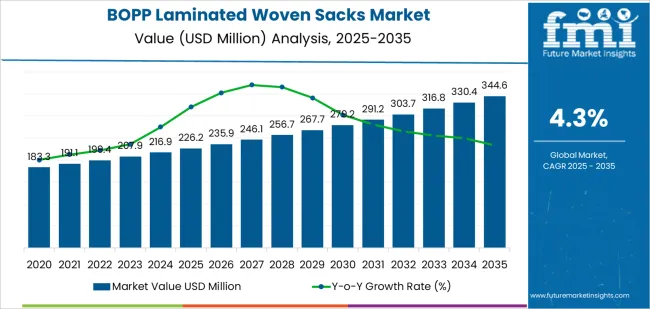
As global supply chains adapt to rising demand for bulk commodity packaging, the market for BOPP (Biaxially Oriented Polypropylene) laminated woven sacks is entering a significant growth phase. According to a comprehensive market analysis, the sector — currently valued at approximately USD 226.2 million — is projected to grow to USD 344.7 million by 2035, registering a compound annual growth rate (CAGR) of 4.3%. The market’s evolution reflects a shift away from traditional woven packaging toward advanced lamination-based systems that offer improved protection, durability, and performance.
At the heart of this transformation lie the leading producers: companies such as Satyendra Packaging, Grupo Excala, C.P. Poly-Industry, and Knack Packaging are doubling down on their laminated-sack portfolios, leveraging decades of expertise to meet rising demand. Simultaneously, a fresh wave of innovators — including LC Packaging, Formosa Synthetics, Emmbi Industries, and newer regional specialists — are entering the fray, pushing the boundaries of technology and offering specialized, application-specific solutions.
Double-sided lamination takes centre stage
One of the most notable shifts in the market is the growing dominance of double-sided lamination systems. With their superior moisture barrier, consistent structural strength, and seamless integration with automated filling and bulk-handling equipment, double-sided laminated sacks now command roughly 64% of global demand. This technology provides enhanced moisture resistance, preventing spoilage and degradation — a vital feature for agricultural commodities, fertilizers, animal feed, grains, and other bulk goods transported and stored in demanding conditions.
On the other hand, single-sided laminated sacks remain relevant in less demanding, price-sensitive segments. They continue to offer a cost-effective entry point for packaging needs where basic protection and lower cost are prioritized over premium performance.
Agriculture: The backbone of demand — but expansion ahead
Agriculture remains the largest application segment by far, accounting for approximately 58% of total demand. As global farming output rises and bulk storage becomes increasingly important, producers favor BOPP laminated sacks for grains, seeds, animal feed, fertilizers, and other commodities — thanks to their durability, resistance to moisture, and ability to safeguard product quality over time.
But the story doesn’t end there. Demand is expanding beyond agriculture into food processing, construction materials, chemical products, and specialized bulk packaging solutions. This diversification opens new avenues for manufacturers to tailor their products to the specific performance needs of food-grade packaging, industrial materials, and high-volume commodity handling.
Regional growth hotspots: Asia Pacific leads, India and China at the forefront
The Asia Pacific region is emerging as the primary growth engine for BOPP laminated sacks, driven by increasing agricultural output, bulk packaging infrastructure expansion, and rising demand from developing economies. Among countries, India and China stand out with impressive projected growth rates of 5.4% and 5.8% respectively.
In India — a market with deep agricultural roots and burgeoning industrial demand — both established packaging players and newer manufacturers are ramping up production capacities, investing in lamination technology, and localizing supply to meet growing domestic and export demand. Meanwhile, China’s packaging industry is scaling rapidly, benefitting from robust commodity production and increasing adoption of advanced bulk-packaging standards.
In more mature markets — including Germany, the United States, Brazil, the United Kingdom, and Japan — adoption continues steadily. Here, regulatory standards, food-safety compliance, and the demand for automated, large-scale commodity handling sustain demand for premium laminated packaging systems.
Manufacturers respond with technology upgrades and supply-chain initiatives
To stay ahead in a market that values performance, reliability, and scalability, leading packaging firms are investing heavily in technology upgrades. Advanced lamination systems, improved barrier formulations, precision printing, and integration with automated filling and palletization platforms are becoming standard. Some manufacturers are also exploring upstream polymer integration to gain greater control over raw-material supply and mitigate volatility in polypropylene prices.
Meanwhile, newer and regional manufacturers are carving out niches by focusing on customization, flexible order sizes, and cost-effective laminated sacks tailored to smaller agribusinesses or localized markets. Their agility and willingness to cater to specific customer needs make them important contributors to market growth.
Why this moment matters — and what’s ahead
The drive toward advanced BOPP laminated sacks comes at a time when global commodity packaging needs are changing dramatically. Farmers, processors, and commodity-service providers increasingly demand packaging that ensures moisture control, product safety, durability, and efficiency — especially in bulk operations. As global populations grow and supply chains scale up, the value of reliable, high-performance packaging becomes critical for minimizing post-harvest losses, preserving quality, and optimizing storage and transportation.
Given these dynamics, the next decade presents a pivotal growth window. Manufacturers with the right mix of technology, capacity, and market focus stand to benefit immensely. For established players with proven lamination capabilities, it’s an opportunity to reinforce leadership. For new or regional manufacturers, it’s a chance to capture market share by offering specialized, flexible, and localized solutions — all while contributing to the broader modernization of global bulk packaging.
About this Release / Call to Action
This press release offers an overview of global trends in the BOPP laminated woven sacks market and highlights the strategies and opportunities for packaging manufacturers — both seasoned and emerging. Companies looking to expand capacity, adopt advanced lamination technology, or explore new application segments in agriculture, food processing, construction, or industrial goods packaging are encouraged to leverage this window of opportunity.
For more information, partnership interest, or to explore manufacturing and supply-chain collaborations, packaging firms and stakeholders are invited to engage with leading BOPP laminated sack producers — as the industry collectively gears up for a decade of growth, innovation, and expansion.