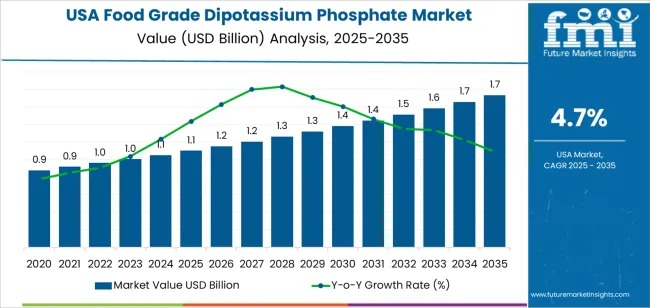
The demand for food grade dipotassium phosphate in the USA is projected to grow from USD 1.1 billion in 2025 to USD 1.7 billion by 2035, reflecting a steady CAGR of 4.7%. Food grade DKP, widely used as a buffering agent, emulsifier, and nutrient supplement, finds applications in dairy products, beverages, processed foods, and baked goods.
This growth is driven by the increasing consumer preference for processed and convenience foods, which require enhanced texture, preservation, and nutritional fortification. In addition, expansion in the plant-based alternatives and functional foods segments is expected to further support DKP demand across the country.
Explore trends before investing – request a sample report today! https://www.futuremarketinsights.com/reports/sample/rep-gb-28840
Technological Advancements and Regulatory Support
Technological improvements in food processing and favorable regulatory approvals have paved the way for broader adoption of dipotassium phosphate in various formulations. Manufacturers are increasingly prioritizing food safety, consistency, and high-quality standards, making DKP an essential ingredient in modern food production.
Market Snapshot – USA Food Grade Dipotassium Phosphate
- Market Value (2025): USD 1.1 billion
- Forecast Value (2035): USD 1.7 billion
- Forecast CAGR (2025–2035): 4.7%
- Leading Form: Powder (64%)
- Key Growth Regions: West, South, Northeast, Midwest
- Top Players: Foodchem International Corporation, TKI Hrastnik, FBC Industries, Aditya Birla Chemicals, Haifa Chemicals Ltd.
Market Growth Phases
From 2025 to 2030, the market is expected to grow from USD 1.1 billion to USD 1.3 billion. This early phase reflects accelerated adoption driven by expanding applications in processed foods, dairy, and beverages. The growing plant-based and functional food markets, coupled with heightened focus on food safety and nutritional enhancement, are key growth drivers.
Between 2030 and 2035, the market will expand from USD 1.3 billion to USD 1.7 billion. While growth remains strong, the rate of acceleration slows slightly as the market approaches maturity. Stabilization in adoption and standardization of DKP use in food products contributes to a moderated growth rate, yet sustained demand in functional foods, beverages, and nutritional supplements ensures continued expansion.
Leading Forms and Applications
Powder form dominates the market, accounting for 64% of demand. Its solubility, ease of integration into food matrices, and storage convenience make it highly suitable for large-scale food production.
The dairy sector leads in application, representing 36.2% of the market. DKP is utilized in milk, cheese, and yogurt to stabilize texture, prevent separation, and extend shelf life. The rise of convenience dairy products further strengthens DKP’s role as a key additive.
Regional Insights
- West: Leads with a CAGR of 5.4%, driven by California, Oregon, and Washington’s large-scale food processing industries and high adoption of processed and functional foods.
- South: Registers 4.8% CAGR, supported by Texas, Florida, and Georgia’s food and beverage manufacturing growth and rising demand for packaged and ready-to-drink foods.
- Northeast: Shows steady growth of 4.3% CAGR, reflecting mature food production hubs and consistent demand for processed and convenience foods.
- Midwest: Demonstrates moderate growth of 3.7% CAGR, with a strong agricultural base and gradual expansion in processed food manufacturing.
Market Drivers
The primary drivers supporting DKP demand include:
- Increased consumption of processed and convenience foods requiring stabilizers and buffers.
- Expansion of dairy, meat, and beverage processing industries.
- Consumer preference for fortified and functional food products.
- Technological advances enabling customized DKP formulations.
- Emphasis on clean label ingredients and regulatory compliance.
Market Restraints
Despite favorable conditions, growth is moderated by:
- Volatility in raw material costs.
- Regulatory scrutiny of food additives.
- Competition from alternative stabilizers and buffers.
- Market maturity in certain segments, such as basic dairy and bakery products.
Key Trends
Emerging trends shaping DKP demand include:
- Rising incorporation in plant-based dairy alternatives and fortified beverages.
- Focus on clean label and mineral-rich functional foods.
- Development of custom DKP grades with improved solubility and compatibility.
- Increasing importance of sustainability and supply chain transparency.
Competitive Landscape
Leading players such as Foodchem International Corporation, TKI Hrastnik, FBC Industries, Aditya Birla Chemicals, and Haifa Chemicals Ltd. are driving competition based on product quality, regulatory compliance, and supply chain reliability. These companies focus on delivering high-purity, contaminant-free DKP suitable for diverse food applications while emphasizing sustainability and alignment with clean label trends.
Conclusion
The USA food grade dipotassium phosphate market is poised for steady growth over the next decade, underpinned by rising processed food consumption, technological advancements, and the growing demand for functional ingredients. Manufacturers focusing on quality, sustainability, and product versatility will remain at the forefront of this evolving market landscape.