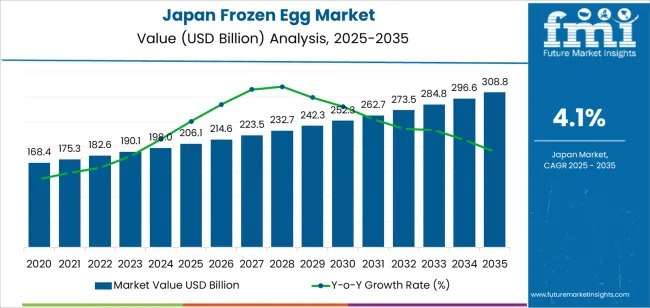
Japan’s frozen egg market is entering a decade of steady expansion, with demand projected to rise from USD 206.1 million in 2025 to USD 308.8 million by 2035, reflecting a CAGR of 4.1%. Growth is being fueled by the country’s advanced food-processing ecosystem, strong need for consistent ingredients, and increasing preference for long-shelf-life, waste-reducing food solutions across industrial and commercial applications.
Japan’s food manufacturers and large-scale bakeries are increasingly relying on frozen egg formats—whole egg, yolk, and egg whites—to maintain product consistency while reducing storage costs, labor requirements, and waste. Frozen eggs offer extended shelf life and streamlined logistics, aligning well with Japan’s growing commitment to sustainability and reduction of food waste. Rising demand for ready-to-eat meals, frozen bakery products, and convenience foods is further supporting the sector’s upward trajectory.
Explore trends before investing – request a sample report today! https://www.futuremarketinsights.com/reports/sample/rep-gb-28770
Market Snapshot (2025–2035)
- Market Value 2025: USD 206.1 million
- Forecast Value 2035: USD 308.8 million
- CAGR: 4.1%
- Leading Product Type: Egg Whites (46%)
- Top End-Use Sector: Food Processing Industry (60%)
- Highest-Growth Regions: Kyushu & Okinawa, Kanto, Kinki
- Key Players: Kewpie Corporation, NH Foods Ltd., Akita Foods Co., Ltd., Ise Foods Inc., Morinaga Milk Industry Co., Ltd., Taiyo Kagaku Co., Ltd., Cargill Inc.
Growth Outlook: Stable Momentum with Expansion in Processed Foods
The frozen egg demand curve exhibits a consistent upward trend throughout the decade. Between 2025 and 2030, market value is set to increase from USD 206.1 million to USD 252.3 million, driven by the adoption of frozen egg ingredients in bakeries, confectioneries, and ready-meal production lines.
From 2030 to 2035, the market continues its climb to USD 308.8 million. Growth moderates slightly due to increasing market maturity and competition from alternative egg-based formats, yet remains positive due to Japan’s continuous shift toward labor-saving, efficient food ingredients.
What’s Driving Demand?
Japan’s food industry is undergoing modernization, and frozen egg products are becoming standard ingredients in industrial and foodservice sectors. Key drivers include:
- Consistency & Quality Standardization: Frozen eggs provide predictable functionality essential for Japan’s high-precision bakery and confectionery sectors.
- Food Safety & Hygiene: Pasteurized frozen eggs reduce microbial risk—an important advantage in Japan’s highly regulated food ecosystem.
- Convenience & Operational Efficiency: Ready-to-use egg inputs reduce labor and sharply cut ingredient wastage.
- Expansion of Convenience Foods: Japan’s urban consumers continue to shift toward ready meals, bento boxes, sauces, and packaged bakery goods—all of which use frozen eggs.
- Sustainability: Extended shelf life supports Japan’s national agenda focused on minimizing food waste.
However, premium pricing relative to shell eggs and Japan’s continued cultural preference for fresh-egg dishes create natural restraints. Still, the market benefits from a clear long-term shift toward automation, efficiency, and ready-to-use ingredients.
Product Type Insights: Egg Whites Lead with 46% Share
Egg whites dominate the segment, capturing 46% of demand. Their high functionality—foaming, whipping, binding—makes them indispensable in meringues, pastries, cakes, sauces, and protein-enriched foods.
Japan’s rising interest in high-protein, low-fat dietary options further strengthens demand. Frozen egg whites also reduce waste and improve cost efficiency for manufacturers, supporting their position as the largest and fastest-growing product category.
End-Use Insights: Food Processing Holds 60% Share
The food processing industry accounts for 60% of Japan’s frozen egg consumption. Bakery chains, confectionery producers, ready-meal brands, and industrial caterers extensively use frozen eggs for:
- Ready-to-eat meals
- Bakery mixes
- Snacks & packaged desserts
- Sauces, dressings, and emulsified foods
Growth in convenience stores, quick-service restaurants, and meal-kit programs reinforces frozen egg adoption across Japan’s largest metropolitan regions.
Regional Demand Trends
Japan’s frozen egg growth varies across regions based on industrial capacity, cold-chain readiness, and foodservice penetration.
Kyushu & Okinawa – CAGR 5.2% (Highest)
Strong poultry farming, robust food manufacturing, and tourism-driven foodservice demand support the region’s leadership.
Kanto – CAGR 4.7%
Home to Tokyo, Kanto benefits from dense urban consumption, leading bakery establishments, and advanced distribution networks.
Kinki – CAGR 4.2%
Driven by Osaka and Kyoto’s strong food manufacturing base and demand for processed bakery goods.
Chubu – CAGR 3.7%
Steady adoption supported by industrial clusters and logistics efficiencies.
Tohoku & Rest of Japan – CAGR 3.1–3.2%
Lower density and traditional food processing practices result in slower, yet ongoing adoption.
Competitive Landscape
Japan’s frozen egg market is shaped by both domestic and global players focusing on:
- High-quality pasteurized frozen egg products
- Pricing competitiveness
- Packaging and cold-chain optimization
- Product innovation (pre-blends, specialty formulations, functional egg derivatives)
Leading companies include Kewpie Corporation, NH Foods Ltd., Akita Foods, Ise Foods Inc., Morinaga Milk Industry, Taiyo Kagaku, and Cargill Inc.—all emphasizing quality assurance, safety standards, and suitability for industrial-scale applications.