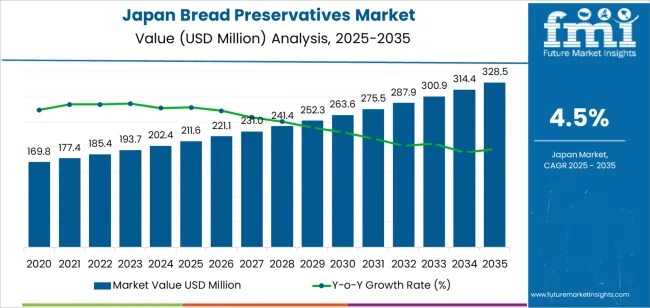
Japan’s demand for bread preservatives is projected to rise from USD 211.6 million in 2025 to USD 328.5 million by 2035, reflecting a steady CAGR of 4.5%. The market continues to expand as commercial bakeries, convenience-store chains, and packaged bread manufacturers rely on robust preservation systems to maintain freshness, prevent spoilage, and ensure product reliability across long distribution networks.
Japan’s bakery sector—known for efficiency, high-volume production, and a dominant packaged-bread culture—has created a stable environment for preservative adoption. Both traditional and advanced preservative blends remain in use as manufacturers optimize formulations for shelf-life stability, texture retention, and distribution feasibility.
Explore trends before investing – request a sample report today! https://www.futuremarketinsights.com/reports/sample/rep-gb-28958
Stable, Predictable Growth Through 2035
The demand trajectory shows a consistent rise from USD 169.8 million in 2020 to USD 211.6 million in 2025, driven by strong packaged bakery consumption and industrial production cycles. Growth then advances annually with predictable increments:
- USD 221.1 million in 2026
- USD 231.0 million in 2027
- USD 263.6 million in 2031
- USD 300.9 million in 2033
By 2035, the market reaches USD 328.5 million, backed by Japan’s evolving consumer preferences and increased adoption of multifunctional preservation technologies.
Market Quick Stats
- 2025 Market Value: USD 211.6 million
- 2035 Forecast Value: USD 328.5 million
- CAGR (2025–2035): 4.5%
- Leading Segment: Artificial Preservatives (61%)
- Top Growth Regions: Kyushu & Okinawa, Kanto, Kinki, Chubu
- Key Companies: Kerry Group, Corbion N.V., DuPont (IFF), Kemin Industries, Puratos Group
What’s Driving Japan’s Rising Demand for Bread Preservatives?
Historically, Japan’s packaged bread culture has been shaped by convenience-store dominance, high consumer expectations for freshness, and strong preference for soft-textured breads such as shokupan. These factors entrenched preservative use early on, helping manufacturers reduce waste and maintain consistent quality.
Looking forward, several modern forces are reshaping demand:
- Shift toward clean-label and enzyme-based preservation.
- Expansion of frozen, ambient and ready-to-eat bread formats.
- Longer logistics routes due to online grocery and home delivery.
- Growing emphasis on food-waste reduction and shelf-life extension.
These dynamics position advanced and multifunctional preservative solutions as essential components in Japan’s bakery supply chain.
Why Artificial Preservatives Lead the Market (61% Share)
Artificial bread preservatives dominate demand due to their:
- Highly predictable performance during long distribution cycles
- Strong mold-inhibition properties in humid climates
- Compatibility with mass-production and automated bakery lines
- Minimal variability in finished-product outcomes
Large commercial bakeries rely on consistent dosing, reliable microbial control, and stable shelf-life performance—factors that keep artificial systems at the forefront, even as natural alternatives gain traction.
Why Powder Forms Hold the Largest Share (67.5%)
Powder preservatives outperform liquid formats thanks to:
- Longer storage stability
- Compatibility with automated batching systems
- Uniform blending in dough mixes
- Ease of transport and temperature-resistant storage
Industrial bakeries favor powder-based systems to optimize workflow efficiency, reduce processing variability, and support high-throughput operations.
Regional Demand Outlook Through 2035
Japan’s demand for bread preservatives varies by region, shaped by climate, bakery density, and production patterns.
Fastest-Growing Regions
- Kyushu & Okinawa (CAGR 5.6%) – High humidity, increased packaged bread output, and strong adoption across urban and rural bakeries.
- Kanto (CAGR 5.2%) – Tokyo’s industrial bakery hub drives demand for food safety, high-volume production, and extended shelf-life requirements.
- Kinki (CAGR 4.5%) – Osaka and Kyoto’s bakery ecosystems push consistent use of preservatives to support expanding packaged bread categories.
- Chubu (CAGR 4.0%) – Growth driven by Nagoya’s food manufacturing base and retail distribution expansion.
Tohoku (3.5%) and the Rest of Japan (3.3%) show gradual but stable adoption as smaller bakeries upgrade processes and expand packaged offerings.
Key Players Shaping Japan’s Bread Preservatives Market
Global ingredient suppliers and domestic formulation specialists play a critical role in delivering compliant and efficient solutions tailored to Japan’s stringent food standards.
Prominent players include:
- Kerry Group
- Corbion N.V.
- DuPont (IFF)
- Kemin Industries
- Puratos Group
These companies support Japanese manufacturers with enzyme systems, bio-based preservatives, customized blends and technical guidance aligned with clean-label transitions and performance requirements.