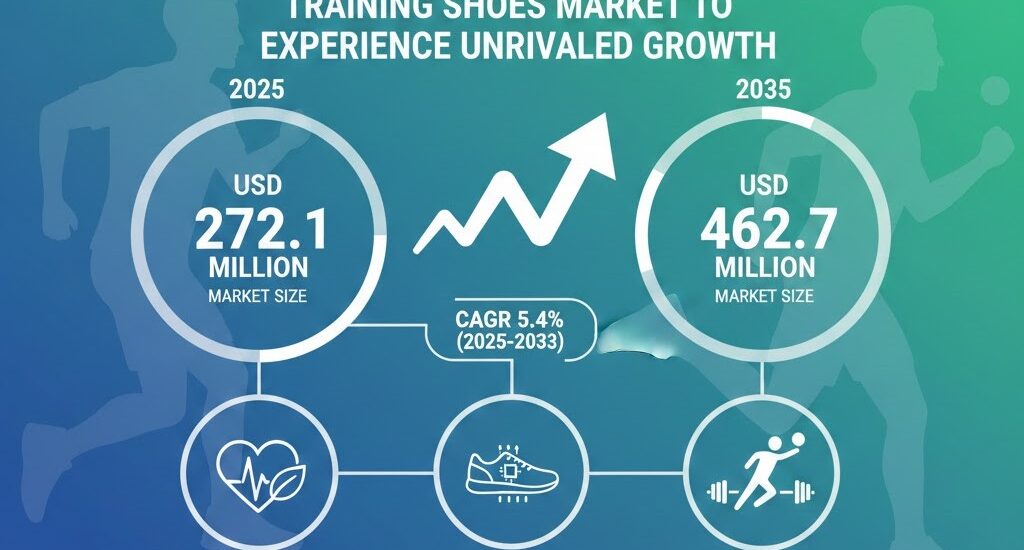
The global Training Shoes Market is on track for significant expansion between 2025 and 2035, propelled by rising health awareness, growing participation in fitness programs, and rapid innovation in footwear materials and smart technologies. According to the new analysis, the market—valued at USD 272.1 million in 2025—is projected to reach USD 462.7 million by 2035, reflecting a steady 5.4% CAGR.
Both established players such as Nike, Adidas, Puma, Under Armour, ASICS, and emerging specialist brands across Asia, Europe, and North America are rapidly adopting new manufacturing methods, sustainable materials, and performance technologies to strengthen their market presence and tap into new customer segments.
Subscribe for Year-Round Insights → Stay ahead with quarterly and annual data updates – https://www.futuremarketinsights.com/reports/sample/rep-gb-16333
A Market Entering a High-Growth Phase
The training footwear industry is rapidly transforming, driven by:
- Increased demand for category-specific training shoes such as weightlifting, HIIT, cross-training, and running shoes.
- Breakthroughs in midsoles, outsoles, and breathable uppers that enhance stability, energy return, and ventilation.
- The rise of eco-friendly materials, including biodegradable soles, algae-based foams, and recycled polyester.
- A surge in smart training shoes powered by AI analytics, ergonomic sensors, and adaptive cushioning.
Market leaders such as Nike (React, ZoomX), Adidas (Boost, Futurecraft Loop), Puma (ProFoam), Under Armour (HOVR, digital shoe sensors), and ASICS (GEL biomechanics technology) continue to invest heavily in research & development. Meanwhile, younger brands like Allbirds, Li-Ning, and Anta are using sustainable and cost-effective production to attract global consumers.
Regional Highlights
North America Leads the Market
North America remains the strongest regional market due to:
- A highly developed sports and training culture
- Adoption of advanced performance footwear by consumers
- Growing demand for plant-based and recycled sneakers
- Expansion of HIIT and functional fitness clubs such as CrossFit and Orangetheory
Major brands such as Under Armour and New Balance continue to launch innovative products catered to both professional athletes and everyday fitness enthusiasts.
Europe Focuses on Sustainability & Performance
Europe maintains strong dominance due to its:
- Concentration of iconic sports brands (Puma, ASICS, Salomon)
- Strong marathon, outdoor fitness, and school sports programs
- Strict EU sustainability regulations driving innovations in recyclable and biodegradable training shoes
Adidas’ recyclable Futurecraft.Loop shoes stand as a major example of circular manufacturing influencing the industry.
Asia-Pacific Emerges as the Fastest-Growing Region
APAC growth is fueled by:
- Massive youth populations adopting fitness culture
- Surge in gym memberships and government fitness initiatives
- Rapid expansion of online channels like Flipkart and Alibaba
However, counterfeit footwear remains a challenge. Governments are increasingly launching anti-counterfeit campaigns to protect both consumers and brands.
Market Challenges and Opportunities
Key Challenge: Environmental Impact
Training shoe production typically uses petroleum-based EVA foam, rubber, and polyurethane—materials that contribute to pollution and waste. The global sustainability push pressures manufacturers to move toward biodegradable, recyclable, and plant-based solutions.
Key Opportunity: Smart Training Shoes
Smart shoes are emerging as a major revenue opportunity, featuring:
- Motion sensors
- Mobile connectivity
- AI-based gait analysis
- Adaptive cushioning
Brands like Nike Adapt and Under Armour HOVR lead this segment. Additionally, 3D-printed shoes tailored to the user’s biomechanics are becoming mainstream, driven by collaborations such as Adidas x Carbon.
Market Evolution: 2020–2024 vs. 2025–2035
Between 2020 and 2024, training shoes benefited from pandemic-driven home workouts, athleisure trends, and early experiments with recycled materials. From 2025 to 2035:
- Regulations enforce fully recyclable materials
- Shoes integrate advanced sensors for real-time performance feedback
- 3D-printed midsoles and personalized fit gain market share
- Modular, repairable training shoes replace throwaway models
- Nearshoring and automation reduce supply chain disruptions
Country-Level Insights
- USA (CAGR 5.4%) – Growth driven by connected fitness platforms like Apple Fitness+ and Peloton; rising adoption of biometric smart shoes.
- UK (CAGR 5.3%) – Strong sustainability commitments and demand for HIIT-specific training shoes.
- EU (CAGR 5.3%) – Circular production and eco-friendly innovation remain priority drivers.
- Japan (CAGR 5.2%) – High demand for technologically advanced shoes featuring micro-engineering and energy-saving soles.
- South Korea (CAGR 5.2%) – Tech-savvy consumers drive adoption of AI-powered personalized footwear.
Competitive Landscape
The market is highly consolidated among global giants, but new brands are quickly rising in popularity due to innovative materials and competitive pricing.
Estimated Market Share
- Nike: 25–30%
- Adidas: 18–23%
- Puma: 10–14%
- Under Armour: 5–9%
- ASICS: 4–8%
- Others (Reebok, New Balance, Skechers, Li-Ning, etc.): 30–40%
These companies invest in:
- Proprietary cushioning technologies
- Athlete collaborations
- Sustainability programs
- Digital integration and DTC distribution models
Key Segments of the Market Report
By Closure Type
- Lace-Up
- Elastic
- Slip-On
- Velcro
- Others
By Sole Material
- Polyurethane
- Rubber
- Leather
- EVA
- Others
By Outer Material
- Leather
- Mesh
- Synthetic Materials
- Others
By Consumer Orientation
- Men
- Women
- Kids
By Sales Channel
- Multi-Brand Stores
- Independent Retailers
- Online Retailers
- Other Channels
By Region
- North America
- Latin America
- Western & Eastern Europe
- East Asia
- South Asia Pacific
- Middle East & Africa
Why FMI: https://www.futuremarketinsights.com/why-fmi
About Future Market Insights (FMI)
Future Market Insights, Inc. (FMI) is an ESOMAR-certified, ISO 9001:2015 market research and consulting organization, trusted by Fortune 500 clients and global enterprises. With operations in the U.S., UK, India, and Dubai, FMI provides data-backed insights and strategic intelligence across 30+ industries and 1200 markets worldwide.
Contact Us:
Future Market Insights Inc.
Christiana Corporate, 200 Continental Drive,
Suite 401, Newark, Delaware – 19713, USA
T: +1-347-918-3531
For Sales Enquiries: sales@futuremarketinsights.com
Website: https://www.futuremarketinsights.com
LinkedIn| Twitter| Blogs | YouTube