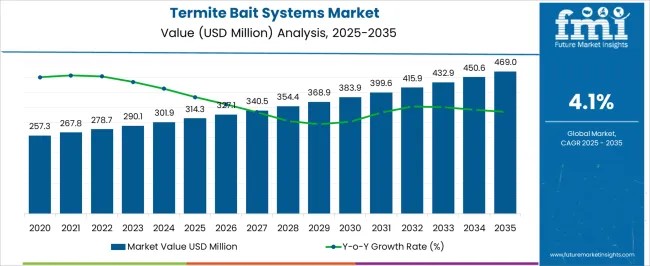
The global Termite Bait Systems Market, valued at USD 314.3 million in 2025, is poised to reach USD 469.0 million by 2035, growing at a 4.1% CAGR. Driven by rising consumer awareness, adoption of sustainable pest control technologies, and regulatory support for low-toxicity solutions, the market is becoming an attractive arena for established players and emerging manufacturers seeking expansion opportunities.
Termite infestation continues to pose a significant risk to residential, commercial, and industrial properties worldwide. As property owners shift toward environmentally friendly, long-lasting pest management solutions, termite bait systems have become a cornerstone of modern termite control. These systems offer targeted treatment, minimal chemical exposure, and colony-elimination capability—making them the preferred choice across high-risk regions.
Subscribe for Year-Round Insights → Stay ahead with quarterly and annual data updates – https://www.futuremarketinsights.com/reports/sample/rep-gb-17993
Growing Opportunities for Both Established and New Manufacturers
With demand surging across the globe, leading companies such as BASF SE, Dow Inc, and Bayer AG continue to invest heavily in advanced formulations, smart monitoring tools, and eco-friendly ingredient systems. Meanwhile, new entrants—including regional pest control providers—are leveraging modern biological research, IoT-based monitoring, and tailored solutions to secure niche markets.
Recent market movements reflect strong consolidation and innovation trends:
- Aantex Pest Control expanded its Northern California presence after acquiring Aantex Pest Control Norcal in 2025.
- Rollins, Inc. strengthened its pest control portfolio following the acquisition of Fox Pest Control Holdings.
- Decke Global launched Bio-Totung, a biotechnology-based pre-construction termite solution, signaling the increasing role of green chemistry in pest management.
Such advancements underscore a market that welcomes technology-driven startups, biotech innovators, and regional service providers seeking scale and global visibility.
Market Dynamics: What’s Driving Growth?
Key Growth Factors
- Growing awareness of structural damage caused by termites
- Preference for eco-safe, low-toxicity pest control methods
- Strong adoption of integrated pest management (IPM) systems
- Rapid urban expansion and large-scale infrastructure development
- Advancements in bait formulations and monitoring technologies
- Supportive regulations limiting chemical pesticide use
Regional Highlights
- United States: Expected to hit USD 469 million by 2035, driven by environmental awareness, advanced monitoring technologies, and strict pesticide regulations.
- China: Projected at USD 68.8 million, supported by intensive R&D, rising urbanization, and increasing preference for non-chemical treatments.
- Japan: Estimated to reach USD 47.8 million, supported by wood-based construction, heritage conservation needs, and widespread adoption of smart termite systems.
- South Korea: Fastest-growing market with 5.0% CAGR, fueled by rapid construction, regulatory support, and sustainability initiatives.
Key Segments of the Market Report
- By Application
- Commercial & Industrial (Leading Segment, 42.7%)
- High-value infrastructure protection
- Compliance with environmental and safety regulations
- Demand for long-term, disruption-free protection
- Widespread adoption of advanced monitoring technologies
- Residential
- Growing homeowner awareness
- Shift toward eco-friendly control methods
- Agriculture & Livestock Farms
- Adoption for wooden structures, feed storage, and fencing
- Other Applications
- Public buildings, heritage sites, hospitality spaces
- By Type
- Subterranean (Dominant, 51.3%)
- Most destructive termite species
- Effective colony elimination
- Compatible with IPM practices
- Well-suited for humid and high-infestation regions
- Dampwood
- Preferred in high-moisture environment treatments
- Drywood
- Popular in coastal and tropical geographies
- Other Types
- Hybrid baits and specialized colony-targeting systems
Emerging Industry Trends
Latest Trends
- Integration of remote sensors and smart monitoring platforms
- Development of eco-friendly, highly attractive bait formulations
- Shift toward colony elimination rather than surface treatment
- Higher investment in data-driven pest management
- Rising preference for biotechnology-based pre-construction solutions
Growth Barriers
- High upfront installation costs
- Longer treatment cycles compared to chemical methods
- Dependence on termite foraging patterns
- Limitations in high-pressure termite zones
Future Opportunities
- Education and awareness campaigns in developing regions
- Customizable, site-specific termite control plans
- Expansion into fast-growing markets such as Asia Pacific, Latin America, and Africa
- Increased R&D investment in intelligent bait stations and biogenic attractants
Historical and Future Market Evolution
Between 2020 and 2025, the termite bait systems market grew at a 5.6% CAGR, driven by increasing structural damage awareness and government restrictions on chemical pesticides. From 2025 to 2035, the market is set to grow at 4.1%, supported by sustainable construction practices, urban expansion, and significant technological upgrades.
Conclusion
The termite bait systems market is entering a decade of strong, innovation-led growth. As global manufacturers, regional players, and emerging innovators invest in new technologies—from smart monitoring to bio-based bait formulations—the competitive landscape is becoming increasingly dynamic.
Commercial and industrial facilities will continue to lead demand, while subterranean bait systems remain the most widely adopted solution globally. With rising environmental awareness and stringent regulations shaping the future of pest control, the termite bait systems market stands as a promising frontier for companies aiming to scale, innovate, and deliver sustainable impact.
Why FMI: https://www.futuremarketinsights.com/why-fmi
About Future Market Insights (FMI)
Future Market Insights, Inc. (FMI) is an ESOMAR-certified, ISO 9001:2015 market research and consulting organization, trusted by Fortune 500 clients and global enterprises. With operations in the U.S., UK, India, and Dubai, FMI provides data-backed insights and strategic intelligence across 30+ industries and 1200 markets worldwide.
Contact Us:
Future Market Insights Inc.
Christiana Corporate, 200 Continental Drive,
Suite 401, Newark, Delaware – 19713, USA
T: +1-347-918-3531
For Sales Enquiries: sales@futuremarketinsights.com
Website: https://www.futuremarketinsights.com
LinkedIn| Twitter| Blogs | YouTube