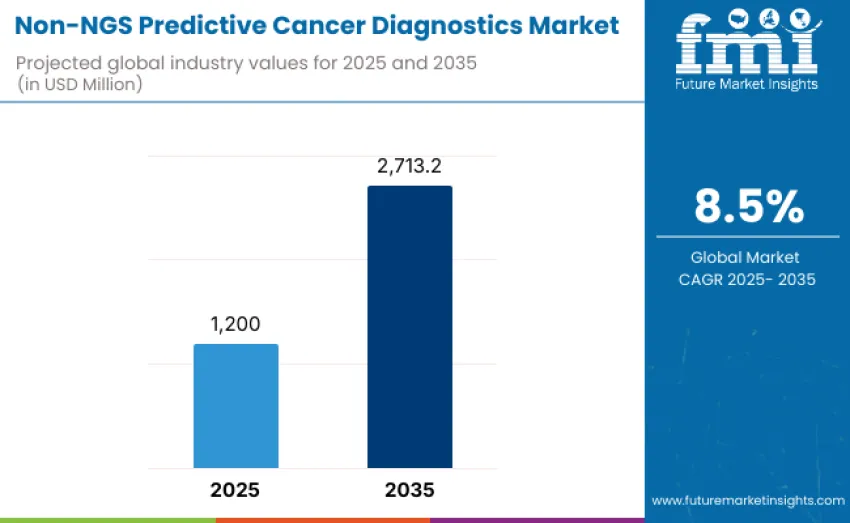
The Non-NGS Predictive Cancer Diagnostics Market is entering a high-growth decade, driven by precision oncology expansion, early cancer detection priorities, and automation in laboratory workflows. Valued at USD 1,200 million in 2025, the Non-NGS Predictive Cancer Diagnostics Market is projected to reach USD 2,713.2 million by 2035, reflecting a robust CAGR of 8.5% and an absolute opportunity of USD 1,513.2 million. The global scale of the Non-NGS Predictive Cancer Diagnostics Market is expected to expand nearly 2.3x during the forecast period.
Explore trends before investing – request a sample report today!
https://www.futuremarketinsights.com/reports/sample/rep-gb-29375
Market Growth Outlook and Revenue Trajectory
The Non-NGS Predictive Cancer Diagnostics Market is benefiting from the accelerating demand for early-stage cancer risk prediction, therapy selection, and recurrence monitoring. Between 2025 and 2030, the market is forecast to expand from USD 1,200 million to USD 1,804.4 million, contributing nearly 40% of total decade growth. From 2030 to 2035, the Non-NGS Predictive Cancer Diagnostics Market is projected to add another USD 908.8 million, marking the most aggressive phase of expansion as advanced non-NGS platforms achieve deeper clinical integration.
Key revenue signals shaping the Non-NGS Predictive Cancer Diagnostics Market include:
- Rising adoption of precision oncology solutions
- Expanding hospital and diagnostic laboratory networks
- Growing emphasis on predictive and preventive oncology
- Integration with electronic health records and clinical decision systems
Technology Advancements Reshaping Predictive Diagnostics
Technological innovation is restructuring the Non-NGS Predictive Cancer Diagnostics Market through multiplex immunoassays, PCR-based companion diagnostics, automated protein expression profiling, and liquid biopsy non-NGS (qPCR) solutions. These platforms enable high-throughput, reproducible results with rapid turnaround times. Advanced analytics embedded within diagnostic systems now provide:
- Predictive risk scores
- Therapy guidance insights
- Automated reporting for oncology teams
Modern assay platforms allow the Non-NGS Predictive Cancer Diagnostics Market to deliver clinically actionable outputs while reducing workflow bottlenecks and human error.
Policy Support and Institutional Adoption
Government healthcare initiatives, national cancer screening programs, and precision medicine policies are accelerating structured expansion of the Non-NGS Predictive Cancer Diagnostics Market. Hospitals, cancer centers, and independent diagnostic networks are actively investing in non-NGS platforms to expand predictive testing capacity. Educational programs and laboratory training initiatives are also strengthening workforce readiness and adoption confidence.
Key institutional drivers supporting the Non-NGS Predictive Cancer Diagnostics Market include:
- Value-based care adoption
- Rising cancer prevalence
- Early detection mandates
- National precision medicine frameworks
Product and Application Leadership Trends
PCR-based companion diagnostics account for the largest share of the Non-NGS Predictive Cancer Diagnostics Market, capturing 30% of total revenue. Their dominance stems from their essential role in mutation detection, biomarker identification, and targeted therapy selection. IHC & protein assays contribute 25%, followed by liquid biopsy non-NGS at 20%, proteomic assays at 15%, and others at 10%.
By application, therapy selection and companion diagnostics dominate with a 58% revenue share in the Non-NGS Predictive Cancer Diagnostics Market. Prognostics account for 15%, research use for 15%, and recurrence monitoring for 12%, reinforcing the expanding clinical utility of predictive diagnostics.
Subscribe for Year-Round Insights → Stay ahead with quarterly and annual data updates –
https://www.futuremarketinsights.com/reports/brochure/rep-gb-29375
Regional Growth Hotspots in the Non-NGS Predictive Cancer Diagnostics Market
Asia Pacific, North America, and Europe remain core revenue engines for the Non-NGS Predictive Cancer Diagnostics Market. India leads with a 10.5% CAGR, supported by expanding hospital infrastructure, government screening programs, and rising precision oncology investments. China follows closely at 9.8% CAGR due to rapid healthcare modernization and diagnostic laboratory expansion. The United States records a strong 9.0% CAGR, backed by advanced clinical diagnostics ecosystems and large oncology networks.
Europe’s Non-NGS Predictive Cancer Diagnostics Market shows stable growth at 8.2%, led by Germany, France, and the UK. Germany benefits from strong regulatory compliance, standardized laboratory practices, and advanced oncology research infrastructure.
Competitive Landscape and Market Structure
The Non-NGS Predictive Cancer Diagnostics Market is moderately concentrated, with leading companies controlling nearly 45% of total global share. Roche Diagnostics leads the competitive field, followed by Abbott Laboratories, Thermo Fisher, Siemens Healthineers, and Bio-Rad. Competition is based on assay accuracy, automation efficiency, workflow integration, regulatory approvals, and turnaround time.
Challenger and regional players continue to gain traction by targeting:
- Liquid biopsy non-NGS
- Proteomic assays
- Cost-sensitive emerging markets
Strategic Growth Drivers and Risk Factors
The Non-NGS Predictive Cancer Diagnostics Market is driven by rising cancer prevalence, aging populations, and the urgent need for faster and more accurate predictive testing. However, premium platform pricing and workforce training requirements still act as adoption barriers in cost-sensitive healthcare systems.
Emerging trends shaping future momentum include:
- Rapid adoption across Asia-Pacific
- Government-funded laboratory modernization
- Expansion of companion diagnostics for targeted therapies
- Increased use in clinical trial workflows
Future Outlook: A Data-Driven Decade Ahead
Over the next ten years, the Non-NGS Predictive Cancer Diagnostics Market will become a cornerstone of global oncology infrastructure. As predictive testing becomes central to therapy decision-making, hospitals and diagnostic laboratories will increasingly prioritize high-throughput non-NGS platforms for speed, accuracy, and clinical efficiency.
For organizations positioned across assay development, automation, data integration, and clinical validation, the Non-NGS Predictive Cancer Diagnostics Market offers sustained double-digit opportunity pockets across multiple regions.
Why Choose FMI Empowering Decisions that Drive Real-World Outcomes:
https://www.futuremarketinsights.com/why-fmi
About Future Market Insights (FMI)
Future Market Insights, Inc. (ESOMAR certified, recipient of the Stevie Award, and a member of the Greater New York Chamber of Commerce) offers profound insights into the driving factors that are boosting demand in the market. FMI stands as the leading global provider of market intelligence, advisory services, consulting, and events for the Packaging, Food and Beverage, Consumer Technology, Healthcare, Industrial, and Chemicals markets. With a vast team of over 400 analysts worldwide, FMI provides global, regional, and local expertise on diverse domains and industry trends across more than 110 countries.
Contact Us:
Future Market Insights Inc.
Christiana Corporate, 200 Continental Drive,
Suite 401, Newark, Delaware – 19713, USA
T: +1-347-918-3531
For Sales Enquiries: sales@futuremarketinsights.com
Website: https://www.futuremarketinsights.com