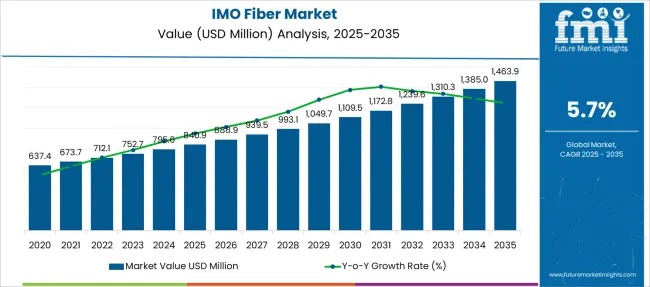
The global IMO Fiber Market is set for steady expansion, with the industry valued at USD 840.9 million in 2025 and projected to reach USD 1,463.9 million by 2035, growing at a CAGR of 5.7%. This growth is fueled by increasing consumer adoption of gut-health-focused foods, clean-label formulations, and functional dietary ingredients across the food, beverage, nutraceutical, and pharmaceutical sectors.
As of 26 August 2025, IMO fiber continues to gain traction as a preferred prebiotic ingredient due to its digestive benefits, low glycemic response, and stability across diverse formulations. Rising emphasis on immunity, microbiome balance, and low-sugar diets is further strengthening its adoption across global markets.
Explore trends before investing – request a sample report today! https://www.futuremarketinsights.com/reports/sample/rep-gb-11778
Key Market Highlights (2025–2035)
- Market Size 2025: USD 840.9 million
- Forecast Value 2035: USD 1,463.9 million
- CAGR: 5.7%
- Largest Segment 2025: Prebiotic Agent – 46.3% share
- Leading Regions: North America, Asia-Pacific, Europe
- Key Companies: Shandong Bailong Group, BioNeutra Global Corporation, Fonterra, Nestlé, ABF plc, Kellogg, PepsiCo, Unilever, Danone, General Mills, Baolingbao Biology, and others
Demand Drivers: Functional Ingredients and Clean-Label Shift
The IMO fiber market is benefiting from a global consumer shift toward preventive health and functional nutrition. IMO’s unique properties—including mild sweetness, digestive resistance, and compatibility with various food matrices—position it as a preferred ingredient for manufacturers reformulating products with lower sugar and higher fiber content.
Regulatory recognition of non-digestible carbohydrates as dietary fiber is aiding market expansion, while innovation in soluble fiber technologies is strengthening applications in sports nutrition, infant formula, and plant-based foods.
Segmental Highlights
Prebiotic Agent Function Leads with 46.3% Share in 2025
Prebiotic IMO fibers are projected to dominate the functional category, supported by increasing evidence of their role in stimulating beneficial gut microbiota. Their neutral taste and flexibility allow seamless incorporation into bakery, dairy, beverage, and supplement formulations.
Soluble IMO Expected to Hold 58.9% Market Share in 2025
Soluble IMO fibers continue to outperform other nature-based categories due to their desirable processing behavior, water retention properties, and benefits related to satiety and glycemic control. Demand is rising across ready-to-drink beverages, yogurt, plant-based formulations, and functional snacks.
Dry Form IMO to Capture 61.7% Market Share in 2025
Dry-form IMO fibers—powders, granules, and premix-compatible formats—are preferred for their shelf stability, cost efficiency, and ease of transport. Use cases are expanding in powdered beverages, bakery mixes, dietary supplements, and low-water-activity systems.
Historical vs. Future Outlook
Historically, the IMO fiber market grew from USD 637.4 million in 2020 to USD 795.6 million in 2024, registering a CAGR of 5%. Heightened global awareness of wellness, plus rising adoption of wholesome foods, accelerated market momentum.
Looking ahead, the market is forecast to expand from USD 840.9 million in 2025 to USD 1,239.6 million by 2035, growing at 5.7% CAGR. Nutritional transparency, fiber fortification, and evolving consumer preferences for gut-supportive products will be key growth catalysts.
Regional Insights
North America: Strongest Revenue Contributor (USA at 34.2%)
North America’s fast-growing demand stems from health-driven product innovation and rising acceptance of plant-based and clean-label foods. Manufacturers are increasingly using IMO fibers to enhance the nutritional profile of snacks, dairy alternatives, and functional beverages.
Europe: Strong Adoption Across Functional Food Categories
Germany captures 24.4% of the regional market, while the UK is projected to grow at 5.3% CAGR. Soluble and insoluble fibers are widely used to improve texture, digestive benefits, and cholesterol-reducing properties in bakery, cereals, and fortified foods.
Asia-Pacific: High Growth Region with Rising Disposable Income
Japan contributes 10.9% of the regional market, while India and China are emerging as major drivers with CAGRs of 6.0% and 3.6%, respectively. Rapid urbanization, evolving diets, and demand for fiber-rich foods are accelerating regional adoption.
Latin America: Growing Demand in Food & Animal Feed
Latin America is witnessing strong growth due to increasing consumption of fortified foods and a rising livestock sector requiring high-quality feed components. IMO fiber is also gaining acceptance in pharmaceutical formulations aimed at digestive wellness.
Rest of World: Australia Holds 2.3% Share
Functional foods, plant-based alternatives, and natural nutritional solutions are key growth drivers in Australia and surrounding regions.
Market Definition and Category Insights
IMO (Isomalto-oligosaccharide) is a short-chain carbohydrate resistant to digestion, naturally found in fermented foods such as miso, soy sauce, and sake. Available in syrup and powder form, IMO is valued for gut health, blood sugar regulation, and prebiotic support.
Competitive Landscape
The IMO fiber market is becoming increasingly competitive, with leading players expanding production capacity, developing advanced prebiotic formulations, and strengthening their presence across high-growth regions. Research organizations are developing next-generation prebiotics, while manufacturers are adopting IMO fibers as sugar substitutes to meet consumer demands for healthier, low-sugar products.