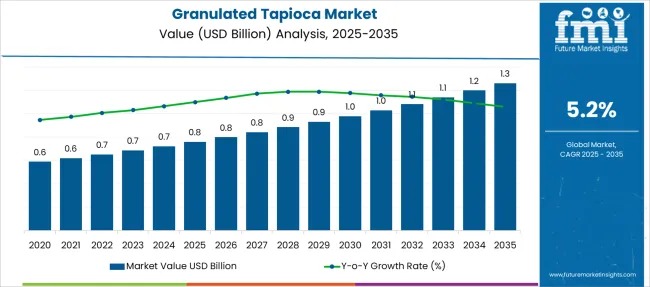
The Granulated Tapioca Market is estimated to be valued at USD 0.8 billion in 2025 and is projected to reach USD 1.3 billion by 2035, registering a 5.2% CAGR over the forecast period. This strong upward trajectory reflects rising consumer demand for gluten-free, plant-derived, and clean-label ingredients across global food and beverage categories.
Explore trends before investing – request a sample report today! https://www.futuremarketinsights.com/reports/sample/rep-gb-9379
Market Overview: Clean-Label and Organic Adoption Drive Strong Growth
The momentum surrounding granulated tapioca continues to accelerate as consumers shift toward natural, organic, and minimally processed ingredients. The market is witnessing robust adoption across prepared foods, desserts, soups, gravies, and packaged beverages—segments increasingly dependent on reliable thickening agents that support texture, stability, and clean formulation.
Rising health consciousness, combined with the swift global embrace of allergen-free foods, is strengthening market fundamentals. The organic segment, in particular, is gaining exceptional traction as buyers prioritize sustainability-focused supply chains and chemical-free cultivation standards.
Quick Market Stats (2025–2035)
- 2025 Market Value: USD 0.8 billion
- 2035 Forecast Value: USD 1.3 billion
- Forecast CAGR: 5.2%
- Leading Segment (2025): Organic – 58.6% market share
- Key Growth Regions: North America, Asia-Pacific, Europe
- Major Companies: Organo Grocers, WinCrest BulkFoods, American Key Food Products, Kauffman’s Fruit Farm, Let’s Do Organic, Reese, COMBRASIL, Edward and Sons, Tasty Nibbles, and others
Why Organic Granulated Tapioca Leads the Market
The organic segment is poised to record 58.6% of global revenues in 2025, securing its position as the industry’s largest and fastest-expanding category. Shoppers are increasingly avoiding synthetic pesticides, genetically modified ingredients, and artificial additives—pushing brands to validate quality via certification and transparent labeling.
Producers have accelerated organic farming practices, strengthened field-to-factory traceability, and invested in sustainability programs. As clean-label trends rise across bakery, beverages, baby foods, and confectionery, organic granulated tapioca continues to outperform synthetic alternatives.
Packaging Spotlight: Stand-Up Pouches Capture 46.3% Share in 2025
Stand-up pouches remain the preferred packaging format, expected to account for 46.3% of total revenue in 2025. These pouches deliver significant advantages, including:
- Resealability and extended freshness
- Lightweight logistics and reduced shipping cost
- Easy storage and shelf visibility
- Strong branding potential with customizable designs
As convenience-driven packaging gains ground, manufacturers across the tapioca value chain are upgrading to cost-efficient, flexible packaging formats that align with consumer expectations.
Functionality Insight: Thickening Agent Segment Dominates with 51.7% Share
Granulated tapioca’s performance as a gluten-free, neutral-flavored, and clean-label thickening agent is a major demand driver. Expected to capture 51.7% of category revenues in 2025, its widespread use in soups, gravies, puddings, sauces, and desserts highlights its functional versatility.
Manufacturers value its ability to enhance viscosity, improve stability, and support product consistency without compromising flavor. As brands replace artificial stabilizers with natural alternatives, tapioca is witnessing consistent adoption across industrial and retail food applications.
Key Market Drivers Influencing Growth
Growing dietary shifts and rising intolerance to gluten-based foods significantly contribute to global demand. According to the American Academy of Allergy Asthma & Immunology, 1% to 4% of the global population is affected by celiac disease or gluten sensitivity. This trend is directly boosting the adoption of tapioca as a reliable gluten-free alternative.
Additional growth catalysts include:
- Rising need for fiber-rich cassava derivatives to support digestive health
- Increasing usage of tapioca in plant-based and allergen-free product innovation
- Expanding R&D investments in sustainable cassava cultivation
Market Restraints to Watch
Despite strong momentum, a few headwinds remain. Excess carbohydrate consumption is increasingly monitored, particularly among obese populations, impacting demand for desserts, puddings, candies, and pie fillings—primary application areas for tapioca.
Challenges also arise from:
- Potential cyanide toxicity when cassava is improperly processed
- Side effects such as bloating or nausea among sensitive consumers
- Preference shifts toward low-carb formulations
Regional Outlook
South Asia Emerges as a High-Growth Hub
With approximately 67,385 babies born daily in India (UNICEF), demand for infant foods and nutritional formulations is rising rapidly. Tapioca’s role as a thickening and bodying agent in baby food positions South Asia as one of the most lucrative markets from 2025–2035.
North America Maintains a Strong Growth Trajectory
North America continues to adopt plant-based thickeners across retail and industrial food sectors. New product launches—such as Kauffman’s Fruit Farm’s 2024 introduction of 2-pound Granulated Minute Tapioca—demonstrate rising innovation and market expansion.
Competitive Landscape
Prominent companies—including Edward and Sons, WinCrest BulkFoods, COMBRASIL, Amafil, YOKI, Red Hill General Stores, Choice Tropical, and Pa Dutch Food & Candy Company—are expanding production capacity and launching diversified packaging formats to strengthen market positioning. Product innovation, organic sourcing, and sustainable packaging remain primary differentiators.