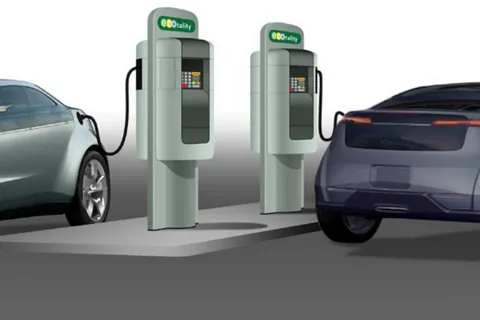
The EV Charging Station Market is on a fast growth trajectory, expected to expand from USD 25.9 billion in 2025 to approximately USD 142.6 billion by 2035, reflecting an impressive CAGR of 18.6%. The surge is propelled by aggressive EV adoption, expanding fast-charging networks, government incentives, and a growing emphasis on renewable-powered infrastructure.
Global efforts to decarbonize transportation are driving monumental
investments in EV infrastructure. From Asia’s rapid deployment of ultra-fast charging corridors to Europe’s green mobility initiatives and the United States’ infrastructure law, EV charging is becoming the backbone of the future transport ecosystem.
Subscribe for Year-Round Insights → Stay ahead with quarterly and annual data updates
https://www.futuremarketinsights.com/reports/sample/rep-gb-16380
Regional Market Growth Highlights
Asia-Pacific (APAC): Charging Ahead with Infrastructure Leadership
APAC leads the global market with over 45% share in 2025, fueled by China’s vast EV ecosystem and government-backed investments in public and private charging networks. Japan and South Korea continue to expand ultra-fast DC charging systems to support next-generation electric vehicles. India is emerging rapidly, with FAME II subsidies and public-private partnerships spurring large-scale station rollouts across highways and urban hubs.
Europe: Accelerating Toward Net-Zero Mobility
Europe represents the second-largest market, driven by stringent emission norms, the European Green Deal, and the Alternative Fuels Infrastructure Regulation (AFIR). Nations such as Germany, the UK, and France are integrating smart charging with renewable grids to support carbon-neutral transport systems. The rise of interoperable, open-access charging platforms is reshaping the consumer experience while ensuring cross-border mobility.
United States: Federal Policy Boosts Infrastructure Expansion
The U.S. EV charging ecosystem is witnessing unprecedented growth under the Bipartisan Infrastructure Law, which allocates billions for nationwide station development. Tesla’s Supercharger network expansion and increasing adoption of the NACS standard are catalyzing a more unified charging landscape. State-level incentives and partnerships between automakers and utilities are further accelerating the rollout of fast-charging infrastructure.
Saudi Arabia: Emerging as the Middle East’s EV Hub
Saudi Arabia’s Vision 2030 is transforming the country into a sustainable mobility leader. The nation’s focus on electric mobility-fueled by NEOM’s smart city projects, renewable energy integration, and growing local EV manufacturing-has spurred a wave of charging infrastructure investments. Partnerships with global OEMs and energy companies are accelerating station deployment across major cities and transit corridors.
Technology and Market Trends Driving the Shift
The future of the EV charging station market is defined by speed, intelligence, and sustainability. Ultra-fast chargers (150-350 kW) are becoming the new benchmark, reducing charge times to under 15 minutes. Meanwhile, smart charging solutions-integrated with IoT, AI, and cloud analytics-are enabling grid optimization and dynamic load balancing.
Wireless charging and vehicle-to-grid (V2G) technologies are gaining traction, allowing EVs to act as mobile energy storage units that feed electricity back to the grid during peak demand. Renewable integration-especially solar-powered EV chargers-is reshaping the sustainability narrative, reducing dependency on non-renewable energy sources.
Competitive Landscape
Key industry leaders including ABB, Siemens, ChargePoint, Schneider Electric, Tesla, and Shell Recharge are strengthening their global footprint through partnerships and mergers. Investment trends show a shift toward energy-as-a-service models, allowing operators to scale infrastructure efficiently.
Automakers are entering the infrastructure race, with companies like Hyundai, BYD, Mercedes-Benz, and Ford establishing joint ventures to build proprietary and shared charging networks. Technology providers are also focusing on cybersecurity and user experience, with real-time payment systems, app integration, and predictive maintenance becoming standard features.
Outlook: Toward a Connected and Carbon-Free Future
By 2035, the global EV charging station market will be at the center of transport electrification. APAC will maintain its leadership with manufacturing scale and government support, Europe will pioneer green grid integration, and the USA will evolve into a unified, interoperable charging ecosystem. Saudi Arabia and other Gulf nations will emerge as regional leaders in renewable-powered EV infrastructure.
The convergence of fast-charging technology, grid digitization, and sustainable urban planning will define the next decade of growth. With every major automaker committed to electrification, the market for EV charging stations is not just expanding-it’s becoming indispensable to the global energy transition.
About Future Market Insights (FMI)
Future Market Insights, Inc. (FMI) is an ESOMAR-certified, ISO 9001:2015 market research and consulting organization, trusted by Fortune 500 clients and global enterprises. With operations in the U.S., UK, India, and Dubai, FMI provides data-backed insights and strategic intelligence across 30+ industries and 1200 markets worldwide.