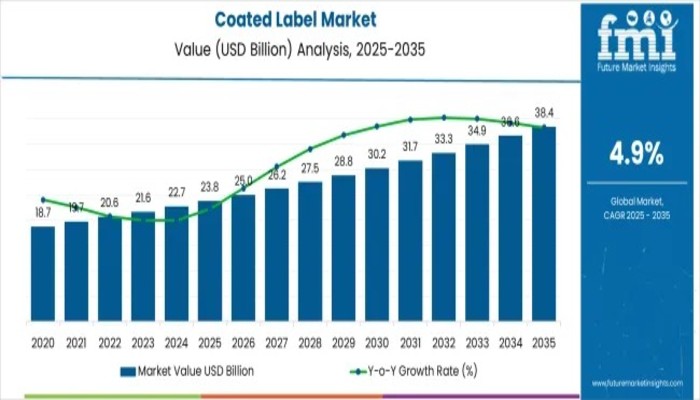
The global Coated Label Market is poised for steady expansion, fueled by rising demand for high-performance labeling solutions across pharmaceuticals, food and beverage, cosmetics, personal care, and industrial sectors. According to the latest market assessment, the industry is expected to grow from USD 23.8 billion in 2025 to USD 38.4 billion by 2035, reflecting a CAGR of 4.9% during the forecast period.
As consumer expectations evolve and regulatory pressures intensify, coated labels are gaining momentum for their enhanced durability, premium finish, and superior printability. These labels are engineered to withstand moisture, abrasion, chemicals, temperature fluctuations, and transit conditions—attributes that make them indispensable across modern supply chains.
Subscribe for Year-Round Insights → Stay ahead with quarterly and annual data updates – https://www.futuremarketinsights.com/reports/sample/rep-gb-19320
Market Momentum Driven by Technology, Compliance, and Branding
The coated label industry is experiencing significant transformation due to advancements in coating technologies such as polymer-based coatings, UV-curable systems, and water-based coatings. These innovations provide better adhesion, higher opacity, enhanced smoothness, and sharper print clarity—key factors that elevate on-shelf branding and customer engagement.
Additionally, growing adoption of automated labeling lines is helping manufacturers streamline production, reduce material waste, and maintain consistency across high-volume packaging operations.
Heightened emphasis on anti-counterfeiting, track-and-trace, and serialization requirements—especially in pharmaceuticals—continues to bolster demand for coated labels designed to support scannable formats, security features, and variable data printing.
Quick Stats: Coated Label Market
- 2025 Market Value: USD 23.8 billion
- 2035 Forecast Value: USD 38.4 billion
- Forecast CAGR: 4.9%
- Leading Product Segment (2025): Acrylic Coatings (27.0%)
- Key Growth Regions: North America, Asia-Pacific, Europe
- Notable Coating Materials: Grounded Calcium Carbonate (GCC), Kaolin Clay, SB Latex, Starch, Wax
Segmental Overview
The market is segmented by Product, End Use, and Region:
By Product
- Acrylic
- Others (Low Coat Weight Papers, Art Papers, etc.)
- Coated Fine Paper
- Standard Coated Fine Paper
- Coated Groundwood Paper
By End Use
- Pharmaceuticals
- Food & Beverages
- Cosmetics & Personal Care
- Automotive
- Electronics
- Others
Regional Segmentation
North America, Latin America, Western & Eastern Europe, Balkan & Baltic countries, Russia & Belarus, Central Asia, East Asia, South Asia & Pacific, and Middle East & Africa.
Acrylic Segment Leads with 27% Share in 2025
The Acrylic product segment is forecast to dominate the market with 27.0% revenue share in 2025. Acrylic coatings are highly preferred for their:
- Excellent print clarity and adhesion
- Compatibility with digital, flexographic, and offset printing
- Superior resistance to moisture, heat, and chemicals
- Cost-effectiveness for high-volume label production
Continuous advancements in acrylic formulations are enabling improved barrier performance, faster drying times, and enhanced surface finishes that meet brand owners’ evolving expectations.
Pharmaceuticals Remain the Top End-Use Segment
With 27% market share in 2025, the pharmaceutical industry stands out as the largest consumer of coated labels.
Stringent regulatory norms necessitate labels that can withstand handling, storage, transportation, and sterilization processes. Coated labels support:
- High legibility with sharp print quality
- Serialization and barcoding
- Chemical and abrasion resistance
- Anti-counterfeiting technologies
Automation across pharmaceutical production lines further accelerates adoption, ensuring safety, accuracy, and compliance at scale.
Performance Drivers and Growth Factors
The coated label market’s expansion is underpinned by:
- Increasing demand for durable and visually appealing labels
- Improved print quality due to non-absorbent coated surfaces
- Resistance to scratches, chemicals, moisture, and temperature variations
- Advancements in UV-curable and water-based coatings
- Rising adoption of variable data printing for customization and traceability
These factors are creating new opportunities for manufacturers to offer personalized, sustainable, and value-added labeling solutions.
Challenges Slowing Market Growth
Despite strong momentum, certain challenges persist:
- Rising demand for sustainable materials increases production costs
- Strict regulatory compliance adds complexity and expense
- Shift toward digital labels and smart packaging alternatives
- Innovation in lightweight or label-free packaging formats
Manufacturers are adjusting strategies by developing eco-friendly coating materials and investing in cost-optimized sustainable production.
Key Trends Shaping the Industry
- Strong push for eco-friendly and recyclable coated labels
- Growing influence of digital printing and hybrid coating technologies
- Increasing demand for customized and embellished labels
- Regulatory shifts encouraging safer and more transparent packaging
- E-commerce growth driving demand for durable, scannable, and damage-resistant labels
Regional Outlook: Asia-Pacific Leads Growth
Country Highlights (CAGR, 2025–2035)
- India: 6.0%
- China: 5.1%
- Germany: 3.8%
- United Kingdom: 3.7%
- Canada: 3.4%
Asia-Pacific dominates the global market driven by rising consumer awareness, rapid industrial expansion, and the shift toward technologically advanced and sustainable labeling solutions.
Competitive Landscape
Leading companies are pivoting toward sustainable solutions, including water-based, biodegradable, and renewable coatings that match the performance of traditional formulations. Strategic partnerships, innovation in printing technologies, and expansion of product portfolios remain core competitive strategies.
Recent Developments
- Sept 2025: AWA introduces cost-effective extrusive coated labels with versatile finishes.
- Aug 2024: SMI and Flexcon partner to offer polyester and vinyl label stock with enhanced adhesives for harsh environments.
Key Players
- Grounded Calcium Carbonate (GCC)
- Kaolin Clay
- SB Latex
- Starch
- Wax
- Other additives (TIO₂, Talc, PCC)
Why FMI: https://www.futuremarketinsights.com/why-fmi
About Future Market Insights (FMI)
Future Market Insights, Inc. (FMI) is an ESOMAR-certified, ISO 9001:2015 market research and consulting organization, trusted by Fortune 500 clients and global enterprises. With operations in the U.S., UK, India, and Dubai, FMI provides data-backed insights and strategic intelligence across 30+ industries and 1200 markets worldwide.
Contact Us:
Future Market Insights Inc.
Christiana Corporate, 200 Continental Drive,
Suite 401, Newark, Delaware – 19713, USA
T: +1-347-918-3531
For Sales Enquiries: sales@futuremarketinsights.com
Website: https://www.futuremarketinsights.com
LinkedIn| Twitter| Blogs | YouTube