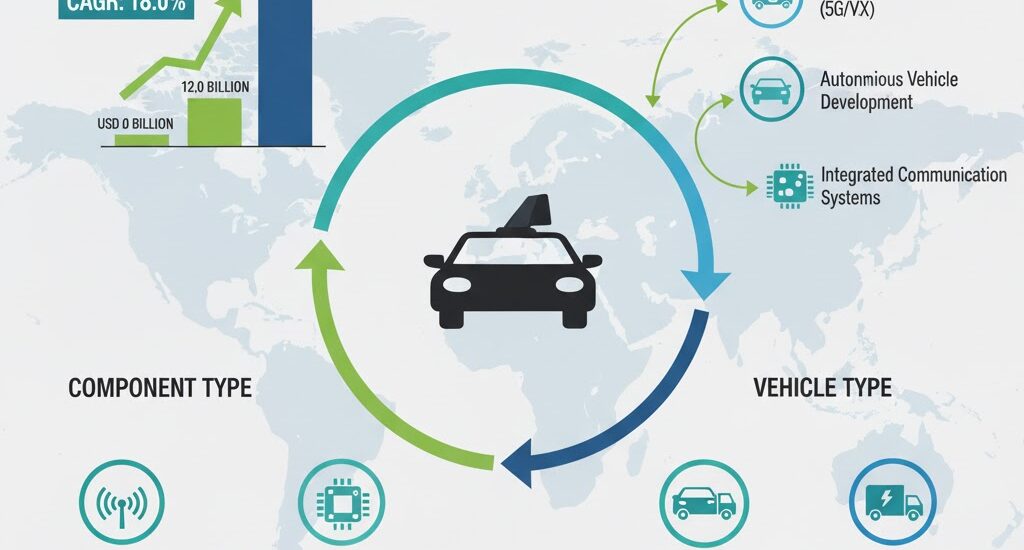
The global Automotive Smart Antenna Market is set for an unprecedented expansion, projected to soar from USD 7.9 billion in 2025 to USD 18.1 billion by 2035, reflecting a strong 8.6% CAGR, according to a recent study by Future Market Insights, Inc. (FMI). Rapid vehicle connectivity adoption, 5G-enabled communication systems, and advanced driver assistance integration are transforming the landscape of automotive connectivity across APAC, Europe, the USA, and Saudi Arabia.
Connected Cars Accelerate Market Momentum
The automotive ecosystem is in the midst of a connectivity revolution. Smart antennas-critical enablers of vehicle-to-everything (V2X) communication-are redefining how vehicles connect, communicate, and operate. In 2025, the cellular antenna segment is expected to dominate with a 35% market share, driven by the integration of LTE, 5G, and ultra-high-frequency bands to ensure uninterrupted in-vehicle communication.
Get access to comprehensive data tables and detailed market insights – request your sample report today!
https://www.futuremarketinsights.com/reports/sample/rep-gb-8257
The shark fin antenna segment will remain the top design preference, accounting for 40% of market revenue in 2025. Its aerodynamic, multi-functional structure supports cellular, GPS, and satellite communications-enabling safer and more efficient driving experiences.
“Today’s connected vehicles are as much about communication as they are about performance,” said a senior FMI automotive analyst. “The integration of 5G-enabled smart antennas ensures not only driver convenience but also forms the backbone of autonomous vehicle ecosystems.”
5G and UHF Technologies Drive Connectivity Evolution
The ultra-high frequency (UHF) category, capturing nearly 45% of the 2025 market, continues to dominate due to its capability to support high-speed, low-latency data transmission essential for autonomous and semi-autonomous driving. These antennas ensure robust vehicle-to-network communication, optimized navigation, and real-time telematics-even under complex driving conditions.
Across regions, investments in 5G network infrastructure are accelerating.
Asia-Pacific (APAC) leads in adoption, led by China, Japan, and India, where connected vehicle programs and electric vehicle (EV) penetration are reshaping the market.
Europe, particularly Germany, continues to pioneer in sustainable mobility, integrating smart antennas for enhanced safety and emission control.
The United States sees rapid consumer demand for in-vehicle infotainment and navigation services, driving strong OEM partnerships.
Saudi Arabia, leveraging its Vision 2030 initiatives, is prioritizing intelligent transport infrastructure-boosting antenna demand for both luxury and commercial fleets.
Regional Highlights
China remains the growth powerhouse, projected to reach USD 2.4 billion by 2035, advancing at 8.9% CAGR, driven by 5G rollouts and surging EV production.
The United States market, valued at USD 1.19 billion by 2035, is expanding at 4.6% CAGR, reflecting growing consumer expectations for uninterrupted infotainment and safety connectivity.
Japan, advancing at 9% CAGR, is witnessing increased adoption in compact vehicles, while India, with an 8.6% CAGR, leads in local innovation for smart traffic and safety systems.
In Europe, Germany spearheads with a 10.2% CAGR, aligning smart antenna adoption with its sustainability and efficiency agenda.
Key Growth Drivers
1. Connected & Autonomous Vehicles: Automakers are integrating smart antennas to power real-time communication, autonomous navigation, and data-rich infotainment systems.
2. 5G & IoT Integration: As 5G technology matures, low-latency, high-bandwidth communication will become indispensable to safety-critical automotive applications.
3. Consumer Experience: Rising demand for personalized, always-connected infotainment and climate systems reinforces smart antenna adoption.
4. Safety Regulations: Governments in APAC, the EU, and the U.S. are pushing for V2X-enabled safety systems, mandating advanced antenna integration.
Challenges: Cost and Data Security
Despite strong momentum, high integration costs and data security concerns remain challenges. Incorporating advanced MIMO systems and 5G support raises manufacturing expenses, while heightened cybersecurity regulations in the EU and the U.S. are prompting additional investments in encryption and compliance technologies.
Manufacturers are addressing these constraints through miniaturization, advanced signal processing, and embedded security architecture, ensuring performance without compromising safety or cost-efficiency.
Segmental Overview
• By Product Type: Cellular Antennas (35%), GPS Antennas (39.5%), Wi-Fi, and Bluetooth systems dominate smart mobility functions.
• By Antenna Type: Shark Fin Antennas (40%) remain the preferred choice for multi-band, aerodynamic integration.
• By Frequency: UHF antennas (45%) support critical communications for ADAS and connected navigation.
• By Vehicle Type: Passenger Cars (56.9% in 2025) lead demand, fueled by infotainment and EV adoption.
• By Sales Channel: OEMs account for the majority share, with the aftermarket steadily growing for retrofitted solutions.
Purchase Full Report for Detailed Insights
For access to full forecasts, regional breakouts, company share analysis, and emerging trend assessments, you can purchase the complete report here: Buy Full Report – https://www.futuremarketinsights.com/checkout/8257
Competitive Landscape: Leaders Shape Connectivity Futures
The global market remains moderately fragmented, with Tier 1 players controlling 40-45% of total share. Prominent companies such as Kathrein Automotive, Continental AG, Harada, TE Connectivity, Yageo Corporation, TDK Corporation, and Harman International (a Samsung company) are setting industry benchmarks.
Recent Innovations:
May 2025: Zetifi launched the world’s first location-aware smart antenna, transforming phone coverage optimization.
January 2025: Texas Instruments unveiled new radar sensor chips with 3D wavelength antennas, enhancing compact vehicle sensor integration.
Other notable players include Laird Connectivity, Hirschmann Car Communication, NXP Semiconductors, Rosenberger, Ficosa, Kyocera Corporation, Anokiwave, and Calearo Antenne S.p.A., each focusing on advancing antenna miniaturization and multi-band communication efficiency.
Future Outlook: A Connected Horizon
From Shanghai to Stuttgart, and from Detroit to Riyadh, automotive smart antennas are redefining mobility. As vehicles become intelligent, autonomous, and electrified, seamless connectivity will be the linchpin of competitive differentiation. The integration of 5G, AI, and IoT ecosystems will not only enable smarter navigation and infotainment but also enhance road safety, fleet management, and sustainability.
The next decade will witness exponential growth in smart, multi-band, energy-efficient antenna systems that bridge the gap between digital and physical driving experiences.
About Future Market Insights (FMI)
Future Market Insights, Inc. (FMI) is an ESOMAR-certified, ISO 9001:2015 market research and consulting organization, trusted by Fortune 500 clients and global enterprises. With operations in the U.S., UK, India, and Dubai, FMI provides data-backed insights and strategic intelligence across 30+ industries and 1200 markets worldwide.