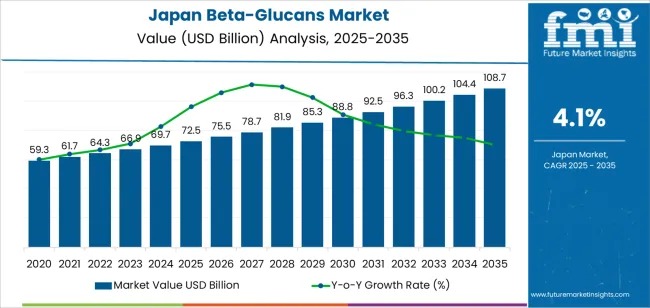
The demand for beta-glucans in Japan is entering a robust growth phase, projected to rise from USD 72.5 billion in 2025 to USD 108.7 billion by 2035, expanding at a CAGR of 4.1%. Driven by accelerating interest in immune-supportive, cholesterol-lowering, and anti-inflammatory ingredients, beta-glucans are increasingly integrated into functional foods, nutraceuticals, beverages, and supplements across Japan’s rapidly evolving health-and-wellness ecosystem.
With beta-glucans derived from oats, barley, yeast, and fungi becoming mainstream, Japanese consumers—particularly aging demographics—are turning to preventive health solutions. Their rising adoption in pharmaceutical, nutraceutical, and functional food applications underscores a shift toward products that support long-term resilience, heart health, gut wellness, and immune modulation.
Explore trends before investing – request a sample report today! https://www.futuremarketinsights.com/reports/sample/rep-gb-29075
Steady Growth Through 2035 Driven by Wellness and Functional Nutrition
Between 2025 and 2030, Japan’s beta-glucan demand is expected to climb from USD 72.5 billion to USD 75.5 billion, reflecting a stable uptick as consumers prioritize holistic wellness and dietary fiber consumption. By 2035, demand is forecast to accelerate sharply, reaching USD 108.7 billion, supported by scientific validation, personalized nutrition trends, and the expansion of functional food categories.
Quick Market Stats (Japan, 2025–2035)
- Market Value 2025: USD 72.5 billion
- Forecast 2035: USD 108.7 billion
- CAGR: 4.1%
- Top Source: Yeast (44% share)
- Leading Application: Health & Dietary Supplements (31.6%)
- Key Growth Regions: Kyushu & Okinawa, Kanto, Kinki, Chubu, Tohoku
- Top Industry Players: Cargill Inc., Koninklijke DSM N.V., Kerry Group Plc., Tate & Lyle Plc., Biotec BetaGlucans AS
What’s Driving Beta-Glucan Demand in Japan?
Japan’s rising demand stems from the ingredient’s proven clinical benefits and increasing inclusion in clean-label products.
Core growth drivers include:
- Increasing consumer awareness of immune and cardiovascular health
- The shift toward preventive healthcare, particularly among seniors
- Strong demand for natural, bioactive, and plant-based ingredients
- Expanding use in functional foods, including beverages, snacks, cereals, dairy, and baked goods
- Ongoing scientific research validating beta-glucan’s role in cholesterol reduction, immune modulation, and blood sugar management
Beta-glucans have become a preferred ingredient for manufacturers formulating immunity-boosting, gut-supportive, and heart-healthy products—categories that are showing rapid growth across the Japanese consumer landscape.
Segment-Wise Demand Analysis
By Source:
- Yeast leads with 44% share due to superior purity, high bioactivity, and consistent performance in supplements and fortified foods.
- Cereal-based beta-glucans (oats, barley) continue to gain traction in bakery, dairy, and beverage applications.
By Application:
- Health & dietary supplements hold 31.6% share, driven by rising demand for immune-support, anti-inflammatory, and heart-health benefits.
- Food & beverages, bakery, dairy, and cosmetics contribute significantly as beta-glucan fortification becomes more common.
By Functionality:
- Soluble beta-glucans dominate due to improved absorption, formulation versatility, and enhanced efficacy.
Innovation Strengthens Market Expansion
Japan’s biotechnology and food-science sectors are accelerating beta-glucan adoption through:
- Advanced extraction methods delivering higher purity
- Enhanced encapsulation technologies for beverages and bars
- Development of high-solubility formats for improved functional performance
- Better sourcing traceability, ensuring consistency for health-focused applications
These innovations support broader use across food, nutrition, and personal-care categories, ensuring sustained market expansion through 2035.
Challenges to Watch
Despite strong momentum, the market faces challenges:
- High production and purification costs
- Raw material variability across yeast, cereals, and mushroom sources
- Regulatory scrutiny around health claims
- Competition from probiotics, plant sterols, and other functional ingredients
Suppliers offering consistent, high-purity, science-backed formulations are best positioned to capture long-term gains.
Regional Outlook: Kyushu & Okinawa Lead with 5.2% CAGR
Beta-glucan demand is rising across all major Japanese regions:
- Kyushu & Okinawa (5.2% CAGR): Strongest growth tied to wellness culture, barley cultivation, and supplement adoption
- Kanto (4.7% CAGR): Tokyo’s health-conscious population drives fortified foods and supplement demand
- Kinki (4.2% CAGR): Growth supported by functional food innovation in Osaka and Kyoto
- Chubu (3.7% CAGR): Biotechnology and dairy fortification strengthen uptake
- Tohoku (3.2% CAGR): Agricultural activity boosts beta-glucan-rich cereal production
- Rest of Japan (3.1% CAGR): Rising interest in natural health foods sustains steady demand
Competitive Landscape
Japan’s beta-glucan market is dominated by global and specialized suppliers including Cargill Inc., DSM, Kerry Group, Tate & Lyle, and Biotec BetaGlucans AS. Cargill leads with a 22% market share, supported by extensive extraction capabilities and robust nutrition portfolios.
Companies differentiate through:
- Specialty grades for supplements and fortified foods
- Clean-label formulations
- High-quality sourcing and consistent purity
- Strong R&D support for food and nutraceutical manufacturers
As Japan’s functional food and nutraceutical sectors expand, these players are poised to benefit from rising beta-glucan integration across consumer-oriented health categories.