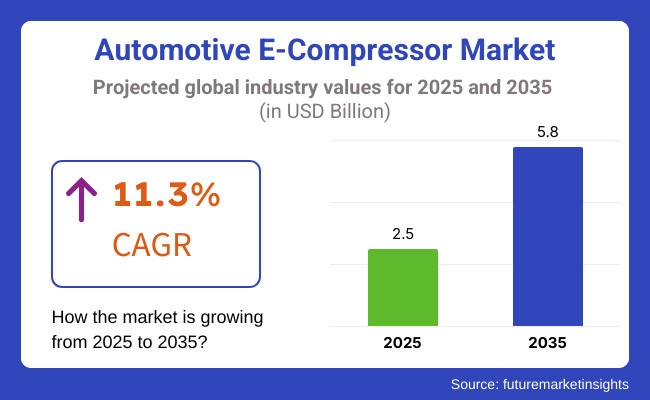
The automotive e-compressor market is poised for remarkable growth, set to reach USD 2.5 billion in 2025 and projected to escalate to USD 5.8 billion by 2035, representing a CAGR of 11.3%. The surge is fueled by the rapid adoption of electric vehicles (EVs), evolving environmental regulations, and continuous technological advancements in e-compressors that optimize energy efficiency and vehicle performance.
Unlike conventional belt-driven compressors, e-compressors operate independently of the engine, enabling superior energy management, reduced emissions, and enhanced design flexibility. Their increasing integration into battery cooling systems and air-conditioning units of EVs and hybrids is a key factor driving global demand.
Get access to comprehensive data tables and detailed market insights – request your sample report today!
https://www.futuremarketinsights.com/reports/sample/rep-gb-17200
Market Drivers and Technological Advances
The market’s expansion aligns with the global electrification of vehicles and rising consumer interest in energy efficiency and sustainability. Advanced e-compressors not only improve thermal management but also support quieter, smaller, and more energy-efficient operations.
However, challenges remain, including high initial costs-USD 500+ per unit versus USD 250 for traditional compressors-integration complexities, and potential battery drain in extreme temperatures. Automotive players are addressing these concerns through innovative thermal management solutions, modular designs, and AI-based climate control systems that optimize energy usage without compromising EV range.
Historical Market Shifts and Future Outlook (2020-2035)
From 2020 to 2024, the e-compressor market grew rapidly due to stricter emissions norms, rising EV adoption, and advancements in variable-speed compressors and semiconductor integration. Investment in high-efficiency systems helped lower energy consumption while enhancing passenger comfort.
Looking ahead to 2025-2035, AI-driven thermal management, green refrigerants such as R-744 and hydrofluoroolefins (HFOs), and 48V hybrid systems will dominate the market. 3D printing and modular manufacturing are expected to lower production costs, ensuring e-compressors remain central to EV thermal management.
Regional Market Insights
• North America: Strong EV adoption and federal incentives are driving demand. Tesla, Ford, and GM are pioneering high-efficiency AI-based e-compressors.
• Europe: EU emissions regulations and carbon neutrality initiatives are boosting adoption, with Germany, France, and the UK leading deployment. AI-driven cooling and 800V e-compressors are becoming mainstream.
• Asia-Pacific: China, Japan, and South Korea are emerging as growth hotspots, driven by government incentives, technology adoption, and rapid EV manufacturing.
• Middle East & Africa (RoW): Gradual uptake of EVs is creating new opportunities for advanced thermal management, with sustainability initiatives spurring e-compressor adoption.
Segment Analysis
• By Vehicle Type: Battery Electric Vehicles (BEVs) represent the largest segment, followed by hybrids (HEVs) and plug-in hybrids (PHEVs).
• By Application: E-compressors are primarily used in battery thermal management systems (BTMS), supporting optimal cooling in all driving conditions. AI-driven dynamic thermal management is enhancing battery performance and EV range.
• By Type: Electrically driven e-compressors dominate due to energy efficiency and independence from engine operation.
Purchase Full Report for Detailed Insights
For access to full forecasts, regional breakouts, company share analysis, and emerging trend assessments, you can purchase the complete report here: Buy Full Report – https://www.futuremarketinsights.com/checkout/17200
Leading Players and Competitive Landscape
Key industry players include DENSO Corporation (20-25% market share), Hanon Systems (15-20%), MAHLE GmbH (12-16%), Valeo (10-14%), and Sanden Holdings (6-10%), focusing on innovation, modular design, and energy-efficient solutions. Other contributors include Toyota Industries, BorgWarner, Panasonic, LG Electronics, and Mitsubishi Electric.
These companies are investing in AI-powered climate control, lightweight designs, and modular, low-noise e-compressors, enabling EV manufacturers to deliver optimal performance while meeting regulatory and sustainability requirements.
Future Trends
The e-compressor market is set to embrace solid-state cooling, hydrogen fuel cell adaptation, and fully autonomous AI-based climate control. These innovations promise reduced noise, improved energy efficiency, and enhanced passenger comfort.
With the global transition to EVs and hybrids, e-compressors are increasingly integral to sustainable mobility solutions. Their role in battery thermal management, hybrid vehicle efficiency, and intelligent climate systems positions them at the forefront of the automotive electrification wave.
About Future Market Insights (FMI)
Future Market Insights, Inc. (FMI) is an ESOMAR-certified, ISO 9001:2015 market research and consulting organization, trusted by Fortune 500 clients and global enterprises. With operations in the U.S., UK, India, and Dubai, FMI provides data-backed insights and strategic intelligence across 30+ industries and 1200 markets worldwide.