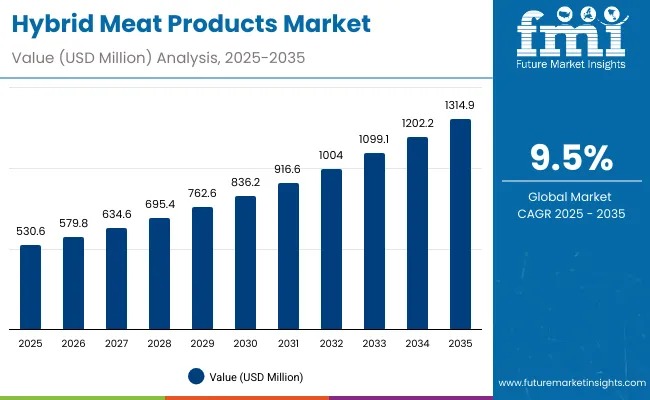
The global Hybrid Meat Products Market is positioned for strong expansion as consumers steadily shift toward protein options that balance flavor familiarity with environmental responsibility. Valued at USD 530.6 million in 2025, the market is forecast to reach USD 1,314.9 million by 2035, reflecting a 9.5% CAGR backed by product innovation, rising health awareness, and strengthened retail visibility.
Growing preference for blended animal- and plant-based proteins is reshaping mainstream food categories. Retailers and foodservice operators continue to prioritize hybrid formats that deliver both taste alignment and sustainability benefits, reducing the hesitation still associated with fully plant-based substitutes. Strategic investments in supply chain optimization, protein technology, and consumer-centric marketing are reinforcing category legitimacy worldwide.
Explore trends before investing – request a sample report today! https://www.futuremarketinsights.com/reports/sample/rep-gb-26197
Decade Outlook: Hybrid Meat Becomes a Mainstream Protein Choice
Between 2025 and 2030, the market is projected to expand from USD 530.6 million to more than USD 836 million, supported by premium-positioned launches, improving sensory profiles, and growing participation of leading meat and plant-protein companies. The period from 2030 to 2035 is expected to unlock accelerated growth, contributing the bulk of decade-long gains as affordability improves, regulatory clarity strengthens, and adoption broadens across emerging economies.
From 2020 to 2024, hybrid meat products transitioned from niche experimentation to a structured market category. Traditional meat processors leveraged existing networks to mainstream hybrid offerings, while plant-based innovators focused on premium, clean-label formulations. By 2025, burgers and patties—holding 26.7% market share—emerged as the primary gateway products, enabling consumers to try hybrid formats without changing established habits.
Why the Market Is Growing: Sustainability, Health, and Familiarity
Hybrid meat products are gaining traction due to a convergence of consumer and industry forces:
- Environmental considerations: Lower greenhouse emissions and reduced resource intensity compared to conventional meat.
- Health-focused choices: Hybrid formulations offer higher protein density, balanced fat profiles, and cleaner labels.
- Consumer familiarity: Blending plant ingredients with meat helps overcome taste and texture barriers of purely plant-based options.
Moreover, partnerships between meat giants and food-tech firms—such as Tyson Foods, JBS S.A., Nestlé S.A., Maple Leaf Foods, Hormel Foods, Conagra Brands, Eat Just (GOOD Meat), Bio Tech Foods, and Mush Foods—are accelerating innovation and boosting retail penetration.
Segmental Insights: Burgers & Patties Lead; Beef-Based Hybrids Dominate Demand
Product Type:
- Burgers & Patties (26.7% share) remain the leading segment in 2025, thanks to widespread consumer acceptance and fast-food integration.
- Minced and ground meat (16.8%) is forecast to grow faster at 7.8% CAGR, reflecting demand for versatility in home cooking and ready-to-eat formats.
Source Breakdown:
- Beef-based hybrids (22.7% share) dominate early adoption, although slower growth (4.5% CAGR) reflects rising environmental concerns.
- Chicken-based hybrids (18.4%) benefit from versatility in processed foods.
- Soy protein (9.8% share) and other plant sources are projected to expand fastest (6.2% CAGR) as consumers seek more sustainable alternatives.
Retail Landscape: Supermarkets Lead, Online Channels Rise Fastest
Supermarkets and hypermarkets are expected to capture 25% of the distribution share in 2025, serving as crucial trust-building touchpoints. Convenience stores hold 22% share, reflecting on-the-go demand, while specialty natural food stores contribute 20%.
Online retail—projected at 8.3% CAGR, the fastest among all channels—continues to expand through subscription models and digital-native brands.
Country-Level Snapshot: India and China Lead Growth, Europe Builds on Sustainability
Key growth markets include:
- India (7.0% CAGR) – rising health awareness and metropolitan adoption.
- China (6.7% CAGR) – strong governmental support and rapid urbanization.
- Germany (6.1% CAGR) – robust sustainability regulations and high product visibility.
- USA (6.3% CAGR) – strong e-commerce and foodservice integration.
In the United States, the market is projected to rise from USD 147.3 million in 2025 to USD 268.4 million by 2035, driven by younger demographics, clean-label preferences, and strong supermarket presence.
Competitive Landscape: Innovation and Partnerships Shape Leadership
Tyson Foods commands 9.5% of global value share, with the remaining market distributed among mid-sized innovators and specialized food-tech players. Competitive differentiation is increasingly centered on:
- Sensory innovation and flavor optimization
- Cost-efficient production models
- Scalable retail and foodservice partnerships
Key developments include new flavor launches under Hillshire Farm (2025) and Nestlé’s earlier hybrid-adjacent “Maggi Rindecarne” (2024).