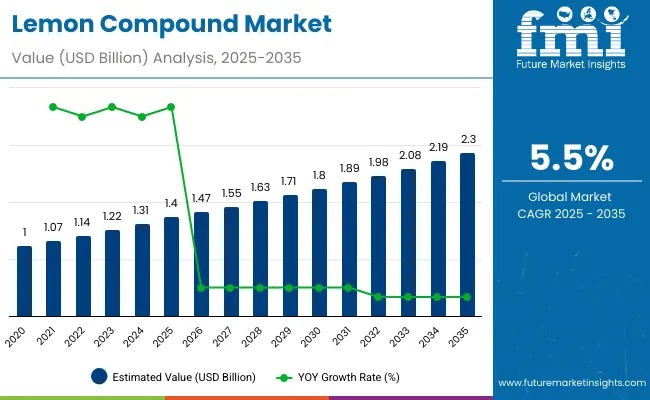
The global lemon compound market, valued at USD 1.4 billion in 2025, is projected to reach USD 2.3 billion by 2035, expanding at a steady CAGR of 5.5%. The long-term value accumulation curve indicates consistent year-over-year expansion, reflecting rising adoption across food, beverage, fragrance, and specialty chemical sectors. Market growth remains stable, supported by the demand for high-purity, natural citrus derivatives used for flavoring, aroma, and functional performance across multiple industries.
Growth between 2026 and 2034 shows predictable market behavior, increasing from USD 1.4 billion to USD 2.2 billion, highlighting strong industrial confidence and steady capacity expansion. Manufacturers continue to scale extraction, formulation, and distillation capabilities to meet the rising need for performance-grade lemon compounds.
Explore trends before investing – request a sample report today! https://www.futuremarketinsights.com/reports/sample/rep-gb-26019
Quick Market Stats
- Market Value (2025): USD 1.4 billion
- Forecast Value (2035): USD 2.3 billion
- CAGR (2025–2035): 5.5%
- Top Segment (2025): D-Limonene (32.4%)
- High-Growth Regions: North America, Asia-Pacific, Europe
- Key Companies: Givaudan, Univar Solutions, Astrra Chemicals, Citromax, Citrus Oleo, DRT, Ernesto Ventós, FBC Chemical, Banner Chemicals, Florida Chemical Company
Market Positioning Across Parent Industries
Lemon compounds hold a measurable share across several ingredient and specialty chemical categories:
- Food Flavors & Additives: 6.1%
- Beverage Ingredients: 5.5%
- Cosmetic Ingredients: 4.2%
- Fragrance Compounds: 5.0%
- Specialty Chemicals: 3.8%
Collectively, lemon compounds contribute 24.6% of activity across these parent industries, underscoring their strategic importance in sensory performance, formulation consistency, and product differentiation.
Why the Lemon Compound Market Is Growing
The market is increasingly influenced by global demand for natural, clean-label, and plant-derived ingredients. Lemon compounds, known for their bioactive and aromatic characteristics, align strongly with:
- The clean-label movement
- Natural flavor and fragrance requirements
- High-intensity citrus preference in beverages and processed foods
- Sustainable and traceable sourcing trends
Regulatory support—particularly GRAS approvals—continues to facilitate broader penetration in food, personal care, nutraceutical, and green cleaning applications.
Segmental Analysis
By Compound
Key compounds include D-Limonene, α-Pinene, β-Pinene, Linalool, Decanal, Myrcene, Nootkatone, Octanal, Nonanal, Valencene, Perillaldehyde, and Sabinene.
D-Limonene, with a 32.4% share, leads due to its versatility across food-grade and technical-grade applications. Its solvent properties, lemon-fresh aroma, biodegradability, and compatibility across formulations continue to drive adoption.
By Application
- Food & Beverage (48.7%)
- Personal Care & Cosmetics
- Others (Industrial, Aromatherapy, Specialty Chemicals)
Food and beverage dominate due to increased dependence on natural citrus-based enhancers that improve freshness, acidity, aroma, and functional performance. Its use is rising sharply in low-sugar beverages, bakery products, savory snacks, and clean-label confectionery.
Market Drivers, Restraints & Trends
Key Growth Drivers
- Rising consumption of flavored beverages, confectionery, and bakery goods
- Expanding use in personal care and aromatherapy
- Greater preference for natural citrus extracts over synthetics
Opportunities
- Premium applications in clean-label beverages
- High-purity citrus aromatic compounds for cosmetics
- Functional blends with botanicals and fruit-based derivatives
Industry Trends
- Encapsulated lemon compounds for improved stability
- Multi-industry adoption in oral care, cosmetics, and aromatherapy
- Controlled-release formats for consistent sensory delivery
Key Challenges
- Seasonal fluctuations in lemon crop yields
- Raw material price volatility
- Stringent global regulatory and certification requirements
Country-Wise Growth Outlook
China (7.4% CAGR) and India (6.9% CAGR) lead global growth due to rising processed food consumption, rapid retail expansion, and increasing demand for flavored snacks and beverages.
- China: Demand rises sharply from beverages, bakery, and ready-to-drink segments.
- India: Growth driven by confectionery expansion and modern retail penetration.
- Germany (6.3% CAGR): Premium formulations and strict standards fuel demand.
- United Kingdom (5.2% CAGR): Beverage and bakery innovation remain key.
- United States (4.7% CAGR): Steady growth supported by premium beverages and industrial applications.
Competitive Landscape
Global and regional players are focusing on purity, consistency, traceable sourcing, and performance reliability:
- Givaudan & Univar Solutions: Market leaders with extensive flavor portfolios and robust supply chains.
- Astrra Chemicals, Banner Chemicals, Citromax: Strong regional presence and cost-effective solutions.
- Citrus Oleo, DRT, Ernesto Ventós: Specialists in premium citrus extractions.
- FBC Chemical & Florida Chemical Company: Focus on bulk supply and industrial-scale distribution.
Brochures and product documents emphasize technical specifications, aroma profiles, stability maps, and application versatility—catering to formulators and procurement teams seeking both quality and cost efficiency.