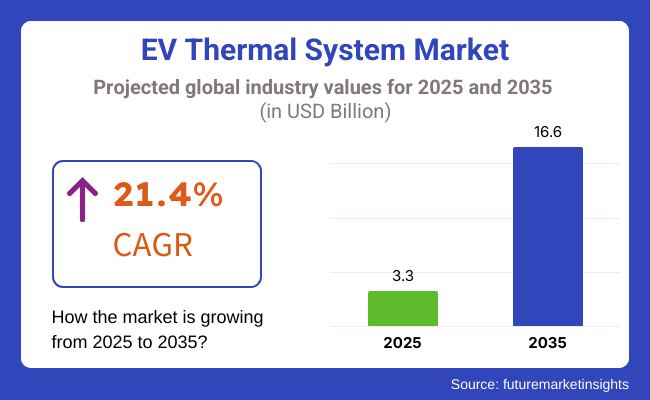
The electric vehicle (EV) thermal systems market is on a high-octane growth trajectory, projected to rise from USD 3.3 billion in 2025 to approximately USD 16.6 billion by 2035, reflecting a robust compound annual growth rate (CAGR) of 21.4%, according to recent analysis by Future Market Insights (FMI). The market expansion is propelled by rising EV adoption, cutting-edge thermal management technologies, and the growing demand for energy-efficient, safe, and reliable EV powertrain solutions.
EV thermal systems, critical for maintaining optimal operating temperatures for batteries, motors, and electrical components, are now at the core of EV design. Effective thermal management directly influences performance, safety, and battery longevity. As consumers increasingly seek EVs with longer driving ranges and reduced charging times, advanced thermal systems have become indispensable to maximize energy efficiency while minimizing heat-related losses.
Get access to comprehensive data tables and detailed market insights – request your sample report today!
https://www.futuremarketinsights.com/reports/sample/rep-gb-16596
Market Dynamics and Technological Drivers
The industry has witnessed a rapid shift from conventional air-cooling to liquid-cooling solutions for batteries and power electronics, driven by high-capacity lithium-ion batteries and stringent efficiency standards. Heat pump technologies are replacing resistive heating, enhancing vehicle range while reducing energy consumption. Furthermore, sustainability initiatives are fueling demand for low-global warming potential (GWP) refrigerants, phase-change materials, and bio-based cooling solutions.
Emerging trends from 2025 to 2035 include predictive cooling, AI-enabled thermal management, dielectric immersion cooling, and waste heat recovery technologies. Smart sensors and digital twin simulations will enable real-time optimization of battery and motor temperatures, while closed-loop thermal systems and eco-friendly coolants reduce environmental impact. Such innovations are expected to play a pivotal role in enabling long-haul electric trucks and next-generation solid-state batteries.
Regulatory Landscape and Sustainability Mandates
Global regulations, such as the EU’s F-Gas Regulation and the USA’s AIM Act, are phasing out HFC refrigerants like R-134a and R-1234yf, prompting the industry to adopt low-GWP alternatives including R-744 and hydrofluoroolefins (HFOs). Automotive manufacturers are responding by integrating advanced heat pumps, energy-efficient HVAC systems, and AI-controlled cooling circuits to meet increasingly stringent emissions and efficiency standards across Europe, North America, and Asia-Pacific.
Regional Insights
• United States: The EV thermal system market is growing rapidly, fueled by government incentives such as the Inflation Reduction Act, expansion of fast-charging networks, and rising consumer demand for high-performance EVs. Manufacturers including Tesla, Ford, and General Motors are deploying liquid-cooled batteries, phase-change materials, and AI-driven thermal management to optimize battery life and vehicle efficiency. Projected CAGR: 8.4% (2025-2035).
• United Kingdom: The UK market is benefiting from the Road to Zero Strategy and Zero Emission Vehicle (ZEV) mandates, with automakers like Jaguar Land Rover, Arrival, and Bentley integrating heat pumps and intelligent cooling circuits to maintain battery performance under varying climatic conditions. Projected CAGR: 7.9% (2025-2035).
• European Union: Driven by the Green Deal and rapid EV adoption, EU countries such as Germany, France, and the Netherlands are leading in solid-state battery thermal management, AI-based cooling, and low-power HVAC systems. Industry leaders Volkswagen, BMW, and Renault are advancing thermally dynamic cooling modules for both passenger and commercial EVs. Projected CAGR: 8.2% (2025-2035).
• Japan: Japanese automakers Toyota, Honda, and Nissan are investing in lightweight, miniaturized, and energy-efficient thermal systems, targeting carbon neutrality by 2050 and enabling the deployment of battery-swapping EVs and solid-state battery technologies. Projected CAGR: 7.8% (2025-2035).
• South Korea: With government support and the rise of manufacturers like Hyundai and Kia, the market is focusing on advanced phase-change materials, AI cooling technologies, and thermoelectric systems for next-gen battery packs. Projected CAGR: 8.1% (2025-2035).
Purchase Full Report for Detailed Insights
For access to full forecasts, regional breakouts, company share analysis, and emerging trend assessments, you can purchase the complete report here: Buy Full Report – https://www.futuremarketinsights.com/checkout/16596
Segment Analysis
• By System Type: HVAC, powertrain cooling, and fluid transport are critical components. Liquid cooling dominates high-voltage electronics management, while fluid transport systems from companies like Dana Incorporated and Hanon Systems ensure reliability under high thermal loads.
• By Vehicle Type: Battery Electric Vehicles (BEVs) rely heavily on liquid-cooled systems for battery longevity and performance, whereas Hybrid Electric Vehicles (HEVs) require efficient cooling solutions for dual powertrains, balancing ICE and electric components.
• By Application: Key applications include engine cooling, battery thermal management, waste heat recovery, HVAC, and heated or ventilated seats, with growing focus on energy efficiency and performance optimization.
Competitive Landscape
Market leaders are capturing value through innovation in liquid cooling, heat pumps, and phase-change technologies. Denso Corporation (18-22% market share), Valeo (15-20%), MAHLE GmbH (12-16%), Hanon Systems (10-14%), and BorgWarner (6-10%) are spearheading the market with advanced thermal management solutions. Other players, including Bosch, Modine, Gentherm, and LG Chem, are also making significant technological strides.
Outlook
The EV thermal systems market is poised for unprecedented growth over the next decade, supported by technological innovation, government regulations, and escalating global EV adoption. Breakthroughs in AI-driven cooling, eco-friendly refrigerants, and predictive thermal management solutions will further accelerate market expansion. Manufacturers capable of balancing cost, efficiency, and sustainability will dominate the landscape as EVs become the standard for global mobility.
About Future Market Insights (FMI)
Future Market Insights, Inc. (FMI) is an ESOMAR-certified, ISO 9001:2015 market research and consulting organization, trusted by Fortune 500 clients and global enterprises. With operations in the U.S., UK, India, and Dubai, FMI provides data-backed insights and strategic intelligence across 30+ industries and 1200 markets worldwide.