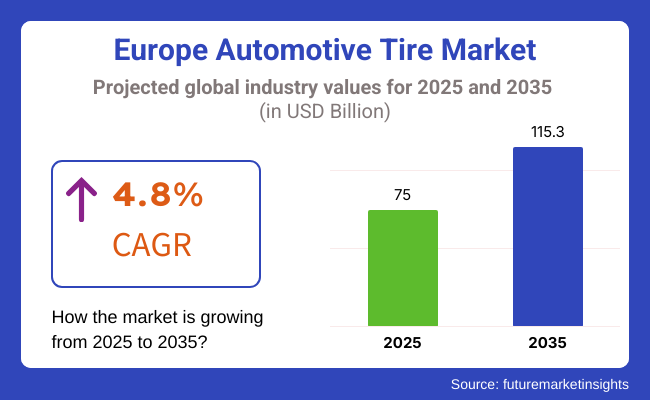
The European automotive tire market is accelerating at an unprecedented pace, projected to reach USD 115.3 billion by 2035, up from USD 75 billion in 2025, registering a steady 4.8% CAGR, according to Future Market Insights (FMI). Rising vehicle ownership, expanding electric vehicle (EV) adoption, and technological innovations in tire design are driving a new era of growth across passenger cars, light commercial vehicles (LCVs), and high-performance automobiles.
The market’s expansion is underpinned by a dual force: increasing demand for replacement and original equipment (OE) tires, and the rapid evolution of tire technologies that balance durability, performance, and eco-friendliness. Manufacturers are leveraging advanced compounds, lightweight designs, and low-rolling-resistance technologies to improve fuel efficiency while meeting stricter EU environmental regulations.
Get access to comprehensive data tables and detailed market insights – request your sample report today!
https://www.futuremarketinsights.com/reports/sample/rep-gb-17433
Innovation Meets Sustainability
The European Union’s rigorous mandates on fuel efficiency, tire labeling, and environmental standards are reshaping production strategies. Tire manufacturers are investing heavily in R&D to develop eco-friendly and energy-efficient tires. Specialized EV tires are emerging as a key trend, designed to handle heavier vehicles, higher torque, and optimize energy consumption. Companies such as Michelin, Bridgestone, and Continental are focusing on bio-based rubber, recycled materials, and advanced tread patterns to create greener solutions.
“Consumer expectations are shifting rapidly. Beyond durability and performance, buyers increasingly demand tires that align with environmental priorities,” said a market analyst at FMI. “Sustainability initiatives-from low-rolling-resistance tires to smart, AI-enabled monitoring-are shaping the future of the European tire market.”
Market Dynamics and Adoption Criteria
Performance, traction, and handling remain paramount, followed closely by durability and tread life. Price-to-value ratio is a key determinant for retailers, while fuel efficiency, though significant, remains secondary to overall vehicle performance. Environmental considerations are gaining traction, with manufacturers focusing on reduced carbon footprints and sustainable production processes.
Technological adoption varies across segments:
• Passenger Cars: Demand for all-season, fuel-efficient, and low-rolling-resistance tires is surging, especially for EVs where battery range optimization is critical.
• Light Commercial Vehicles (LCVs): Urban logistics and last-mile delivery growth drive demand for high-mileage, performance-oriented tires. Fleet electrification accelerates adoption of eco-friendly solutions.
• Winter Tires: In regions with harsh winters, such as Scandinavia and Germany, specialized winter tires with reinforced sidewalls and advanced tread compounds maintain traction and safety under extreme conditions.
Market Shifts: 2020-2035
Between 2020 and 2024, Europe witnessed growing adoption of fuel-efficient and all-season tires, expansion of EVs, and increased use of intelligent tire technologies such as basic TPMS (Tire Pressure Monitoring Systems). Retreading and recycling practices gained traction, while tighter EU emissions rules prompted greater sustainability.
Looking ahead to 2025-2035, the market is expected to embrace fully bio-based, self-healing, and adaptive tires with AI-driven predictive analytics. Wireless energy transfer for EV tires may extend battery range, while 3D printing could enable on-demand production and reduce waste. Tire subscription services are expected to emerge, further promoting circular economy principles.
Country-Level Insights
• Germany: The largest European market, driven by luxury brands like BMW, Audi, and Mercedes, is projected to grow at a 6.8% CAGR. Government-backed sustainability initiatives encourage bio-rubber and recycling technologies.
• France: Growth is fueled by EV adoption, subsidies, and Michelin’s innovations in airless tire technology and AI wear forecasting. Expected CAGR: 6.5%.
• Italy: Luxury sports car demand and Pirelli’s high-performance innovations drive a 6.4% CAGR, focusing on nano-materials and advanced tread patterns.
• Spain: Urbanization, EV adoption, and smart tire solutions from Goodyear and Bridgestone support a 6.3% CAGR.
• Netherlands: Green mobility policies and EV incentives encourage low-resistance, bio-based, and intelligent tires, driving a 6.6% CAGR.
Purchase Full Report for Detailed Insights
For access to full forecasts, regional breakouts, company share analysis, and emerging trend assessments, you can purchase the complete report here: Buy Full Report – https://www.futuremarketinsights.com/checkout/17433
Competitive Landscape
Europe’s automotive tire industry is highly competitive, dominated by global players leveraging innovation, brand reputation, and extensive distribution networks:
• Michelin (20-25%): Focused on energy-efficient, sustainable, and low-rolling-resistance tires.
• Continental AG (15-20%): Leading intelligent tire solutions with real-time monitoring and adaptive traction.
• Bridgestone (12-16%): Run-flat and ultra-high-performance tires for EVs and luxury vehicles.
• Goodyear (10-14%): AI-powered tire analytics and self-regenerating tread technologies.
• Pirelli (6-10%): High-performance tires combining motorsport traction and digital connectivity.
Emerging players and startups are gaining traction by offering specialized, eco-friendly, and performance-focused solutions for EVs and premium segments. The emphasis on recyclable materials, smart sensors, and energy-efficient production is expected to shape the competitive advantage in the next decade.
Segment-Wise Highlights
• Vehicle Type: Passenger cars dominate sales, followed by LCVs, HCVs, and specialty vehicles.
• Tire Type: All-season tires lead due to versatility, while winter tires remain critical in cold climates.
• Material: Synthetic rubber adoption grows for durability and temperature resistance.
• Sales Channels: OEM and aftermarket sales are balanced, with aftermarket driven by replacement and upgrades.
• Tube Category: Tubeless tires are preferred for safety and efficiency.
Outlook
The European automotive tire market is entering a transformative phase, characterized by advanced EV-specific tires, AI-driven solutions, and sustainability-focused production. With rising consumer expectations, regulatory pressures, and technological innovation, the market is positioned for a decade of steady growth, profitability, and environmental responsibility.
As Europe continues to champion green mobility, tire manufacturers that integrate innovation, sustainability, and high performance will be best positioned to lead the industry, delivering safer, smarter, and eco-friendly solutions to drivers across the continent.
About Future Market Insights (FMI)
Future Market Insights, Inc. (FMI) is an ESOMAR-certified, ISO 9001:2015 market research and consulting organization, trusted by Fortune 500 clients and global enterprises. With operations in the U.S., UK, India, and Dubai, FMI provides data-backed insights and strategic intelligence across 30+ industries and 1200 markets worldwide.