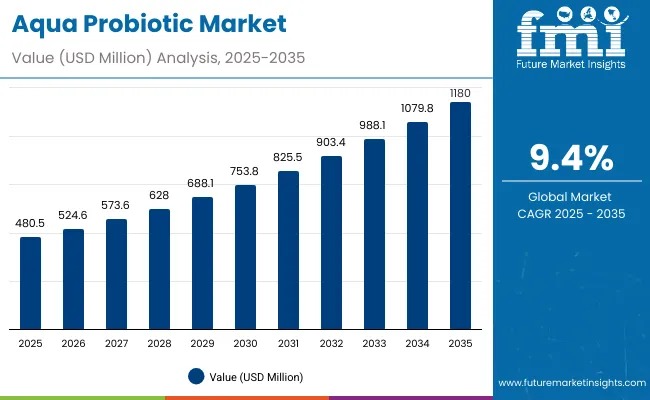
The global Aqua Probiotic Market, valued at USD 480.5 million in 2025, is projected to reach USD 1,180.0 million by 2035, reflecting a strong 9.4% CAGR. The decade is set to witness a structural shift as probiotics move from supplementary solutions to mainstream pillars in aquaculture health management.
The market is expected to generate a cumulative USD 264.9 million in new revenue over the forecast period. Early growth is anticipated from the transition toward preventive health strategies, driven by demand for sustainable, antibiotic-free farming. From 2025 to 2030, the industry is projected to expand by USD 273.3 million, representing nearly 39% of the entire decade’s value increase.
Explore trends before investing – request a sample report today! https://www.futuremarketinsights.com/reports/sample/rep-gb-26136
Between 2030 and 2035, acceleration intensifies as the market rises from USD 753.8 million to USD 1,180.0 million, contributing roughly 61% of the total expansion. The surge is reinforced by rapid aquaculture intensification in Asia-Pacific, species-specific formulations, and the adoption of digital aquaculture systems for water-quality and health monitoring.
Growing Preference for Sustainable Aquaculture
Demand for aqua probiotics is rising as farms prioritize disease prevention, feed efficiency, and microbial balance. Governments worldwide are tightening restrictions on antibiotics, positioning probiotics as essential tools for safe and sustainable seafood production. Increased disease outbreaks in high-density aquaculture ponds are also accelerating adoption, with producers viewing probiotics as cost-effective health stabilizers.
Research and innovation in microbial strains are expanding probiotic performance capabilities—especially for gut health support, water-quality optimization, and species-specific immune enhancement. Integration with digital monitoring technologies is creating data-driven probiotic solutions that improve survival rates and streamline farming efficiency.
Segmental Highlights: Bacillus Dominates Microorganism Type
Microorganism Type, 2025 Share:
- Bacillus – 38.9%
- Saccharomyces – 11.4%
Bacillus maintains leadership due to its spore-forming stability and proven role in pond ecosystem management. Its resilience in fluctuating water conditions makes it the most preferred strain. Lactobacillus also holds a strong presence as producers focus on digestive and immune benefits, while emerging strains such as Enterococcus and Rhodobacter gain traction in targeted applications.
Species Insights: Fish Account for Nearly Half of Demand
Species Share, 2025:
- Fish – 46.2%
- Shrimp & Prawn – 36.8%
- Mollusks – 9.4%
Fish farming—led by salmon, tilapia, carp, and catfish—remains the primary application area. The rising global appetite for fish protein and growth of intensive farming systems underpin this dominance. Shrimp and prawn follow closely, supported by export-driven demand and heightened disease susceptibility in crustaceans.
Form Insights: Powder Leads with 57.4% Share
Powdered probiotics hold a 57.4% market share due to their cost-efficiency, convenience, and ease of integration with feed. Liquids and granules are expected to grow as hatcheries and specialty farms adopt rapid-dispersal or slow-release formulations for water-quality enhancement.
Country-Level Outlook: India Leads Global Growth
Growth trajectories vary significantly across key markets:
- India: 6.9% CAGR – fastest globally, driven by shrimp export compliance.
- China: 4.6% CAGR – growth supported by sustainable aquaculture mandates.
- Germany: 6.0% CAGR – strong focus on traceability and EU sustainability standards.
- UK: 5.7% CAGR – probiotics integral to salmon aquaculture health strategies.
- USA: 5.0% CAGR – adoption shaped by digital aquaculture integration.
The U.S. market is predicted to grow from USD 33.06 million in 2025 to USD 58.8 million by 2035, supported by consumer preference for antibiotic-free seafood and the modernization of aquaculture systems.
Asia-Pacific Spotlight: Japan & South Korea See Strong Upside
In Japan, Bacillus (37.5%) and Lactobacillus (18.9%) dominate microorganism demand. Strict food-safety regulations and R&D advancements are positioning Japan as a premium innovation hub for high-performance strain development.
South Korea’s market is led by fish farming (45.2%), with rapid growth expected across shrimp, mollusks, and specialty species such as eels and ornamental fish. Government investments in food safety and microbial research are accelerating adoption.
Competitive Landscape: Innovation and Digital Integration Drive Differentiation
The market remains moderately fragmented. Novonesis leads with a 9.4% global share, while companies including Evonik Industries AG, Bluestar Adisseo Co., Lallemand Animal Nutrition, Skretting, Alltech, Kemin Industries, Zeus Biotech, and Biostadt India are expanding through:
- Strain-specific R&D advancements
- Digital aquaculture system integration
- Partnerships with fish and shrimp producers
- Sustainable production and traceability commitments
Recent developments include Aquaintech’s PRO4000X launch and expansions in probiotic R&D centers across Asia by major feed-additive companies.