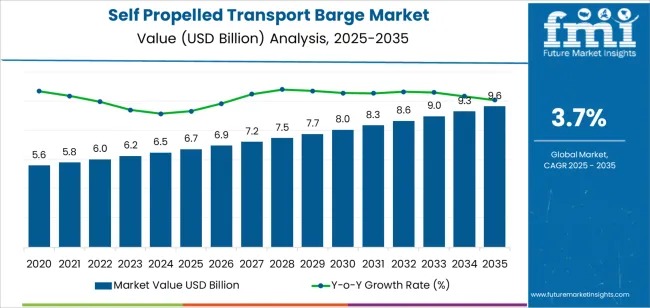
The global Self-Propelled Transport Barge Market is entering a transformative growth phase as industries worldwide accelerate maritime logistics, expand bulk material transport, and shift toward cleaner, fuel-efficient inland shipping. With strong adoption across oil & gas, chemicals, agriculture, mining, and marine infrastructure, the market is projected to record steady demand between 2025 and 2035, supported by modernization of ports and inland waterways.
According to recent industry assessments, self-propelled transport barges are increasingly recognized for their cost efficiency, operational autonomy, and ability to reduce emissions compared to conventional marine vessels. The surge in cross-border trade, the expansion of inland waterway networks, and government-backed green shipping programs continue to strengthen market prospects.
Subscribe for Year-Round Insights → Stay ahead with quarterly and annual data updates: https://www.futuremarketinsights.com/reports/sample/rep-gb-28468
Market Drivers Supporting Long-Term Growth
The market is benefiting from three fundamental drivers:
- Expansion of Maritime Trade and Bulk Cargo Movement
Rising seaborne trade volumes—especially in petroleum, grains, minerals, and construction materials—are encouraging fleet operators to adopt barges with integrated propulsion for higher efficiency and flexible deployment. Demand is particularly strong across Asia-Pacific, Europe, and the Middle East, where industrial production and resource trade remain high.
- Port Infrastructure Modernization
Governments are investing heavily in modernizing ports, dredging waterways, and enhancing inland cargo corridors. These initiatives are creating favorable conditions for self-propelled barges to operate on extended routes while improving turnaround times and reducing logistics costs.
- Shift Toward Low-Emission Marine Transport
Stringent emission norms and the global transition toward cleaner transportation are accelerating the adoption of fuel-efficient, hybrid, and electric propulsion technologies. This shift provides a competitive edge to self-propelled barges, which consume less fuel per ton-mile than traditional maritime vessels.
Market Restraints and Challenges
Although long-term outlook remains positive, several challenges persist:
- High initial investment costs for propulsion-equipped barges
- Fluctuating fuel prices impacting operating economics
- Seasonal water-level risks on inland waterways
- Presence of non-propelled alternatives, which offer lower upfront costs
Despite these factors, investments in sustainable marine logistics and increasing demand for autonomous and semi-autonomous vessels are expected to mitigate long-term risks.
Key Market Opportunities (2025–2035)
The decade ahead will offer several high-value opportunities:
– Expansion of Hydrogen and LNG Marine Propulsion
With a sharp rise in green shipping initiatives, hydrogen and liquefied natural gas propulsion systems are attracting global interest.
– Autonomous Navigation and Digital Fleet Optimization
AI-based navigation, real-time fleet monitoring, and automated cargo operations are increasingly influencing fleet modernization strategies.
– Strong Uptake in Energy, Construction, and Mining Sectors
New offshore energy installations, rapid infrastructure development, and rising mineral transport continue to expand the addressable market.
Segment Overview
- By Cargo Type
The market spans petroleum, dry cargo, liquid chemicals, agricultural products, and construction materials. Petroleum and dry bulk segments currently dominate global revenue share.
- By Propulsion Technology
Diesel propulsion remains the most widely used system, but hybrid-electric and LNG propulsion technologies are gaining traction due to efficiency and regulatory compliance benefits.
- By Application
Transport, offshore support, dredging support, port operations, and material handling constitute key application areas. Offshore support operations are expected to grow steadily due to new energy projects and coastal infrastructure development.
Regional Outlook
North America
Supported by inland waterway modernization, shale-energy logistics, and fleet upgrades, North America remains one of the highest-demand regions for self-propelled transport barges.
Europe
Europe’s leading inland waterway network, strong environmental regulations, and port electrification initiatives continue to shape market expansion. Demand is particularly strong in Germany, France, and the Netherlands.
Asia-Pacific
APAC remains the fastest-growing region due to rapid industrialization, rising commodity movement, and large-scale development of maritime trade corridors across China, India, Indonesia, and Southeast Asia.
Middle East & Africa
Oil and petrochemical expansion, along with marine infrastructure projects, are driving strong adoption across GCC countries and parts of Africa.
Competitive Landscape
The market features a mix of global manufacturers, regional shipbuilders, fleet operators, and marine technology companies. Leading players focus on propulsion innovation, vessel durability, hybrid systems, and autonomous control solutions to enhance operational efficiency.
Companies are increasingly partnering with port authorities, energy firms, and logistics operators to deliver high-performance barge fleets tailored to cargo-specific requirements. Digital fleet analytics, remote monitoring, and predictive maintenance are also becoming core differentiators for top manufacturers.
Get data that aligns with your strategic priorities — ask for report customization today: https://www.futuremarketinsights.com/customization-available/rep-gb-28468
Related Reports:
Thermal Cleaning System Market- https://www.futuremarketinsights.com/reports/thermal-cleaning-system-market
Tower Crane Market- https://www.futuremarketinsights.com/reports/tower-crane-market
Residual Current Circuit Breaker Market- https://www.futuremarketinsights.com/reports/residual-current-circuit-breaker-market
Have a specific Requirements and Need Assistant on Report Pricing or Limited Budget please contact us – sales@futuremarketinsights.com
About Future Market Insights (FMI)
Future Market Insights, Inc. (FMI) is an ESOMAR-certified, ISO 9001:2015 market research and consulting organization, trusted by Fortune 500 clients and global enterprises. With operations in the U.S., UK, India, and Dubai, FMI provides data-backed insights and strategic intelligence across 30+ industries and 1200 markets worldwide.
Contact Us:
Future Market Insights Inc.
Christiana Corporate, 200 Continental Drive,
Suite 401, Newark, Delaware – 19713, USA
T: +1-347-918-3531
Why FMI: https://www.futuremarketinsights.com/why-fmi
For Sales Enquiries: sales@futuremarketinsights.com
Website: https://www.futuremarketinsights.com
LinkedIn| Twitter| Blogs | YouTube