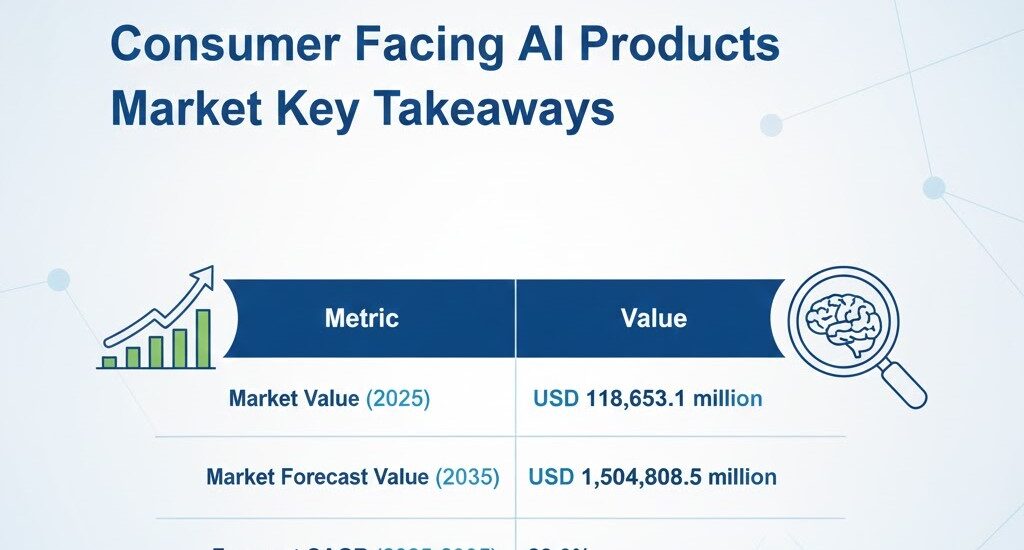
The global Consumer Facing AI Products Market is entering an unprecedented growth phase, fueled by rapid advancements in AI technologies and rising consumer demand for intelligent, intuitive, and personalized digital experiences. According to the latest industry outlook, the market is forecast to soar from USD 118,653.1 million in 2025 to USD 1,504,808.5 million by 2035, registering a remarkable CAGR of 29%.
As AI adoption moves beyond niche applications into mainstream consumer lifestyles, products such as virtual assistants, smart home devices, AI-powered wearables, and intelligent entertainment systems are becoming indispensable. Both global tech giants and emerging AI innovators are accelerating investments to capture opportunities across consumer electronics, healthcare, retail, mobility, smart home, and digital entertainment.
Subscribe for Year-Round Insights → Stay ahead with quarterly and annual data updates – https://www.futuremarketinsights.com/reports/sample/rep-gb-26619
A New Era of AI-Driven Consumer Technology
The shift toward AI-enhanced living is reshaping consumer behavior. Today’s customers expect more than manual convenience—they seek devices that can listen, learn, predict, and adapt. This evolution is driving companies like Apple, Google, Amazon, Samsung, Microsoft, Meta, Sony, Huawei, Xiaomi, Tesla, and LG Electronics to rapidly innovate.
At the same time, new and emerging players such as Snap Inc., Replika, iRobot, and multiple AI-first startups are developing breakthrough solutions in generative AI, conversational agents, predictive wellness, and autonomous home robotics. These entrants are not only opening fresh pathways for personalization but also creating new competitive standards.
Market Momentum: What’s Driving Growth?
The Consumer Facing AI Products Market is expanding due to:
- Advanced AI Capabilities: Improvements in natural language understanding, computer vision, and transformer-based models enable near-human interactions.
- Smart Home Explosion: AI-powered automation, voice-controlled systems, and IoT connectivity make homes more intuitive and energy efficient.
- Healthcare Digitalization: Consumers are embracing AI wearables and wellness platforms that offer personalized insights and preventive care.
- Evolving Entertainment Ecosystems: AI-driven content recommendation, immersive gaming, and personalized media experiences redefine consumer engagement.
- Edge AI Adoption: Devices with on-device processing reduce latency, improve privacy, and deliver seamless real-time intelligence.
Market Value Analysis
The surge in consumer-facing AI products reflects deeper technological transformations happening globally. As AI capabilities integrate into routine activities—including work, shopping, health monitoring, and entertainment—companies are competing to deliver more intuitive, human-like AI systems. This shift is ushering in a new generation of business models centered on personalized, interconnected, and autonomous experiences.
By 2035, AI-based consumer platforms are expected to dominate sectors such as smart homes, personal health, digital retail, and immersive entertainment. Companies investing early in AI innovation, privacy-preserving technologies, and device integration ecosystems will secure a competitive edge.
Key Segments of the Market
- By Product Type
- Smart Home & IoT Devices (38%)
Automated lighting, climate control, smart speakers, connected appliances. - Wearables & Health AI
Fitness trackers, biometric sensors, predictive health tools. - Smartphones with AI Features
AI imaging, voice assistants, real-time translation. - Entertainment & Media AI
Personalized content, immersive gaming, virtual influencers. - Robotics & Drones
Domestic robots, autonomous home devices, smart drones. - Others
Emerging AI gadgets and hybrid consumer applications.
- By Application
- Healthcare & Wellness (28%)
AI-driven diagnostics, continuous monitoring, preventive care. - Smart Home & IoT
AI-enabled automation, security, and predictive comfort systems. - Retail & E-commerce
Personalized shopping, virtual try-ons, recommendation engines. - Media & Entertainment
Content creation, AI storytellers, generative media platforms. - Automotive
AI-assisted driving, in-car assistants, personalized mobility. - Financial Services / Fintech
AI budgeting tools, adaptive financial planning. - Education
Intelligent tutoring, adaptive learning. - Others
Cross-industry consumer applications.
- By Region
- North America – Led by the U.S. with advanced AI adoption.
- Europe – Strong growth in Germany, UK, France, Italy, Spain.
- East Asia – China leads globally, followed by Japan and South Korea.
- South Asia & Pacific – India and Australia emerging as high-growth hubs.
- Latin America – Brazil remains dominant, supported by rising digitalization.
- Middle East & Africa – Saudi Arabia and emerging African economies accelerating AI adoption.
Global Growth Highlights: Country Outlook (CAGR 2025–2035)
- China – 39.2%
- India – 36.3%
- Germany – 33.4%
- Brazil – 30.5%
- United States – 27.6%
- United Kingdom – 24.7%
- Japan – 21.8%
With China, India, and Germany emerging as AI powerhouses, the market’s international expansion reflects widespread acceptance of AI as a lifestyle technology rather than a novelty.
Competitive Landscape: Established & New Manufacturers
The market is highly competitive, with innovations coming from established leaders and disruptive newcomers.
Established Powerhouses
- Apple, Google, Amazon continue to dominate smart ecosystems.
- Samsung, Huawei, Xiaomi lead hardware innovation and affordable AI devices.
- Microsoft, Meta, Sony push boundaries in productivity AI, mixed reality, and entertainment.
Emerging Innovators
- Replika advancing conversational AI.
- Snap Inc. innovating in AR-powered consumer experiences.
- iRobot enhancing autonomous home robotics.
- Multiple AI startups specializing in edge AI, generative content, emotional intelligence AI, and predictive wellness are reshaping market dynamics.
These companies are forming new technologies, forging strategic partnerships, expanding global footprints, and focusing on user-centric design to stay competitive in a growing AI-driven ecosystem.
Conclusion
The Consumer Facing AI Products Market is entering a decade of exponential growth, redefining how people live, work, and connect with technology. As AI becomes the backbone of consumer innovation, opportunities for established companies and new entrants are limitless. With breakthrough advancements, expanding global demand, and rising digital maturity, the industry is poised to reach an extraordinary USD 1.5 trillion valuation by 2035—solidifying AI’s position as the most influential technology force of the next decade.
Why FMI: https://www.futuremarketinsights.com/why-fmi
About Future Market Insights (FMI)
Future Market Insights, Inc. (FMI) is an ESOMAR-certified, ISO 9001:2015 market research and consulting organization, trusted by Fortune 500 clients and global enterprises. With operations in the U.S., UK, India, and Dubai, FMI provides data-backed insights and strategic intelligence across 30+ industries and 1200 markets worldwide.
Contact Us:
Future Market Insights Inc.
Christiana Corporate, 200 Continental Drive,
Suite 401, Newark, Delaware – 19713, USA
T: +1-347-918-3531
For Sales Enquiries: sales@futuremarketinsights.com
Website: https://www.futuremarketinsights.com
LinkedIn| Twitter| Blogs | YouTube