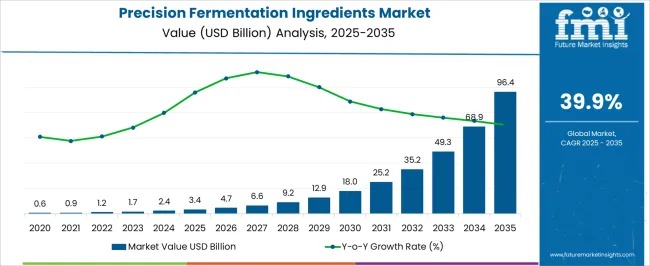
The global precision fermentation ingredients market, valued at USD 3.4 billion in 2025, is set for an unprecedented expansion, projected to reach USD 96.4 billion by 2035 at a steep CAGR of 39.9%. This growth trajectory underscores the rapid transformation of the global ingredient ecosystem as food, pharmaceutical, and specialty chemical industries shift toward sustainable, high-purity bio-based solutions.
This fast-scaling market is supported by a massive USD 93.0 billion absolute dollar opportunity created between 2025 and 2035. The acceleration is particularly evident between 2030 and 2035, when the sector jumps from USD 12.9 billion to USD 96.4 billion, accounting for most of the decade’s value creation. Rising industrial adoption, improvements in fermentation efficiency, and expanding regulatory approvals are accelerating the shift from early-stage innovation to global commercialization.
Explore trends before investing – request a sample report today! https://www.futuremarketinsights.com/reports/sample/rep-gb-25783
Market Overview: Strong Momentum Across Parent Ecosystems
Precision fermentation sits at the intersection of several high-growth industries:
- Biotechnology: ~25% influence through the wider push for bio-manufacturing
- Food & Beverage Ingredients: ~20%, led by alternative proteins and dairy replacement demand
- Pharmaceutical Ingredients: ~15%, driven by fermentation-derived APIs
- Cosmetic & Personal Care: ~10%, supported by clean-label actives
- Industrial Enzymes, Feed Additives & Specialty Chemicals: ~25% combined
This diversified base ensures sustained commercial demand, making precision fermentation one of the highest-value emerging ingredient technologies of the decade.
Why the Market Is Growing
Demand for sustainable, ethical, and resource-efficient food systems is a key driver. Precision fermentation enables the production of proteins, fats, enzymes, and functional molecules with high purity and consistent performance—reducing dependence on animal agriculture and volatile supply chains.
Growth is further supported by:
- Rapid investment from food-tech innovators and biotech companies
- Advancements in microbial strain engineering
- Lower production costs through scalable fermentation systems
- Favorable regulations for alternative proteins across North America, Europe, and Asia
These factors collectively position precision fermentation as a cornerstone in next-generation food, nutrition, and specialty ingredient innovation.
Segmental Insights
By Product Type – Proteins Lead with 36.3% Share
Proteins remain the largest segment, capturing 36.3% of the 2025 market. Precision-fermented proteins are widely adopted in:
- Dairy alternatives (casein, whey analogs)
- Meat substitutes
- Sports nutrition
- Functional beverages
Their appeal lies in superior bioavailability, clean-label positioning, and ability to replicate the texture and functionality of animal-derived proteins.
By Ingredient Source – Microbial-Based Systems Dominate (51.8%)
Microorganisms—yeast, fungi, and bacteria—account for 51.8% of revenue due to:
- High scalability and cost-efficiency
- Strong performance in producing complex molecules
- Compatibility with industrial fermentation infrastructure
Continuous innovation in synthetic biology is expanding the range of high-value ingredients produced through microbial platforms.
By Application – Food & Beverages Control 41.8% Share
Food and beverages represent the largest application area as global brands adopt animal-free proteins, fats, and functional compounds for:
- Dairy replacements
- Plant-based meats
- Functional nutrition
- Clean-label formulations
Strategic partnerships between fermentation companies and major food manufacturers continue to accelerate mainstream adoption.
Country-Level Growth Insights
The market shows strong regional variation, with emerging economies driving the fastest growth:
- China: 53.9% CAGR, supported by large-scale biomanufacturing investments
- India: 49.9% CAGR, fueled by functional foods and nutraceutical adoption
- Germany: 45.9% CAGR amid strict quality and sustainability regulations
- UK: 37.9% CAGR led by food-tech startup innovation
- USA: 33.9% CAGR backed by FDA approvals and venture capital funding
Asia-Pacific leads growth momentum, while North America and Europe maintain technology leadership.
Competitive Landscape
The market is shaped by a dynamic ecosystem of biotech innovators and food-tech pioneers. Key players include:
Amyris, BlueNalu, Brightseed, Biomilq, Bolt Threads, Ginkgo Bioworks, Clara Foods, Conagen, Enzymaster, Impossible Foods, KnipBio, Lygos, Motif FoodWorks, Novozymes, and Perfect Day.
These companies are advancing proprietary fermentation platforms to produce:
- Alternative dairy proteins
- Specialty enzymes
- Bioactive compounds
- Functional lipids
- Novel biomaterials
Competitive differentiation is driven by scalability, cost-optimised production, product purity, and collaboration with global food and ingredient manufacturers.
Outlook
With more than 28x growth expected between 2025 and 2035, precision fermentation is transitioning from niche innovation to a mainstream industrial technology. Combined with rising sustainability demands, advancing biomanufacturing capabilities, and strong regulatory progress, the market is positioned for explosive expansion across food, pharma, cosmetics, and specialty chemical industries.