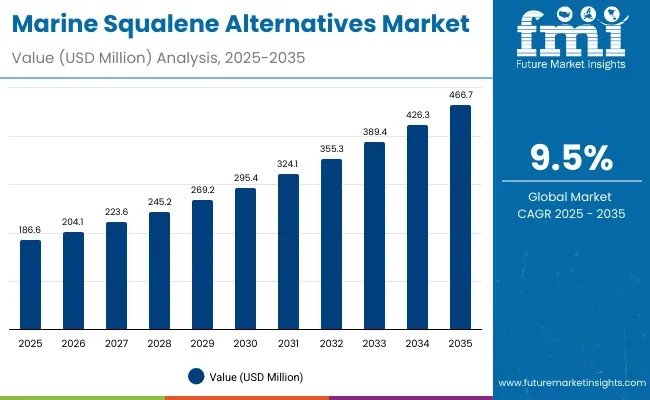
The Marine Squalene Alternatives Market is set for a decade of strong expansion, projected to grow from USD 186.6 million in 2025 to USD 466.7 million by 2035. The market’s absolute growth of USD 280.1 million reflects a robust 9.5% CAGR, signaling a major shift toward ethical sourcing, sustainable ingredients, and advanced biotechnology-driven production models.
Explore trends before investing – request a sample report today! https://www.futuremarketinsights.com/reports/sample/rep-gb-26232
Early Momentum Strengthens as Clean-Label Demand Rises
Between 2025 and 2030, the market is forecasted to climb to USD 295.4 million, adding nearly USD 108.8 million, or 39% of the decade’s total growth. Much of this early expansion stems from the cosmetics and personal care industry, which accounts for 50.6% of 2025 demand. Consumers are increasingly insisting on cruelty-free, traceable, and sustainable formulations—pressuring brands to eliminate shark-derived squalene entirely.
Biotechnology innovations including microbial and yeast-based fermentation are also expected to play a major role in this early phase, supporting better cost predictability, improved purity, and more resilient supply chains.
Accelerated Growth Expected Between 2030 and 2035
From 2030 onward, the market is projected to scale rapidly, adding USD 171.3 million over five years. This acceleration will be driven by:
- Growing pharmaceutical and nutraceutical integration
- Improved refining of bio-based squalane
- Rising adoption in functional food applications
- Deeper partnerships between biotech innovators and global consumer goods companies
By 2035, marine squalene alternatives are expected to transition from niche sustainability substitutes into mainstream bio-based lipid solutions with broad cross-industry adoption.
Product Type Insights: Olive Oil Leads, Biotech Emerges Fastest
In 2025, olive oil–derived alternatives account for 25% of the market, supported by established supply systems and consumer recognition. Amaranth seed oil follows at 15%.
However, biotech-based pathways—synthetic biology, microbial fermentation, and yeast-based processes—are expected to register the fastest growth. These approaches provide consistent purity, scalable yields, and lower environmental impact, making them increasingly attractive as regulatory scrutiny tightens.
End-Use Application Insights: Cosmetics Hold Over Half the Market
The cosmetics and personal care segment remains the dominant end-use area, capturing 50.6% of market share in 2025. Pharmaceutical and nutraceutical adoption is projected to escalate as GMP-grade formulations gain traction, supported by the strong bioactivity and stability of squalane derivatives.
Food and beverage applications, while smaller at 14.5%, are expected to grow as lipid-based fortification becomes more common.
Purity Grade Landscape: Cosmetic Grade Leads with 40.6% Share
Cosmetic-grade squalene alternatives hold the largest share at 40.6%, while pharmaceutical and nutraceutical-grade products make up 34.2% and 25.2%, respectively. Over the next decade, higher-purity offerings are anticipated to gain prominence as manufacturers elevate compliance standards and innovate in precision fermentation.
Key Market Drivers
Sustainability and Ethical Sourcing:
Global restrictions on shark-derived squalene continue to reshape sourcing strategies. Brands are increasingly leveraging eco-certifications and traceability transparency to bolster consumer trust.
Biotechnology Transformation:
Fermentation-based and synthetic biology pathways are reducing dependence on agricultural crops while offering greater supply security. These innovations are expected to define future cost competitiveness and performance benchmarks.
Global Country-Level Outlook
- China (6.3% CAGR): Strong momentum from domestic cosmetics and nutraceutical manufacturers.
- India (6.6% CAGR): Rapid adoption fueled by pharmaceutical manufacturing growth and plant-based product awareness.
- France (7.2% CAGR): Europe’s fastest-growing market, driven by its premium beauty sector and green chemistry focus.
- USA (6.2% CAGR): Supported by biotechnology R&D, clean-label cosmetics, and FDA-aligned GMP-grade advancement.
- Brazil (6.1% CAGR): Rising consumer demand for bio-based ingredients across cosmetics and supplements.
USA Market Outlook
The U.S. market is projected to reach USD 79.5 million by 2035, up from USD 43.6 million in 2025, reflecting growing demand from ethical beauty, nutraceuticals, and high-purity pharmaceutical applications. Partnerships between U.S.-based consumer brands and biotech firms are expected to unlock early commercialization of synthetic biology–derived squalane.
Competitive Landscape
Key companies shaping this market include Amyris, Inc., Croda International Plc, Clariant AG, Sophim S.A., Takasago International Corporation, Nucelis Inc., Arista Industries, Henry Lamotte Oils GmbH, Kishimoto Special Liver Oil Co., Ltd., and EFP Biotek. Competitive advantage is expected to shift increasingly toward innovation ecosystems, fermentation efficiency, synthetic biology IP, and sustainability-driven branding.