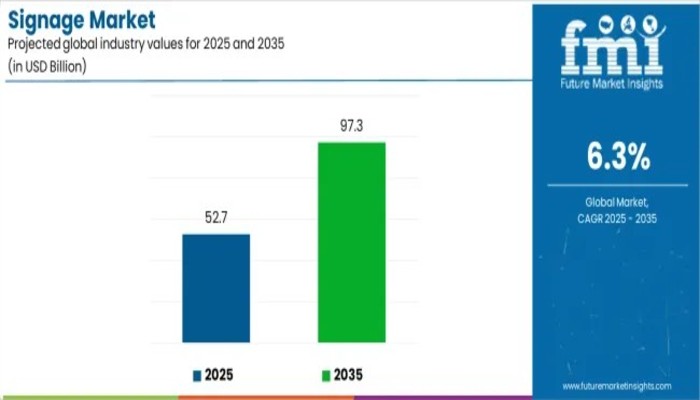
The global signage market is entering a decade of transformative growth, reflecting rapid digital adoption, rising infrastructure development, and evolving customer experience expectations across industries. Valued at USD 52.7 billion in 2025, the market is forecast to reach USD 70.8 billion by 2030, charting a value rise of USD 18.1 billion—equivalent to 40.6% of the decade’s total growth. The first phase of expansion is largely driven by surging demand for LED display technologies, an intensifying focus on outdoor advertising networks, and the growing integration of signage in global smart city initiatives.
Between 2030 and 2035, the industry is projected to accelerate further as the market climbs from USD 70.8 billion to USD 97.3 billion, adding USD 26.5 billion, or 59.4% of the decade’s growth. Cutting-edge OLED advancements, AI-driven content management, IoT connectivity, and the widespread adoption of interactive touchscreen-based communication systems in both public and private environments will define this second period.
Subscribe for Year-Round Insights → Stay ahead with quarterly and annual data updates – https://www.futuremarketinsights.com/reports/sample/rep-gb-13113
Key Market Indicators
- Market Value 2025: USD 52.7 Billion
- Market Value 2035: USD 97.3 Billion
- CAGR (2025–2035): 6.3%
The advertising and marketing sector holds a dominant 25–30% contribution to total demand, as businesses increasingly prioritize digital and interactive signage for branding, retail promotion, and customer engagement. Meanwhile, construction and real estate applications contribute 20–25%, driven by expanding retail developments, transportation hubs, and urban infrastructure investments. Automotive, tourism and hospitality, and digital signage applications represent additional high-growth segments, each contributing between 8–18%.
Why the Market Is Expanding
Businesses worldwide are rapidly transitioning from static displays to dynamic, data-driven systems capable of real-time updates, visual richness, and interactive engagement. Digital signage is now a central tool for improving customer experience, enhancing brand recall, and delivering targeted communication.
Smart city development is another critical growth engine. Whether deployed in transportation networks, public buildings, or commercial districts, signage systems enable faster information flow, efficient navigation, and visually cohesive urban environments. The convergence of analytics, programmatic advertising, and AI-enabled content delivery is further transforming signage from a traditional display tool into an advanced communication ecosystem.
Segmental Landscape
By Product Type
Digital signage maintains its leadership position, commanding 42% of the total market share in 2025. Its popularity stems from unmatched flexibility, content customization, and superior visual performance. Video walls, interactive displays, and specialty signage continue to expand their footprint across corporate, retail, and institutional environments.
By End-Use Application
Retail remains the dominant segment with 38% market share in 2025, driven by brands seeking immersive, customer-centric shopping experiences. Digital displays support promotions, navigation, and brand storytelling—making them indispensable in modern retail strategies.
Other major end-use categories include transportation, healthcare, hospitality, and corporate sectors, each increasingly adopting signage for operational efficiency and visitor engagement.
Key Growth Drivers, Challenges & Trends
Drivers:
- Rapid urbanization and infrastructure development
- Rising digital advertising budgets
- AI, IoT, and cloud-based content management
- LED and OLED advancements
Restraints:
- Complex content integration
- Cost-intensive deployment in large networks
- Compatibility issues with legacy systems
Trends:
- Smart city-linked signage networks
- Touchscreen and gesture-based interactive systems
- Data-driven personalization and programmatic display
Regional & Country-Level Highlights
The global signage market demonstrates robust multi-regional momentum, with noteworthy performance across major economies:
- China leads with an impressive 8.4% CAGR, supported by rapid urban development and manufacturing strength.
- USA shows a 5.8% CAGR, driven by digital advertising expansion and retail modernization.
- Germany (6.1%) and UK (5.9%) strengthen Europe’s position through advanced engineering and retail excellence.
- Japan, with 5.2% CAGR, continues to prioritize high-precision, quality-focused visual communication systems.
Europe alone is set to grow from USD 16.8 billion in 2025 to USD 31.2 billion by 2035, with Germany, the UK, France, Italy, and Spain accounting for the majority of regional demand..
Competitive Landscape
Industry leadership is dominated by global display and signage innovators, including: Samsung Electronics Co. Ltd., LG Electronics Inc., Sony Corporation, NEC Corporation, Sharp Corporation, Panasonic Corporation, Philips Professional Display Solutions, Barco NV, Daktronics Inc., and Leyard Optoelectronic Co. Ltd.
These companies are advancing next-generation LED, OLED, and interactive platforms while investing in AI-based content systems and robust installation infrastructures.
Why FMI: https://www.futuremarketinsights.com/why-fmi
About Future Market Insights (FMI)
Future Market Insights, Inc. (FMI) is an ESOMAR-certified, ISO 9001:2015 market research and consulting organization, trusted by Fortune 500 clients and global enterprises. With operations in the U.S., UK, India, and Dubai, FMI provides data-backed insights and strategic intelligence across 30+ industries and 1200 markets worldwide.
Contact Us:
Future Market Insights Inc.
Christiana Corporate, 200 Continental Drive,
Suite 401, Newark, Delaware – 19713, USA
T: +1-347-918-3531
For Sales Enquiries: sales@futuremarketinsights.com
Website: https://www.futuremarketinsights.com
LinkedIn| Twitter| Blogs | YouTube