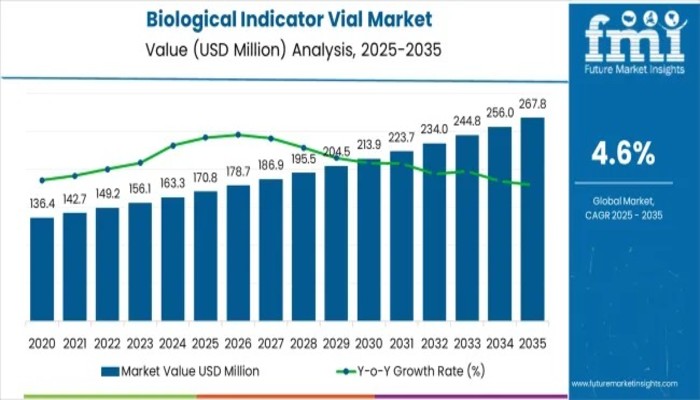
The global Biological Indicator Vial Market is entering a transformative decade—one defined by accelerated sterilization validation needs, tighter regulatory oversight, and the rapid emergence of next-generation biological monitoring technologies. Valued at USD 170.8 million in 2025, the market is forecast to reach USD 267.8 million by 2035, expanding at a 4.6% CAGR as industries strengthen contamination control, automate quality assurance, and adopt rapid-readout validation platforms at unprecedented scale.
A Decade of Transformation: Growth Outlook (2025–2035)
Over the next ten years, the market will add USD 97 million in new value, reshaping sterilization workflows across pharmaceuticals, food & beverages, medical devices, and laboratory quality assurance.
Subscribe for Year-Round Insights → Stay ahead with quarterly and annual data updates – https://www.futuremarketinsights.com/reports/sample/rep-gb-6240
2025–2030: The Acceleration Phase
The market is projected to grow from USD 170.8 million to USD 213.9 million, contributing 44% of total decade growth.
This period will see:
- Widespread adoption of rapid-readout biological indicators
- Rising regulatory pressure from FDA, ISO 11138, USP, and global GMP authorities
- Mass market acceptance of automated incubation systems and digitalized documentation
- Enhanced spore technology and quick-turnaround validation cycles becoming standard
2030–2035: The Optimization Phase
The second half of the forecast period pushes growth to USD 267.8 million, accounting for 56% of new revenue and marking the commercialization of:
- Self-contained biological indicators with integrated media
- Fully automated incubation platforms
- Cloud-connected reporting, audit trails, and electronic batch records
- High-volume deployment in pharmaceutical and food safety applications
Market Drivers and Structural Shifts
Key Growth Catalysts
- Regulatory stringency (FDA, ISO, pharmacopeial standards) requiring biological verification
- Food safety modernization (FSMA, HACCP) pushing validation in canning, retort, and aseptic lines
- Expansion of sterile manufacturing across biologics, injectables, and medical device packaging
- Growing demand for rapid-readout technologies with sub-24-hour results
Restraints
- Longer incubation cycles delaying batch release
- Budget limitations in emerging markets
- Need for specialized expertise in validation documentation
Pervasive Trends
- Fluorescence-based rapid indicators
- Self-contained vial formats reducing error risk
- Digital monitoring platforms with cloud connectivity
- Sustainability-focused product designs
Segmental Spotlight
By Sterilization Type
- Steam Sterilization leads with 57% share, driven by autoclave compatibility and strong regulatory acceptance.
- Ethylene Oxide Sterilization accounts for 43%, preferred for temperature-sensitive medical devices.
By Incubation Time
- 24–32 hours segment leads with 45% market share, balancing speed and accuracy.
- Up to 24 hours gains momentum for rapid-readout needs.
- Longer cycles (32–48 hours and >48 hours) sustain demand for traditional validation protocols.
By End Use
- Food & Beverages dominate with 52% share, propelled by tightening global food safety regulations.
- Pharmaceuticals hold 28%, supported by sterile production growth.
- Cosmetics capture 20% through rising contamination prevention standards.
Regional & Country-Level Outlook
High-Growth Markets
- China (6.2% CAGR) – Pharmaceutical capacity expansion, food safety modernization, and strong GMP enforcement
- India (5.8% CAGR) – Contract manufacturing surge, export-focused pharma, and affordable validation solutions
- South Korea (5.4% CAGR) – Biosimilar growth and K-FDA-driven aseptic validation requirements
Established Markets
- Germany (5.3% CAGR) – EU GMP leadership and advanced sterile manufacturing
- United States (4.4% CAGR) – FDA compliance culture and biologics manufacturing dominance
- United Kingdom (3.9% CAGR) – Strong biotech footprint and MHRA-regulated validation rigor
- Japan (3.5% CAGR) – Premium quality standards and high validation documentation requirements
Europe Market Overview
Europe will advance from USD 59.6 million in 2025 to USD 96.8 million by 2035, led by:
- Germany (36.2% share)
- United Kingdom (24.8%)
- France (18.4%)
- Italy (12.3%)
- Spain (8.3%)
Growing adoption in the Nordics and Eastern Europe supports additional expansion.
Competitive Landscape
The market is moderately consolidated, with the top 5 players controlling 60–65% revenue.
Key companies include:
VWR Corporation, STERIS plc., Mesa Labs, 3M Company, Siltex Australia
Where Competition Intensifies
- Rapid-readout systems
- Self-contained indicators
- Automated incubation & digital reporting
- Regulatory compliance documentation
- Validation service packages
Emerging Opportunities
- Fluorescent rapid indicators
- Sustainable vial materials
- Subscription-based digital monitoring services
- Integrated sterilization validation ecosystems (indicator + incubator + documentation)
Why FMI: https://www.futuremarketinsights.com/why-fmi
About Future Market Insights (FMI)
Future Market Insights, Inc. (FMI) is an ESOMAR-certified, ISO 9001:2015 market research and consulting organization, trusted by Fortune 500 clients and global enterprises. With operations in the U.S., UK, India, and Dubai, FMI provides data-backed insights and strategic intelligence across 30+ industries and 1200 markets worldwide.
Contact Us:
Future Market Insights Inc.
Christiana Corporate, 200 Continental Drive,
Suite 401, Newark, Delaware – 19713, USA
T: +1-347-918-3531
For Sales Enquiries: sales@futuremarketinsights.com
Website: https://www.futuremarketinsights.com
LinkedIn| Twitter| Blogs | YouTube