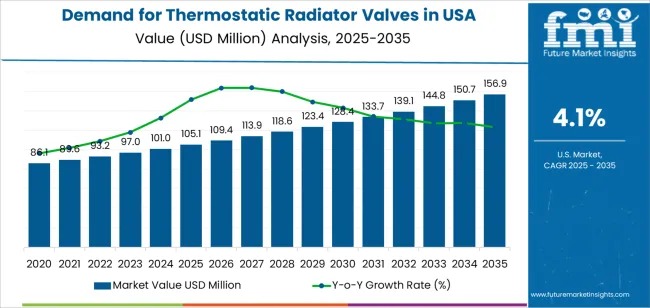
The Demand for Thermostatic Radiator Valves in the USA is expected to grow from USD 105.1 million in 2025 to USD 156.9 million by 2035, representing a CAGR of 4.1%. Thermostatic radiator valves (TRVs) are vital for controlling radiator temperature by regulating hot water flow, enhancing comfort, and improving energy efficiency in both residential and commercial settings.
Government energy-efficiency mandates and the adoption of sustainable building practices are fueling TRV growth in both new construction and retrofit projects. As more homeowners and businesses prioritize energy conservation and seek smart heating solutions, demand for TRVs continues to rise. The integration of smart thermostats and IoT-enabled heating systems is further strengthening market momentum, enabling remote control and automation of heating schedules.
Subscribe for Year-Round Insights → Stay ahead with quarterly and annual data updates: https://www.futuremarketinsights.com/reports/sample/rep-gb-28661
Market Dynamics Driving Thermostatic Radiator Valve Adoption
The U.S. TRV market is primarily driven by the need for energy-efficient heating solutions, smart home integration, and the modernization of older HVAC systems. Electric operated TRVs dominate with a 58% share, favored for their precision, automation, and compatibility with smart home systems. Offline distribution channels, including hardware stores and plumbing suppliers, remain the largest avenue for TRV sales, accounting for 68% of the market, due to the professional installation requirements and consumer preference for in-person purchase and support.
The market growth is expected in two phases: 2025–2030, where steady adoption will push market value to USD 128.4 million, and 2030–2035, where stronger uptake of smart heating technologies will expand market value to USD 156.9 million. The latter phase is expected to contribute 56.6% of total growth, highlighting the increasing adoption of integrated heating systems and home automation.
Regional Insights: Growth Patterns Across the USA
- West: Leading the market with a CAGR of 4.7%, driven by stringent energy-efficiency regulations and strong smart home adoption in states like California.
- South: Exhibits a CAGR of 4.2%, fueled by growing residential and commercial construction, energy-conscious consumers, and new HVAC installations.
- Northeast: With a CAGR of 3.8%, colder winters and older building stock drive steady TRV adoption.
- Midwest: Moderate CAGR of 3.3%, as traditional heating systems remain prevalent, yet growing awareness of energy efficiency supports TRV uptake.
The West’s strong market position is attributed to both climate variability and regulatory support for energy-efficient heating systems, whereas the South is gaining traction through new builds and eco-friendly construction trends. The Northeast and Midwest are steadily adopting TRVs due to renovation projects and increasing smart home integration.
Key Players and Competitive Landscape
Major players in the U.S. TRV market include:
- Danfoss A/S
- Honeywell International Inc.
- Schneider Electric SE
- IMI Hydronic Engineering
- Siemens AG
These companies focus on product innovation, smart connectivity, and energy-efficient features. Smart TRVs compatible with Wi-Fi, building management systems, and smart thermostats offer remote temperature control, zone management, and operational cost reduction, meeting both regulatory requirements and consumer expectations. Offline channels dominate, supported by a robust network of installers and HVAC professionals, while online sales continue to grow as consumers adopt e-commerce solutions for home improvement.
Trends Shaping Market Growth
Emerging trends include:
- Integration of TRVs with smart home platforms and IoT systems.
- Expansion of retrofit-friendly TRVs to modernize older heating systems.
- Focus on energy-saving certifications and green building compliance.
- Increasing adoption in multifamily housing, hospitality, and commercial projects.
While challenges such as upfront costs and competition from alternative heating controls exist, the overarching market drivers—including energy efficiency mandates and smart home adoption—support a positive growth trajectory.
Get data that aligns with your strategic priorities — ask for report customization today: https://www.futuremarketinsights.com/customization-available/rep-gb-28661
Related Reports:
Gasoline Generator Market- https://www.futuremarketinsights.com/reports/gasoline-generator-market
In-Chassis Cooling Market- https://www.futuremarketinsights.com/reports/in-chassis-cooling-market
Palletizing Machines Market- https://www.futuremarketinsights.com/reports/palletizing-machines-market
Have a specific Requirements and Need Assistant on Report Pricing or Limited Budget please contact us – sales@futuremarketinsights.com
About Future Market Insights (FMI)
Future Market Insights, Inc. (FMI) is an ESOMAR-certified, ISO 9001:2015 market research and consulting organization, trusted by Fortune 500 clients and global enterprises. With operations in the U.S., UK, India, and Dubai, FMI provides data-backed insights and strategic intelligence across 30+ industries and 1200 markets worldwide.
Contact Us:
Future Market Insights Inc.
Christiana Corporate, 200 Continental Drive,
Suite 401, Newark, Delaware – 19713, USA
T: +1-347-918-3531
Why FMI: https://www.futuremarketinsights.com/why-fmi
For Sales Enquiries: sales@futuremarketinsights.com
Website: https://www.futuremarketinsights.com
LinkedIn| Twitter| Blogs | YouTube