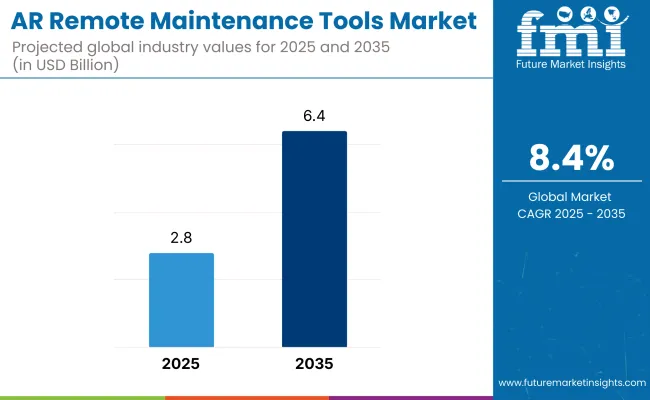
The augmented-reality (AR) remote maintenance tools market— once niche and specialized — is now accelerating toward broad adoption worldwide. According to the latest comprehensive analysis, the global AR remote maintenance tools market is set to more than double over the next decade. From a base value of US $2.8 billion in 2025, the market is projected to reach approximately US $6.4 billion by 2035, implying a robust compound annual growth rate (CAGR) of 8.4%.
This transformation reflects a deeper industrial shift: manufacturers and service providers — both long-established players and ambitious newcomers — are embracing digital technologies to streamline operations, cut downtime, and scale maintenance efforts efficiently.
A Booming Market Driven by Real Needs
At the heart of this surge is a growing demand for real-time technical support across sectors such as manufacturing, energy, automotive, aerospace, pharmaceuticals, and packaging. Traditional maintenance methods often require expert technicians to travel onsite — a process that is time-consuming, costly, and frequently disruptive to operations. AR remote maintenance tools eliminate much of that burden, enabling on-site personnel to receive live guidance from experts anywhere in the world through immersive AR overlays, remote diagnostics, and IoT-enabled data integration.
These solutions deliver hands-free, step-by-step instructions, 3D overlays, and remote annotations, dramatically improving repair accuracy, minimizing costly downtime, and accelerating technician productivity. In effect, AR maintenance tools translate complex machinery schematics and maintenance manuals into intuitive, visual, real-time workflows — accessible even via smart glasses or wearable AR devices.
Smart Glasses, Cloud Integration, and Real-Time Video: What’s Leading Today
Among the various AR device categories, smart glasses stand out — projected to hold roughly 41.7% of market share in 2025. Their hands-free design, real-time 3D overlay capability, and integration with enterprise systems make them ideal for field maintenance, especially in complex industrial environments.
Functionality-wise, real-time video support remains dominant, expected to account for nearly 38% of usage in 2025. This enables live communication and interactive troubleshooting between on-site technicians and remote specialists — cutting down repair cycles substantially.
Meanwhile, on the infrastructure side, cloud-based deployment is projected to lead (approximately 62.5% share in 2025). Cloud platforms allow organizations to scale AR maintenance across multiple sites, synchronize data seamlessly, update software continuously, and deliver predictive maintenance services — all without heavy upfront on-premise infrastructure.
Applications of these tools already span packaging line troubleshooting, machine setup, remote operator training, and general industrial equipment maintenance, with industries like food packaging, pharmaceuticals, automotive, and heavy manufacturing at the forefront of adoption.
Where Legacy Strength Meets New-Age Disruptors — Diverse Players Fuel Growth
What makes this market especially dynamic is the blend of established technology vendors and fresh, agile entrants — all contributing to innovation and competitiveness.
Veteran industry leaders such as PTC, Eon Reality, ZOHO, CareAR, VSight, Mitsubishi Electric – M’s BRIDGE™, LG CNS, ABB, Taqtile and Acty continue to invest heavily in AR visualization, enterprise-grade deployment, and integration with asset management systems. Their offering typically includes advanced AR platforms, secure remote collaboration, and multi-device compatibility — making them the backbone of large-scale industrial maintenance across many sectors.
At the same time, newer entrants — identified in the market intelligence as challengers — are making noise. Firms such as Librestream, RE’FLEKT and XMReality are gaining traction by offering modular, flexible AR deployments tailored to niche or industry-specific needs. These companies often emphasize enhanced cybersecurity, customizable AR content libraries (e.g. for aerospace, energy, or advanced manufacturing), and lighter, more accessible AR deployments — opening the door for smaller enterprises or mid-sized firms to adopt this technology without large capital expenditure.
This combination of entrenched players and agile newcomers is helping expand the market’s reach — beyond big conglomerates to mid-tier manufacturers, SMEs, and companies in emerging economies where industrial growth and digital transformation are rising rapidly.
The Road Ahead — What to Watch
As the market evolves, several trends are likely to shape its trajectory:
-
Integration with AI and IoT: AR maintenance tools will increasingly incorporate AI-driven diagnostics, predictive maintenance based on IoT sensor data, and cloud-based analytics. This helps anticipate failures before they occur, schedule preventive maintenance, and optimize lifecycle costs.
-
Wearable AR + Edge Computing: Lighter, more ergonomic AR wearables, combined with edge-AI for instant fault detection, will make remote maintenance more practical even on mobile sites or locations with limited infrastructure.
-
Global Expansion — Emerging Markets: Regions such as Asia-Pacific (with countries like India, China, South Korea) — where industrial automation, infrastructure growth, and workforce upskilling are strong — are projected to see rapid uptake of AR maintenance tools. This aligns with global efforts toward Industry 4.0, digital transformation, and remote support capabilities.
-
Accessibility for Mid-sized Firms & SMEs: Modular AR solutions and subscription-based deployment models from newer entrants will lower barriers to entry, enabling smaller manufacturers and service providers to leverage AR-driven maintenance without huge upfront costs.
-
Sustainability and Cost Efficiency: Reduction in travel, faster maintenance cycles, and fewer operational delays contribute to lower environmental footprint and better asset utilization — making AR solutions not just a cost-saver, but a green and future-oriented investment.
Conclusion — A Leap Forward for Industrial Maintenance
The coming decade is shaping up to be transformative for industrial maintenance worldwide. AR remote maintenance tools are no longer futuristic concepts; they are fast becoming essential infrastructure for manufacturing, energy, aerospace, automotive, and many other sectors — enabling teams to operate smarter, faster, and more collaboratively than ever before.
With a strong mix of legacy providers and nimble innovators, and with powerful trends like AI, IoT, and cloud computing converging, the market is poised not only for growth — but for a revolution in how machinery is maintained, repaired, and operated. For companies ready to embrace this change, the opportunity is enormous.
Whether you’re an established industrial conglomerate or a growing mid-sized enterprise, now is the moment to explore how AR remote maintenance can transform your operations, reduce downtime, and position you for the next wave of industrial innovation.