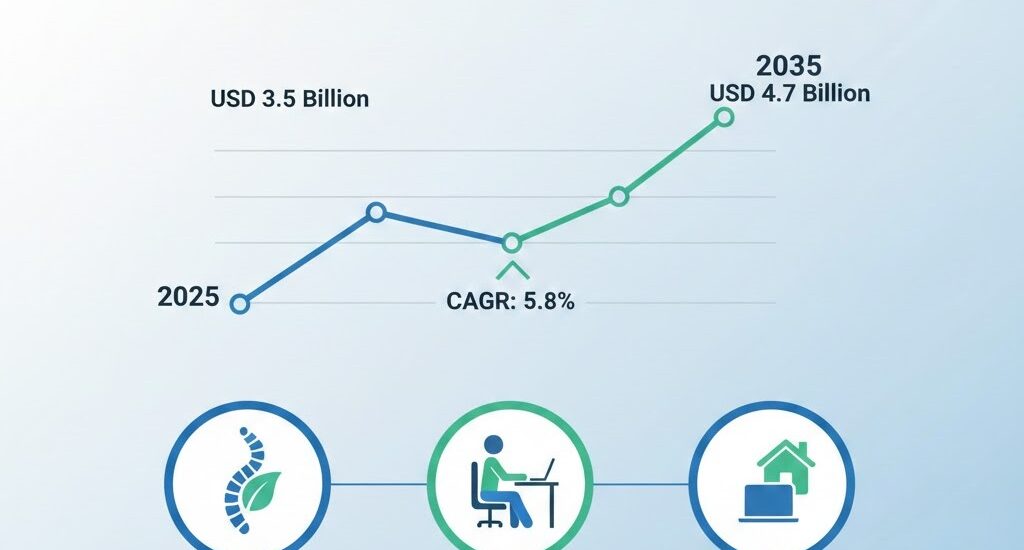
The global office seat cushion market is set for steady expansion from USD 3.5 billion in 2025 to USD 4.7 billion by 2035, reflecting a CAGR of 5.8%. The surge is driven by rising awareness of spinal health, growth of hybrid work environments, and increasing demand for ergonomic seating solutions across corporate and home-office setups.
With long sitting hours now a concern shared by professionals worldwide, both established companies and new entrants are investing aggressively in high-performance, posture-correcting cushions. The landscape is quickly shifting toward smart, sustainable, and customizable office seating products.
Subscribe for Year-Round Insights → Stay ahead with quarterly and annual data updates – https://www.futuremarketinsights.com/reports/sample/rep-gb-12030
Shifting Consumer Needs Fuel Market Adoption
Demand for office seat cushions continues to grow as the workforce becomes more sedentary, increasing the need for pressure-relief seating made from memory foam, gel-infused components, and orthopedic materials. Remote workers, freelancers, students, and hybrid employees now expect cushions that relieve back pain, offer temperature regulation, and promote proper spinal alignment.
However, market players face challenges from low-cost, low-quality substitutes, making innovation an essential survival strategy. Premium manufacturers are responding with breathable fabrics, AI-assisted posture tracking, and eco-friendly materials tailored to user needs.
Emerging Trends: Smart Technology and Eco-Friendly Materials
From 2025 to 2035, the office seat cushion industry will enter a transformative phase shaped by smart technology and sustainability:
- AI-backed posture correction cushions
- Temperature-regulated and cooling-gel designs
- Adaptive firmness levels for personalized support
- Plant-based memory foam and recycled textile covers
- Portable, lightweight models for hybrid workers
These innovations align with rising corporate wellness initiatives and tightening safety regulations on cushion materials.
Market Evolution: 2020–2024 vs. 2025–2035
The pandemic years saw a demand boom for ergonomic seating accessories, with leaders like Purple, Tempur-Pedic, and Everlasting Comfort strengthening their portfolios with memory foam and gel-based cushions.
During 2025–2035, the market will move further into:
- Pressure-sensing and AI-enabled seating solutions
- Thermotherapy and real-time spinal feedback
- Stricter chemical-free material standards
- Compact, travel-friendly designs for hybrid offices
Brands that invest in technology, eco-friendly materials, and D2C distribution channels will gain a competitive edge.
Risk Landscape and Growth Challenges
Key risks include:
- Market saturation leading to price competition
- Volatile raw material costs (memory foam, gel, fabrics)
- Supply chain uncertainties
- Regulatory compliance in toxicity and fire-safety standards
To thrive, manufacturers must focus on product differentiation, stronger R&D, cost control, and green manufacturing.
Country-Level Demand Insights (2025–2035)
- USA (6.8% CAGR): High adoption of orthopedic and smart seat cushions; strong D2C expansion.
- UK (6.5% CAGR): Demand led by eco-friendly ergonomic pillows and corporate wellness programs.
- France (6.3% CAGR): Growth driven by demand for hypoallergenic, antibacterial cushions.
- Germany (6.7% CAGR): Preference for clinically approved, customizable orthopedic cushions.
- Italy (6.2% CAGR): Lightweight, stylish, temperature-controlled cushions gain traction.
- South Korea (7.0% CAGR): Rising demand for tech-driven posture and heating cushions.
- Japan (6.4% CAGR): Market favors minimalist, anti-sweat, portable cushions.
- China (7.3% CAGR): High-tech innovations, smart massaging cushions dominate.
- Australia (6.6% CAGR): Increased demand for breathable cushions fit for warmer climates.
- New Zealand (6.1% CAGR): Rise in eco-friendly, biodegradable seat cushion materials.
Segment-Wise Market Analysis
By Product Type
- Microfiber Leather – 38.5% share
Leading due to durability, breathability, and appeal in premium office furniture brands such as Herman Miller and Steelcase. - Artificial Leather – 27.2% share
Popular among budget-focused corporate buyers and home-office users; widely used by IKEA, Humanscale, AmazonBasics.
By Seat Type
- Bucket Seat Cushions – 63.5%
Preferred for their lumbar support and posture-correcting design; strong demand from gaming and executive seating. - Bench Seat Cushions – 36.5%
Popular in collaborative spaces, waiting areas, and conference rooms for uniform support.
By Modality
- Portable seat cushions
Growing rapidly among remote workers and commuters. - Fixed cushions
Common in conference halls and commercial office infrastructure.
By Distribution Channel
- Original manufacturers
- Retail stores
- Online marketplaces (fastest-growing)
By Application
- Home-based offices (major driver post-pandemic)
- Commercial establishments, including coworking spaces, call centers, and corporate campuses
Competitive Outlook: Established vs. Emerging Players
The industry is witnessing healthy competition as traditional leaders and new manufacturers expand through technology upgrades, sustainability, and D2C branding.
Estimated Market Share
- Purple Innovation: 18–22%
- Everlasting Comfort: 14–18%
- ComfiLife: 10–14%
- Tempur-Pedic: 8–12%
- Others (combined): 40–50%
Key Company Developments
- Purple Innovation: Hyper-elastic polymer grid technology boosting airflow and durability.
- Everlasting Comfort: Focus on affordable orthopedic cushions with premium memory foam.
- ComfiLife: Leading provider of gel-infused, lightweight, portable cushion designs.
- Tempur-Pedic: Luxury memory foam cushions gaining popularity in executive seating.
- Other innovators: Xtreme Comforts, SOFTaCARE, FORTEM, Aylio, and emerging Asian manufacturers entering with eco-friendly and smart-tech models.
Both established brands and newcomers are investing in AI posture systems, cooling technologies, sustainable foam polymers, and custom-fit ergonomic designs to strengthen their market presence.
Key Segments of the Office Seat Cushion Market (Pointwise)
- Product Type:
- Microfiber Leather
- Artificial Leather
- Chemical Fibre
- Gel-Based Materials
- Seat Type:
- Bucket Seat Cushions
- Bench Seat Cushions
- Modality:
- Portable
- Fixed
- Distribution Channel:
- OEMs
- Retail Stores
- Online Sales
- Application:
- Home-Based Offices
- Commercial Establishments
- Region:
- North America
- Latin America
- Western Europe
- Eastern Europe
- Asia Pacific
- China
- Japan
- Middle East & Africa
Why FMI: https://www.futuremarketinsights.com/why-fmi
About Future Market Insights (FMI)
Future Market Insights, Inc. (FMI) is an ESOMAR-certified, ISO 9001:2015 market research and consulting organization, trusted by Fortune 500 clients and global enterprises. With operations in the U.S., UK, India, and Dubai, FMI provides data-backed insights and strategic intelligence across 30+ industries and 1200 markets worldwide.
Contact Us:
Future Market Insights Inc.
Christiana Corporate, 200 Continental Drive,
Suite 401, Newark, Delaware – 19713, USA
T: +1-347-918-3531
For Sales Enquiries: sales@futuremarketinsights.com
Website: https://www.futuremarketinsights.com
LinkedIn| Twitter| Blogs | YouTube