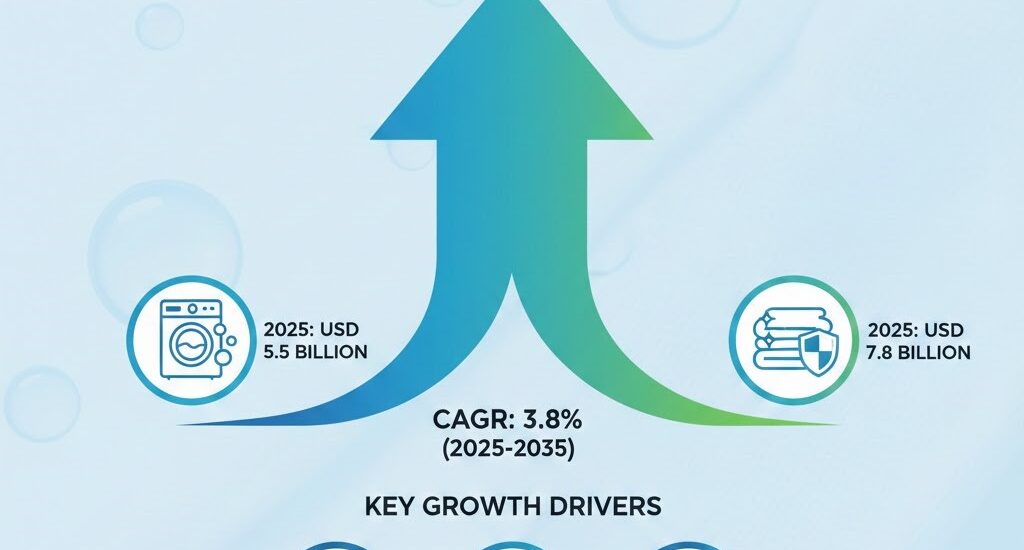
The global laundry sanitizers market is expected to witness remarkable expansion from USD 5.5 billion in 2025 to USD 7.8 billion by 2035, registering a CAGR of 3.8%. As consumers increasingly prioritize hygiene, germ protection, sustainability, and fabric care, the market is shifting rapidly toward high-performance antibacterial, antiviral, and eco-friendly laundry sanitizing solutions.
From major international brands like Reckitt Benckiser, Procter & Gamble, Unilever, and Henkel to fast-developing regional players in Asia-Pacific, the industry is witnessing both product innovation and competitive expansion. The post-pandemic hygiene-conscious culture, combined with technological advancements like AI-driven formulations, smart laundry solutions, and biodegradable fabric sanitizers, is expected to redefine the market landscape over the next decade.
Subscribe for Year-Round Insights → Stay ahead with quarterly and annual data updates – https://www.futuremarketinsights.com/reports/sample/rep-gb-12006
Market Overview: 2025–2035 Outlook
Growing concerns about bacterial, viral, and allergen exposure—especially in households with children, elderly individuals, or pets—are fueling the adoption of laundry sanitizers worldwide. Consumers are actively seeking non-toxic, dermatologically tested, and plant-based sanitizing products that promise 99.9% germ elimination without damaging fabrics.
Key Market Metrics
- Industry Size (2025E): USD 5.5 billion
- Forecasted Value (2035F): USD 7.8 billion
- CAGR (2025–2035): 3.8%
Long-lasting antibacterial technologies, convenience-driven formats, sustainable packaging, and fragrance-free variants are becoming mainstream across global markets.
Regional Market Outlook
North America
North America remains one of the most mature and high-value markets, driven by:
- Heightened household hygiene awareness
- Strong adoption among families with children and pet owners
- Increasing demand for eco-conscious, plant-based sanitizers
The USA and Canada are experiencing growing sales of biodegradable, hypoallergenic sanitizers and innovative deodorizing and antibacterial formulas designed for sensitive-skin users.
Europe
Europe continues to lead in sustainability-driven innovations, with consumers preferring:
- Fragrance-free formulations
- Bio-based antibacterial agents
- Recyclable and eco-certified packaging
Strict EU chemical regulations further push brands to develop non-toxic and allergy-safe solutions.
Asia-Pacific
Asia-Pacific is expected to record the fastest growth due to:
- Rising hygiene awareness
- Increasing disposable incomes
- Expanding e-commerce penetration
China, India, and Japan are demanding multifunctional sanitizers featuring odor removal, softness enhancers, and antibacterial performance in a single product. Hospitals, hotels, and industrial laundries are also adopting sanitizers to meet hygiene compliance.
Challenges and Opportunities
Key Challenge
Stringent regulations on chemical disinfectants—particularly quaternary ammonium compounds, chlorine-based agents, and harsh preservatives—are prompting manufacturers to reformulate products with:
- Biodegradable ingredients
- Low-allergen preservatives
- Non-toxic plant-based antibacterial agents
Meeting global safety standards is crucial for expanding into regulated markets.
Key Opportunity
Brands can gain competitive advantages by offering:
- Baby-safe and sensitive-skin sanitizers
- Sportwear-specific and activewear antibacterial solutions
- AI-enhanced formulations and capsule-based sanitizers
- Waterless, biodegradable sheets and tablets
Demand for niche and premium products is rising rapidly as consumers seek personalized garment care.
Country-Wise Market Highlights
United States
- Strong demand for antibacterial, EPA-compliant, hypoallergenic sanitizers
- High per capita spending: USD 22.50
- Robust online and offline distribution through Walmart, Amazon, and Costco
Canada
- Preference for plant-based and biodegradable disinfectants
- High sanitation awareness due to colder climate and indoor lifestyles
- Per capita spending: USD 18.30
United Kingdom
- Consumers prioritize dermatologically tested, fragrance-free sanitizers
- Strong retail presence through Tesco and Sainsbury’s
- Per capita spending: USD 16.20
Germany
- Strong orientation toward eco-friendly and hypoallergenic formulations
- High-quality, research-backed household products dominate
- Per capita spending: USD 17.80
Japan
- High demand for multifunctional and odor-eliminating sanitizers
- Popular innovations include green tea, bamboo extract, and silver-ion antibacterials
- Per capita spending: USD 20.40
Market Survey Insights
A global survey of 300 consumers revealed:
- 81% require sanitizers that kill 99.9% of germs
- 63% prefer hypoallergenic and fragrance-free options
- 69% shop online for convenience and competitive pricing
- 76% trust established brands, but 45% of Asians are open to new, plant-based local brands
Eco-friendly, efficient, and scientifically verified sanitizers are driving overall adoption.
Competitive Landscape & Key Players
Market Share, 2024
- Reckitt Benckiser (Lysol): 20–25%
- Procter & Gamble (Dettol, Tide): 15–20%
- Unilever (Persil, Comfort): 12–16%
- Henkel (Persil Hygiene, Perwoll): 8–12%
- Others (Seventh Generation, ECOS, Clorox, Dropps): 35–45%
Innovation Trends Among Established & Emerging Manufacturers
- Expansion of plant-based, biodegradable sanitizers
- Launch of AI-optimized and fabric-specific disinfectants
- Development of waterless and capsule-based formats
- Growth of eco-friendly packaging and refill systems
- Entry of regional startups focusing on herbal, enzyme-based solutions
Both legacy brands and new manufacturers are strategically innovating to capture growing global demand.
Key Market Segments (Pointwise)
By Product Type
- Liquid Laundry Sanitizers
- Powder Sanitizers
- Spray/Spritz Sanitizers
- Waterless Sheets/Tablets
- Others
By Ingredient Type
- Chemical-Based
- Plant-Based
- Hypoallergenic/Fragrance-Free
By Sales Channel
- Supermarkets & Hypermarkets
- Convenience Stores
- Online Retail & E-Commerce
- Departmental Stores
- Direct-to-Consumer (DTC)
By End-User
- Residential
- Commercial (Hotels, Hospitals, Laundry Services)
- Industrial
By Region
- North America
- Europe
- Asia-Pacific
- Latin America
- Middle East & Africa
Conclusion
The laundry sanitizers market is entering a dynamic growth phase driven by health awareness, sustainability demands, and technological advancements. Companies—both established global leaders and innovative new entrants—are leveraging eco-friendly ingredients, AI-enabled laundry solutions, and targeted fabric-specific sanitizers to meet evolving consumer needs.
Manufacturers who continue to invest in green chemistry, smart laundry technologies, and dermatologically safe fabric disinfecting solutions are poised to gain significant market share from 2025 to 2035.
Why FMI: https://www.futuremarketinsights.com/why-fmi
About Future Market Insights (FMI)
Future Market Insights, Inc. (FMI) is an ESOMAR-certified, ISO 9001:2015 market research and consulting organization, trusted by Fortune 500 clients and global enterprises. With operations in the U.S., UK, India, and Dubai, FMI provides data-backed insights and strategic intelligence across 30+ industries and 1200 markets worldwide.
Contact Us:
Future Market Insights Inc.
Christiana Corporate, 200 Continental Drive,
Suite 401, Newark, Delaware – 19713, USA
T: +1-347-918-3531
For Sales Enquiries: sales@futuremarketinsights.com
Website: https://www.futuremarketinsights.com
LinkedIn| Twitter| Blogs | YouTube