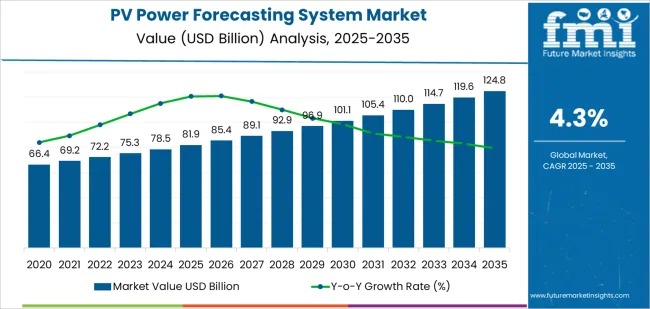
The PV Power Forecasting System Market is projected to grow from USD 81.9 billion in 2025 to USD 124.9 billion by 2035, registering a CAGR of 4.3%. Growth is propelled by expanding solar capacity, rising grid-integration requirements, and adoption of high-precision forecasting platforms that optimize scheduling accuracy and reduce balancing costs. Cumulative annual gains indicate a steady, layered growth pattern as utilities, independent power producers, and solar asset owners increasingly deploy forecasting solutions.
Subscribe for Year-Round Insights → Stay ahead with quarterly and annual data updates: https://www.futuremarketinsights.com/reports/sample/rep-gb-28635
Market Forecast and Growth Drivers
- 2025–2030: Market expands from USD 81.9B to USD 101.1B, adding USD 19.2B. Volume growth accounts for 65–70%, driven by rising utility-scale PV installations. Price growth contributes 30–35%, supported by advanced machine-learning models and high-resolution weather mapping technologies.
- 2030–2035: Market grows from USD 101.1B to USD 124.9B, adding USD 23.8B. Volume contributes 55–60%, price growth 40–45%, reflecting adoption of next-generation forecasting engines with real-time analytics, cloud-motion vector modeling, and enhanced grid integration.
Key Market Trends and Technology Drivers
- Increasing reliance on forecasting for accurate short-term and day-ahead solar generation predictions.
- Integration of satellite imagery, sky cameras, numerical weather models, and plant telemetry to support dispatch scheduling and reduce curtailment risks.
- Advances in AI, machine learning, and high-resolution weather datasets improving forecasting accuracy for large-scale solar farms and complex terrains.
- Growth in hybrid PV-battery and multi-asset renewable plants driving demand for sophisticated, multi-asset forecasting solutions.
Market Segmentation
By Type:
- Hardware (43% market share, 2025): Includes radiation sensors, sky imagers, temperature probes, and wind-speed instruments. Essential for collecting real-time data and reducing forecasting errors.
- Software: AI-driven modeling, cloud-based analytics, and probabilistic forecast outputs for grid integration.
By Application:
- Centralized PV Power Stations (57% market share, 2025): Dominant due to utility-scale installations requiring structured forecasting for grid balancing and market participation.
- Distributed PV Power Stations: Increasing adoption with rising rooftop and microgrid solar deployments.
By Region:
- China: CAGR 5.8%, driven by rapid solar expansion and AI-based forecasting adoption.
- India: CAGR 5.4%, supported by grid modernization and utility-scale PV growth.
- Germany: CAGR 4.9%, mature market with high-resolution forecasting adoption.
- Brazil: CAGR 4.5%, expanding solar capacity requiring accurate dispatch forecasts.
- USA: CAGR 4.1%, advanced analytics and grid stability solutions.
- UK: CAGR 3.7%, focused on distributed generation and rooftop solar.
- Japan: CAGR 3.2%, emphasis on precise, short-term solar predictions.
Competitive Landscape
The PV power forecasting system market shows moderate concentration, with leading companies providing grid-integration, dispatch-planning, and asset-monitoring solutions:
- Vaisala: Advanced irradiance modeling combining satellite data, numerical weather predictions, and site calibration.
- Beijing Millennium Software & XNY Predict: Localized forecasting solutions for utility-scale PV plants in China.
- State Power Rixin Tech.: Regional grid operator-focused forecasts and curtailment management.
- emsys: Real-time forecasting for mixed renewable portfolios integrated with SCADA and trading platforms.
Market competition is driven by forecast accuracy, model reliability, integration with existing grid infrastructure, and long-term operational support.
Market Challenges
- Quality and availability of local weather and irradiance data in emerging markets.
- High costs of robust forecasting systems, limiting adoption among smaller PV operations.
- Uncertainty in model accuracy for volatile weather conditions.
Conclusion
The PV power forecasting system market is on a consistent growth trajectory, driven by increasing solar deployments, grid integration mandates, and technological advancements in AI-driven forecasting platforms. Utilities, solar developers, and grid operators are increasingly leveraging these solutions to improve scheduling accuracy, optimize dispatch, and mitigate variability risks across centralized and distributed PV assets.
Get data that aligns with your strategic priorities — ask for report customization today: https://www.futuremarketinsights.com/customization-available/rep-gb-28635
Related Reports
Transformer Monitoring System Market- https://www.futuremarketinsights.com/reports/transformer-monitoring-system-market
Sulphur Recovery Technology Market- https://www.futuremarketinsights.com/reports/sulphur-recovery-technology-market
Marine Fuel Injection System Market- https://www.futuremarketinsights.com/reports/marine-fuel-injection-system-market
Have a specific Requirements and Need Assistant on Report Pricing or Limited Budget please contact us – sales@futuremarketinsights.com
About Future Market Insights (FMI)
Future Market Insights, Inc. (FMI) is an ESOMAR-certified, ISO 9001:2015 market research and consulting organization, trusted by Fortune 500 clients and global enterprises. With operations in the U.S., UK, India, and Dubai, FMI provides data-backed insights and strategic intelligence across 30+ industries and 1200 markets worldwide.
Contact Us:
Future Market Insights Inc.
Christiana Corporate, 200 Continental Drive,
Suite 401, Newark, Delaware – 19713, USA
T: +1-347-918-3531
Why FMI: https://www.futuremarketinsights.com/why-fmi
For Sales Enquiries: sales@futuremarketinsights.com
Website: https://www.futuremarketinsights.com
LinkedIn| Twitter| Blogs | YouTube