As demand intensifies across food, electronics, automotive, and industrial sectors, the global interleave paper market is enjoying a strong growth trajectory — and industry leaders along with ambitious new entrants are seizing the opportunity for expansion and innovation.
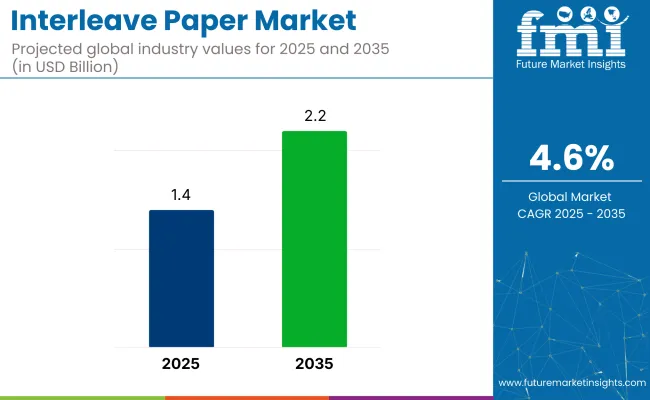
According to the latest market data, the interleave paper market is projected to grow from USD 1.4 billion in 2025 to USD 2.2 billion by 2035, at a steady compound annual growth rate (CAGR) of 4.6%. As packaging, protection, and sustainable materials continue to gain importance worldwide, interleave paper is increasingly seen as a versatile, environmentally friendlier alternative to traditional plastic or synthetic separators.
Demand Surge Across Key Sectors
Interleave paper plays a critical role in preventing abrasion, contamination, or damage during storage, shipment, or handling, making it indispensable in sectors like food processing, metal and glass manufacturing, electronics, and automotive parts. As consumer demand surges for processed and frozen foods, bakery items, and fragile electronics — along with rising e-commerce activity — the need for reliable, recyclable, and safe interleave solutions is surging.
Of particular note is the growing appetite for lightweight (< 40 GSM) interleave variants, which are ideally suited for high-speed automated lamination and wrapping systems; these lightweight variants are estimated to account for about 41% of global interleave paper demand in 2025. Meanwhile, wax-coated and waxed-paper formats — valued for moisture resistance, grease repellence, and temperature stability — dominate material consumption, representing around 44% of the market. Surface protection applications account for the largest share of demand (about 58%), while metal and glass industries together command nearly half (47%) of the total consumption.
Leaders and Newcomers: Innovation Meets Expansion
At the forefront of the market is long-established player Ahlstrom, which alone holds roughly 31% of the global share. Ahlstrom has recently introduced dual-layer wax-coated sheets targeted at chilled bakery and frozen food applications — demonstrating a commitment to both product performance and regulatory compliance for food-grade packaging.
Other established suppliers such as UPM Specialty Papers, Mondi, and Stora Enso are also updating their portfolios: UPM with temperature-resistant interleaves for baked goods, Mondi and Stora Enso expanding food-safe and barrier-grade variants to meet growing global demand.
At the same time, a wave of newer or regional manufacturers are stepping up — driven by both demand and technological innovation. Firms such as Kanemo Shoji Co., Ltd., Nagara Paper Mfg. Co., Ltd., and Hankuk Paper Co., Ltd. are scaling up production of moisture-resistant, waxed, and unbleached kraft interleaves, often collaborating directly with food processors, electronics manufacturers, and metal sheet fabricators to provide customized interleaves tailored to local needs.
These emerging players benefit from lower overheads, flexibility, and agility — enabling them to experiment with specialized coatings, eco-friendly alternatives, and format customization for regional industries. Some are even launching anti-static or anti-curl variants designed for sensitive electronics or glass applications.
Innovation, Sustainability & Customization: The Future of Interleave Paper
The interleave paper market is being reshaped by customers’ rising demand for sustainability, regulatory changes restricting plastic packaging, and the push for automation in manufacturing and packaging processes. As a result, companies are investing heavily in R&D — developing recyclable and biodegradable interleaves, coated variants that offer barrier properties, and formats that accommodate high-speed automated production lines.
Customization is becoming a differentiator: manufacturers now offer specialized interleaves for distinct end-uses — from food-safe wax-coated wraps for frozen meats and bakery goods to anti-static, precision-grade sheets for electronics and optics. This trend is opening doors for both global players and niche regional firms willing to tailor products for niche sectors such as glass, automotive sheet metal, or regional food processors.
India & Asia — Growth Hotspots
Markets in Asia, particularly India, are emerging as key growth engines. With a projected CAGR of about 4.8% through 2035, India is set to outpace many mature markets. The rise of processed food consumption, expanding electronics manufacturing hubs, and increased demand for protective packaging in automotive and metal components are major drivers.
For regional manufacturers and converters in India and neighboring countries, this translates into an attractive opportunity: local production of kraft and waxed interleaves for food, metal, and industrial use; collaborations with OEMs and packaging companies; and adoption of sustainable practices that resonate with global environmental trends.
Invitation to Stakeholders
This is an opportune moment for both established giants and new entrants to reassess their strategies, expand capacity, and invest in innovation. Established firms can continue reinforcing their leadership with high-performance, compliant products — while newcomers can carve out a niche by offering tailored, cost-effective, and eco-friendly interleave solutions designed for regional demand.
At the same time, packaging companies, contract manufacturers, and OEMs across food, electronics, metal, and automotive sectors should consider integrating interleave paper into their supply and packaging chains — not only to improve protection and compliance but also to future-proof operations against evolving regulations and sustainability demands.