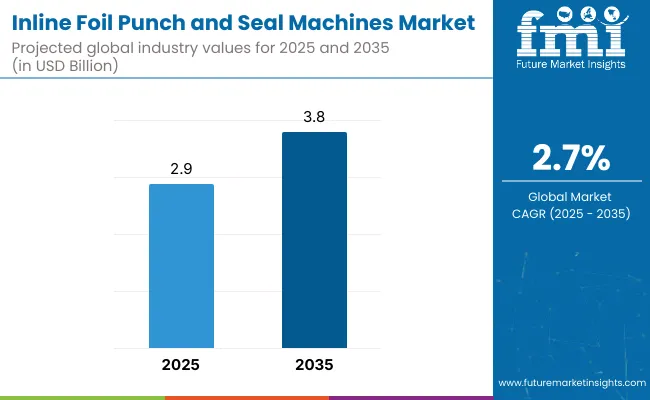
The global market for inline foil punch and seal machines is set to embark on a period of robust expansion — from a market value of USD 2.9 billion in 2025 to an estimated USD 3.8 billion by 2035, representing a 31% overall growth and a compound annual growth rate (CAGR) of 2.7%.
This growth trajectory presents a promising horizon not only for long-standing market leaders, but also for newer and nimble manufacturers looking to expand their footprint with cutting-edge technologies and region-specific solutions.
🚀 Market Momentum and Innovation Drivers
The demand surge is being driven by a growing need for high-speed, precision sealing solutions across sectors such as pharmaceuticals, FMCG, nutraceuticals, dairy, and personal care. As packaged products increasingly move toward single-serve and convenience formats — with stringent requirements for hygiene, tamper-evidence, and shelf-life — inline foil sealing has become a critical enabler for modern production lines.
Manufacturers are now favoring integrated systems that combine die-punching and sealing in a single pass, drastically reducing downtime and boosting throughput. Meanwhile, automation technologies — including servo-driven punching, PLC control, and real-time quality inspection — are gaining ground, helping production facilities ensure consistently high standards while optimizing operational efficiency.
Further fueling the growth is a shift toward digital tooling, smart sensors, and even IoT-based maintenance platforms. These advances are helping transform foil punch-and-seal machines from simple mechanical tools into intelligent, connected components of packaging lines — offering predictive maintenance, format memory for multi-SKU operations, and easier changeovers.
Market Segments Where Demand Soars
-
Rotary Punching Dominance: As of 2025, the rotary punching segment accounts for nearly half (47.2%) of the entire market. Its continuous-motion operation delivers superior throughput and precision, making it the go-to choice for high-volume pharmaceutical blister packaging lines.
-
Medium-Speed Systems in High Demand: Machines operating at 100–300 cycles per minute (medium-speed) are expected to dominate in 2025, capturing about 47.3% of the market share — a result of their balance between output, cost efficiency, and flexibility, especially for contract-packers and mid-scale operations.
-
Aluminum Foil as Preferred Substrate: Aluminum foil continues to be the substrate of choice, with 42.1% market share in 2025, due to its superior barrier properties — resistance to moisture, oxygen, UV light, and microbes — essential for industries like pharma, nutraceuticals, and dairy.
-
Pharmaceutical Sector Leading Application: The pharmaceutical industry, particularly blister-pack drug formats, remains the largest end-user segment — forecast to account for nearly half (49.2%) of the demand by 2025. Precise punching, cavity sealing, batch coding, and compliance with global regulatory norms make inline foil punch-and-seal machines indispensable for modern drug manufacturing and packaging.
Industry Leaders and Rising Challengers
The competitive landscape features a mix of established giants and agile newer players — a dynamic that’s reshaping how manufacturers approach expansion, technology adoption, and regional reach:
-
Longstanding leaders such as IMS / Imsmachines, NK Industries Limited, and Pillar Technologies, Inc. continue to command significant market share, thanks to their modular, high-speed machines, proven reliability, and compatibility with high-output form–fill–seal production lines.
-
Meanwhile, emerging and regional-focused manufacturers like For‑Bro Engineers (ForBropack), Mahalaxmi Machines, and Shree Vishvakarma Industries are gaining traction by offering compact, cost-optimized designs — ideal for mid-sized operations, regional pharma firms, dairy cooperatives, nutraceutical packers, and small to medium FMCG producers.
These newer players are increasingly seen as viable alternatives to global OEMs, particularly for companies seeking flexible, scalable, and budget-conscious inline sealing solutions in emerging markets.
Why This Growth Matters — Beyond the Numbers
This market expansion isn’t just about rising revenues. It reflects a broader transformation:
-
From one-time, hardware-centric investments to software-enabled, automated, and service-driven packaging ecosystems. Over the coming decade, a growing portion of revenue is expected to come from digital features, remote diagnostics, tool-change services, and predictive maintenance — shifting the value proposition from “buy the machine” to “buy reliable, scalable, compliant packaging infrastructure.”
-
From generic, one-size-fits-all equipment to highly customized, region-specific solutions. Compact footprint machines with flexible tooling options are making automation accessible even to smaller manufacturers and smaller-volume SKUs in countries with price-sensitive markets.
-
From simple sealing machines to mission-critical hygiene and compliance tools — especially for regulated sectors such as pharmaceuticals, nutraceuticals, dairy, and other aseptic packaging lines.
A Call to Action for Manufacturers and Investors
For established players, this is a moment to double down on innovation — embed smarter controls, expand modular product ranges, and offer after-market service models, to stay ahead as demand moves toward automation and digital traceability.
For emerging and regional manufacturers, the window has opened wide: by focusing on affordability, compact design, and compliance with regional packaging needs, there is a massive opportunity to capture market share — particularly in fast-growing economies seeking local solutions with global reliability standards.
For investors and stakeholders, the coming decade offers a unique blend of stable growth and disruptive innovation: inline foil punch and seal machines are no longer a niche — they are becoming foundational to modern manufacturing, packaging, and distribution infrastructure.