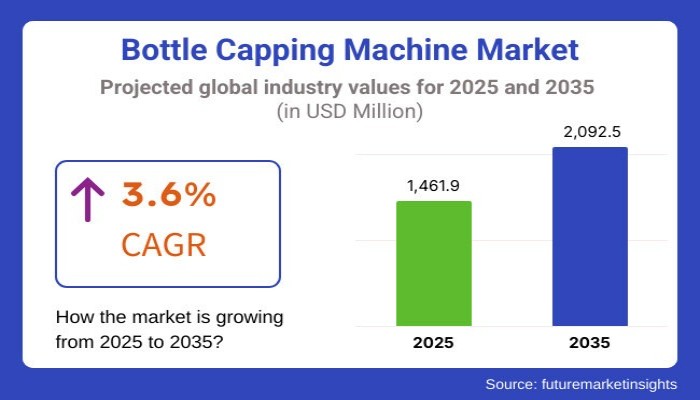
The bottle capping machine market is set for steady growth over the coming decade, with an anticipated valuation of USD 1,461.9 million in 2025, expected to rise to USD 2,092.5 million by 2035, growing at a CAGR of 3.6%. The rising adoption of automation, smart technologies, and sustainable practices across the food & beverage, pharmaceutical, cosmetics, and chemical industries is driving this expansion.
Bottle capping machines are critical in modern packaging lines, ensuring bottles are sealed tightly to maintain product integrity, prevent contamination, and comply with regulatory requirements. These machines are extensively employed across industries where high-speed, precise, and reliable sealing is essential to maintain shelf life and quality standards.
Subscribe for Year-Round Insights → Stay ahead with quarterly and annual data updates – https://www.futuremarketinsights.com/reports/sample/rep-gb-18437
Market Trends: 2020–2035
From 2020 to 2024, the market witnessed steady growth driven by increasing packaging demands and the gradual adoption of semi-automatic and automatic capping machines. Companies began focusing on reducing plastic waste, energy consumption, and labor costs. Moving into 2025–2035, the market trajectory will be defined by advanced robotics, AI-driven automation, and sustainability initiatives, supporting flexible, modular, and energy-efficient capping solutions.
Consumer Dynamics
The rise of automation and smart technologies is reshaping the market. Manufacturers are increasingly implementing AI-enabled quality control systems, IoT-based monitoring, and robotics to boost production efficiency while minimizing human intervention. Food & beverage and pharmaceutical industries, in particular, benefit from consistent, contamination-free sealing processes.
Sustainability is another driving force. Environmentally conscious consumers and regulatory pressures are encouraging the adoption of biodegradable materials, recyclable caps, and energy-efficient processes. Manufacturers are innovating to reduce waste and carbon footprint while maintaining high-performance capping efficiency.
Segment Insights
By Machine Type: Screw capping machines dominate the market, expected to grow at a CAGR of 5.2% by 2025. Available in semi-automatic and automatic variants, these machines ensure airtight sealing, safeguard product quality, and improve line efficiency. Automatic models deliver high-speed, consistent capping, whereas semi-automatic variants offer versatility for smaller production setups.
By End-use Industry: The food & beverage sector leads the adoption of bottle capping machines, with a projected CAGR of 4.2% through 2035. Growing packaged beverage consumption, ready-to-drink foods, and strict food safety regulations drive the need for efficient, automated capping solutions.
By Automation: Fully automated capping machines are gaining traction due to high-speed production capabilities, improved precision, and minimal waste. AI-driven systems further enhance efficiency, safety, and adaptability across varying bottle and cap types.
Regional Insights
- USA: Expected CAGR of 3.2%, supported by rising packaged drinks and pharmaceuticals, with automation enhancing efficiency.
- Germany: Leading European market at 5.3% CAGR, driven by precision engineering, pharmaceutical demand, and green initiatives.
- UK: Moderate growth at 2.6% CAGR, fueled by sustainable packaging and digitalization trends.
- Japan: 3.4% CAGR, led by food sector automation and robotics adoption.
- China: 5.8% CAGR, dominated by large-scale food, beverage, and pharmaceutical production with intelligent automation.
- India: Fastest-growing at 6.3% CAGR, driven by sustainable capping solutions and expanding industrialization.
Competitive Landscape
The market is highly competitive, dominated by global and regional players emphasizing automation, precision, and sustainability. Leading companies include Accutek Packaging Equipment, Closure Systems International (CSI), E-PAK Machinery, Acasi Machinery, Liquid Packaging Solutions, KWT Machine Systems, TORQ Packaging USA, Kinex Cappers, and ZALKIN AMERICAS LLC.
These players excel through innovation, such as AI-integrated torque-based systems, lightweight tamper-evident caps, and servo-driven real-time adjustments, reinforcing operational efficiency and reducing waste. Smaller competitors leverage customization and flexible solutions to serve niche segments.
Why FMI: https://www.futuremarketinsights.com/why-fmi
About Future Market Insights (FMI)
Future Market Insights, Inc. (FMI) is an ESOMAR-certified, ISO 9001:2015 market research and consulting organization, trusted by Fortune 500 clients and global enterprises. With operations in the U.S., UK, India, and Dubai, FMI provides data-backed insights and strategic intelligence across 30+ industries and 1200 markets worldwide.
Contact Us:
Future Market Insights Inc.
Christiana Corporate, 200 Continental Drive,
Suite 401, Newark, Delaware – 19713, USA
T: +1-347-918-3531
For Sales Enquiries: sales@futuremarketinsights.com
Website: https://www.futuremarketinsights.com
LinkedIn| Twitter| Blogs | YouTube