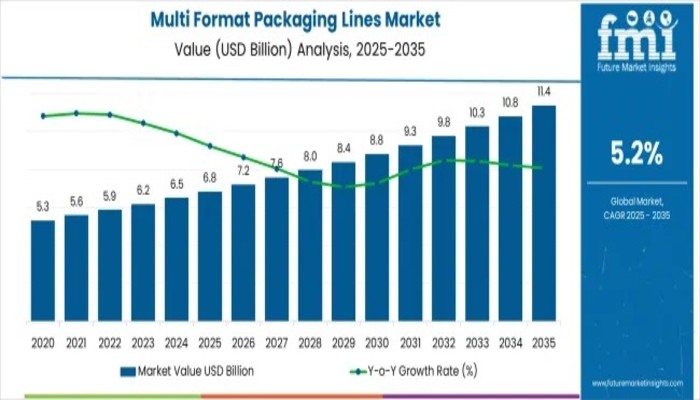
The multi-format packaging lines market is projected to grow from USD 6.8 billion in 2025 to USD 11.4 billion by 2035, registering a steady CAGR of 5.2%. Early adoption defined the years 2020–2024, when manufacturers validated the viability of flexible packaging lines, leading to annual growth between USD 5.3–6.5 billion.
From 2025–2030, broader industry adoption drives scaling and standardization, pushing the market to USD 8.8 billion. Between 2030–2035, consolidation takes shape as leading suppliers dominate installations, strategic partnerships strengthen supply chains, and procurement focuses increasingly on operational reliability and cost optimization.
As global manufacturing becomes increasingly dynamic, brands are abandoning rigid single-format packaging systems and moving toward integrated, multi-format solutions. From rapid product launches to evolving consumer expectations, the need for flexibility has never been greater.
Subscribe for Year-Round Insights → Stay ahead with quarterly and annual data updates – https://www.futuremarketinsights.com/reports/sample/rep-gb-24584
Multi-format packaging lines systems designed to handle various packaging styles, sizes, and materials with minimal changeover time are quickly becoming the backbone of modern production environments. This blog unpacks the market’s evolution, drivers of growth, emerging trends, regional dynamics, and competitive landscape shaping the sector between 2025 and 2035.
Meaning: What Are Multi-Format Packaging Lines?
Multi-format packaging lines are advanced production systems engineered to process multiple packaging formats—such as bottles, pouches, cans, cartons, tubes, and sachets—on a single line. Equipped with modular components, intelligent controls, robotics, and automated changeovers, these systems allow manufacturers to switch between product formats quickly and efficiently.
Their core value lies in:
- Enhanced flexibility
- Reduced downtime
- Optimized factory space
- Improved operational efficiency
- Adaptability to consumer-driven product variations
As product portfolios diversify and SKU counts rise, these lines help manufacturers stay competitive and agile.
Seasonal demand cycles also influence market dynamics:
- Q3–Q4 account for 35–40% of annual orders, driven by holiday production peaks.
- Q1 typically declines 10–15%, as manufacturers recalibrate inventory and refine production plans.
These cycles overlay the broader growth trend, occasionally creating USD 0.5–1 billion demand surges driven by equipment upgrades, regulatory changes, and sustainability-driven packaging transitions.
Market Overview
Key Stats (2025):
- Market Value: USD 6.8 billion
- 2035 Forecast: USD 11.4 billion
- Leading Packaging Type: Primary (52%)
- Top Format Type: Pouch (30%)
- Top Automation Level: Fully Automatic (41%)
- Key Regions: North America, Europe, Asia-Pacific
- Major Players: Krones AG, Tetra Pak, Syntegon, Sidel, IMA, Coesia
The market is supported by expanding packaged food demand, sustainability regulations, rising e-commerce penetration, and digital transformation across manufacturing lines.
Growth & Demand Drivers
Flexibility for Multi-SKU Environments
Modern consumers demand variety—different sizes, features, and packaging aesthetics. Multi-format lines ensure:
- Shorter changeover times
- Fewer dedicated machines
- Faster response to market shifts
This flexibility reduces capital expenditure and optimizes production costs.
Food & Beverage Sector Leads Adoption
Frequent launches, promotional packs, and varied product sizes make the F&B industry the largest adopter. Speed, hygiene, and precision requirements further push manufacturers toward fully automated lines.
Automation & Digital Integration
Packaging lines now incorporate:
- Robotics
- Vision inspection
- Predictive maintenance
- Real-time monitoring
- ERP/MES integration
These features enhance accuracy, reduce labor dependency, and improve throughput.
Sustainability Pressures
Manufacturers increasingly switch to recyclable, lightweight, and eco-friendly materials. Multi-format lines offer the adaptability required to handle this material diversity.
Key Market Trends
- Modular, tool-free changeover systems reduce downtime dramatically.
- Smart sensors and AI-driven controls improve detection, alignment, and quality checks.
- Compact layouts optimize floor space, especially beneficial for urban and small-scale production units.
- Sustainable packaging compatibility positions these lines for future regulatory landscapes.
- Rise of cloud-enabled remote monitoring accelerates line optimization and downtime prevention.
Global Market Insights
China (CAGR: 7.0%)
A leader in automation adoption, China benefits from massive FMCG demand, robotics integration, and strong manufacturing infrastructure.
India (CAGR: 6.5%)
Growing packaged food demand, rapid industrialization, and government support for automation drive adoption.
Germany (CAGR: 6.0%)
A pioneer in Industry 4.0, Germany leads in advanced robotics, sustainability, and precision manufacturing.
UK (CAGR: 4.9%)
Modernization of manufacturing facilities and sustainability initiatives fuel demand.
USA (CAGR: 4.4%)
High automation levels, strong consumer goods production, and regulatory compliance shape steady growth.
Competitive Landscape
The market is moderately consolidated, with leading players focusing on:
- Modular, customizable packaging systems
- Robotics-enabled multi-format capabilities
- Sustainability-ready packaging solutions
- Enhanced digital integration and predictive analytics
Key Manufacturers Include:
- Krones AG – Highly modular systems for beverages and liquid products
- Tetra Pak – Advanced carton and liquid food packaging technologies
- Syntegon (Former Bosch) – Strong automation and inspection capabilities
- Sidel – High-speed, flexible PET and liquid packaging lines
- IMA & Coesia – Robust pharmaceutical and personal care packaging solutions
New entrants focus on cost-efficient systems and regional markets but face strong competition from established brands with integrated service networks and proven reliability.
Why FMI: https://www.futuremarketinsights.com/why-fmi
About Future Market Insights (FMI)
Future Market Insights, Inc. (FMI) is an ESOMAR-certified, ISO 9001:2015 market research and consulting organization, trusted by Fortune 500 clients and global enterprises. With operations in the U.S., UK, India, and Dubai, FMI provides data-backed insights and strategic intelligence across 30+ industries and 1200 markets worldwide.
Contact Us:
Future Market Insights Inc.
Christiana Corporate, 200 Continental Drive,
Suite 401, Newark, Delaware – 19713, USA
T: +1-347-918-3531
For Sales Enquiries: sales@futuremarketinsights.com
Website: https://www.futuremarketinsights.com
LinkedIn| Twitter| Blogs | YouTube