The global smart coatings market is poised for robust expansion, according to the latest study by Future Market Insights (FMI). Valued at USD 4.7 billion in 2025, the market is projected to reach USD 18.1 billion by 2035, advancing at an impressive compound annual growth rate (CAGR) of 14.4%.
Driven by breakthroughs in nanotechnology, sustainability mandates, and industrial automation, smart coatings are redefining how materials perform under stress, corrosion, and environmental exposure. From automotive and aerospace to construction, marine, and healthcare, industries are shifting toward coatings that deliver self-healing, anti-corrosive, antimicrobial, and energy-efficient functionalities—marking a new era in intelligent surface engineering.
Early Growth Momentum and Second-Wave Acceleration
FMI’s analysis segments the forecast period into two growth phases. Between 2025 and 2030, the market will expand from USD 4.7 billion to USD 9.2 billion, generating USD 4.5 billion in incremental revenue—about 34% of total value creation. This initial phase is dominated by industrial and automotive adoption for corrosion resistance and abrasion control.
Subscribe for Year-Round Insights → Stay ahead with quarterly and annual data updates: https://www.futuremarketinsights.com/reports/sample/rep-gb-23236
From 2030 to 2035, the industry will see its steepest curve, climbing to USD 18.1 billion and contributing USD 8.9 billion, or 66% of the total decade-long gain. This accelerated phase is linked to wider deployment in smart infrastructure, medical equipment, and green building technologies, alongside cost optimization and increased manufacturing scalability.
“Smart coatings are becoming strategic assets rather than mere protective layers,” said an FMI spokesperson. “They enable predictive maintenance, durability, and energy efficiency—qualities that resonate with every industry transitioning to sustainability and digital intelligence.”
APAC Commands Global Leadership with Technological Edge
The Asia-Pacific (APAC) region remains the powerhouse of smart coatings innovation, underpinned by dynamic growth in China and India.
- China is forecast to lead globally, expanding at a CAGR of 19.4% between 2025 and 2035. National R&D programs and vertically integrated manufacturing ecosystems are driving breakthroughs in temperature-sensitive, anti-bacterial, and corrosion-resistant coatings. Rapid deployment in automotive, aerospace, and electronics strengthens China’s industrial competitiveness.
- India, growing at 18.0% CAGR, is leveraging government manufacturing initiatives to integrate self-healing and thermochromic coatings into railways, defense, and heavy equipment sectors. Local R&D hubs in Bengaluru and Hyderabad are fostering cost-effective, responsive coatings suitable for domestic and export markets.
Together, these markets account for more than 45% of global value share by 2035, making APAC the undisputed engine of innovation and volume growth.
Europe: Regulatory Excellence and Sustainability Integration
Europe’s smart coatings market continues to expand through technological sophistication and green compliance.
- Germany, with a 16.6% CAGR, is at the forefront of industrial deployment, incorporating self-cleaning, anti-fingerprint, and corrosion-sensing coatings in automotive, wind energy, and machinery exports.
- France and the United Kingdom are advancing R&D in photochromic and thermochromic applications for construction and aerospace. UK-led university consortia are trialing sensor-embedded coatings for structural health monitoring in defense and transport.
Europe’s leadership in sustainability regulations—especially regarding low-VOC formulations and circular economy standards—is fostering a rapid transition from conventional to intelligent, water-based coating systems. These policies not only reduce environmental footprint but also drive performance-based procurement across EU industries.
United States: Smart Materials Reinforce Industrial and Aerospace Strength
In the United States, the smart coatings market is projected to grow at 12.2% CAGR between 2025 and 2035, reaching significant value through niche, high-performance applications.
U.S. adoption remains concentrated in aerospace, defense, and advanced manufacturing, where coatings with impact-resistant, anti-icing, and self-diagnostic properties are being trialed. Automotive and electronics OEMs in Texas, Michigan, and California are piloting color-changing and conductivity-regulating coatings for energy-efficient designs.
While slower than Asia and Europe due to longer validation cycles, the U.S. market’s R&D strength and deep capital investment in IoT-integrated materials ensure long-term scalability and resilience. The focus is on coatings that can sense stress, signal fatigue, and self-repair, aligning with the nation’s shift toward smart infrastructure and defense readiness.
Saudi Arabia and the Middle East: Emerging Green Infrastructure Frontier
The Kingdom of Saudi Arabia is spearheading the Middle East’s entry into the global smart coatings market, supported by Vision 2030 and national sustainability goals.
Smart coatings are increasingly used in construction, transportation, and renewable energy projects, with applications in anti-corrosion infrastructure, antimicrobial surfaces, and heat-regulating coatings for desert conditions. The region’s large-scale infrastructure projects and public-private R&D partnerships are paving the way for localized manufacturing and imports of nanotechnology-enabled coatings.
Saudi Arabia’s adoption trajectory is projected to outpace regional peers, positioning it as the Middle East’s strategic hub for advanced material innovation by 2035.
Need tailored insights? Request report customization to match your specific business objectives: https://www.futuremarketinsights.com/customization-available/rep-gb-23236
Segment Insights: Anticorrosion and Nano-Coatings Lead
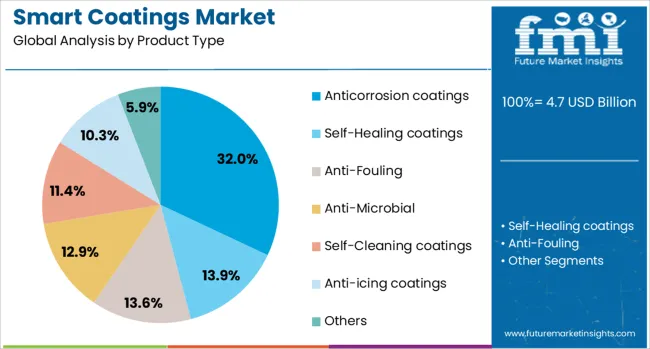
- Product Type: Anticorrosion coatings will retain dominance, capturing 32% market share in 2025. Their ability to release protective agents on demand and extend asset life under harsh environments has made them essential for energy, marine, and construction sectors.
- Technology: Nano-coatings will command 45% of market revenue by 2025. Their superior adhesion, chemical resistance, and UV protection, combined with thinner, more efficient layers, are enabling adoption across electronics, automotive, and healthcare.
- End-Use Industry: Automotive remains the leading sector, accounting for 28% of total share in 2025, as OEMs integrate multifunctional coatings that enhance fuel efficiency, durability, and aesthetic resilience.
Technological Breakthroughs Reshaping the Market
Continuous innovation defines the smart coatings landscape. Microencapsulated self-healing agents, conductive nanocomposites, and photochromic additives are creating coatings that sense, react, and adapt. Integration with IoT and edge devices allows real-time performance monitoring, facilitating predictive maintenance across industrial assets.
These technologies are not only reducing material waste and downtime but also enabling adaptive building facades, hygienic healthcare environments, and energy-optimized transport systems.
Regulatory and Manufacturing Challenges Persist
Despite strong momentum, the industry faces barriers including high production costs, stringent testing, and scaling complexity for nanomaterials. Smart coatings often require precision in formulation and substrate compatibility, increasing cost by 2–3x compared to conventional coatings.
However, FMI notes that ongoing cost rationalization, automation in nano-dispersion, and expanded testing infrastructure—especially in Asia and Europe—are mitigating these challenges and paving the way for industrial-scale adoption.
About Future Market Insights (FMI)
Future Market Insights, Inc. (FMI) is an ESOMAR-certified, ISO 9001:2015 market research and consulting organization, trusted by Fortune 500 clients and global enterprises. With operations in the U.S., UK, India, and Dubai, FMI provides data-backed insights and strategic intelligence across 30+ industries and 1200 markets worldwide.
Why Choose FMI: Empowering Decisions that Drive Real-World Outcomes: https://www.futuremarketinsights.com/why-fmi