According to the latest analysis by Future Market Insights (FMI), the global Polytetrafluoroethylene (PTFE) market is on a robust trajectory, projected to reach USD 2.5 billion by 2035 from an estimated USD 1.5 billion in 2025, registering a CAGR of 5.5%. The report highlights PTFE’s steady rise as a critical industrial polymer, driven by its exceptional chemical resistance, low friction, and thermal stability, which enable its use in sectors ranging from automotive and aerospace to electronics and pharmaceuticals.
Steady Expansion Underpinned by Industrial Reliability
FMI’s data reveals a stable growth curve between 2025 and 2035, with incremental gains of USD 0.1–0.2 billion annually. Unlike volatile materials markets, PTFE demonstrates predictable demand, supported by long product lifecycles, minimal substitution threats, and regulatory compliance requirements across mission-critical applications.
By 2031, accelerated adoption in miniaturized electronics, automotive heat management, and filtration systems is expected to maintain consistent year-over-year growth, solidifying PTFE’s reputation as a durable, high-performance polymer.
Subscribe for Year-Round Insights → Stay ahead with quarterly and annual data updates: https://www.futuremarketinsights.com/reports/sample/rep-gb-23105
Segment Insights: Granular PTFE Leads Market Adoption
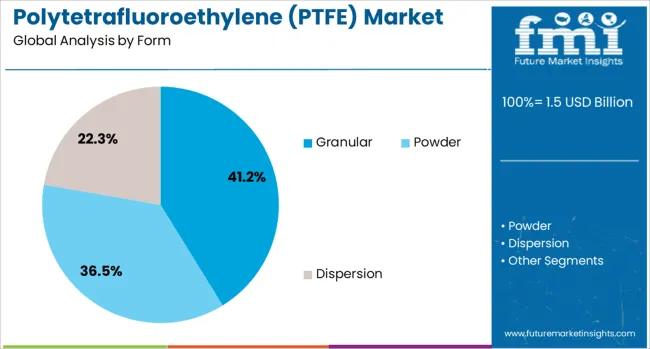
The granular PTFE segment continues to dominate, accounting for 41.2% of global market share in 2025. FMI attributes this dominance to granular PTFE’s mechanical strength, molding versatility, and compatibility with large-scale production. Industries use this form for rods, sheets, and tubes, benefiting from high-density performance under extreme conditions.
Meanwhile, unmodified PTFE types represent 65.7% of market share, upheld by their purity, electrical insulation capabilities, and chemical inertness—qualities essential in semiconductors, chemical processing, and food-grade machinery.
In terms of manufacturing, the suspension process holds a commanding 52.3% share, favored for producing granular PTFE with superior structural consistency and scalability.
Industry-Wide Adoption: Chemical, Automotive, and Electronics Drive Growth
FMI’s report indicates that approximately 37% of global PTFE demand stems from the chemical and industrial sectors, primarily for valves, seals, and linings resistant to heat and reactive substances. Automotive applications account for 32%, particularly in fuel systems, brake linings, and gaskets.
The electrical and electronics segment contributes 23%, propelled by PTFE’s vital role in high-purity wire insulation, semiconductor manufacturing, and low-dielectric coatings. Moreover, surface coatings and non-stick applications comprise 18% of demand, while medical and laboratory uses make up another 10%.
Regional Outlook: APAC Commands Half of Global Demand
The Asia-Pacific (APAC) region continues to dominate the global PTFE market, accounting for nearly 50% of total consumption in 2025. FMI’s country-level analysis shows:
- China leads globally, growing at a CAGR of 7.4% through 2035. The expansion of fluoropolymer tubing, gasket sealing, and wire insulation production—coupled with stringent emission regulations—is strengthening local PTFE manufacturing.
- India follows closely with a 6.9% CAGR, bolstered by rapid industrialization, electrical insulation demand, and domestic resin production. The nation’s defense and electronics sectors are emerging as major end-users, reducing import dependence by nearly 19% since 2024.
Europe’s Precision-Driven Growth: Germany and the UK Take Lead
In Europe, the PTFE market remains strong, with Germany posting a 6.3% CAGR through 2035. FMI attributes this to its medical, laboratory, and aerospace sectors, which rely on cleanroom-grade PTFE components. German manufacturers have embraced REACH-compliant production, ensuring superior dimensional control and export growth within the EU.
The United Kingdom holds 5.2% of global market share, driven by food-grade seals, chemical linings, and heat-resistant electrical insulation. Post-Brexit trade shifts have diversified PTFE imports toward South Korea and Taiwan, enhancing supply chain resilience across Europe.
USA Market: Specialty and High-Value PTFE Applications Dominate
The United States, representing 4.7% of global market share, continues to specialize in aerospace, pharmaceuticals, and semiconductor applications. FMI’s data show:
- Glass-filled PTFE is widely used in semiconductor wafer-processing valves and etching chambers.
- Pharmaceutical-grade PTFE diaphragms and filters are standardized across drug manufacturing lines.
- High-performance blends—notably low-permeability and wear-resistant grades—are central to the U.S. shift toward cleanroom-compliant materials.
These developments, coupled with R&D-driven specialization, reinforce the U.S. role as a premium PTFE technology hub.
Need tailored insights? Request report customization to match your specific business objectives: https://www.futuremarketinsights.com/customization-available/rep-gb-23105
Saudi Arabia’s Emerging Industrial Demand
In the Middle East, Saudi Arabia stands out as a key growth engine within the Gulf Cooperation Council (GCC). Government initiatives to diversify industrial production—notably within chemical processing, energy infrastructure, and construction—are fostering PTFE adoption.
Saudi manufacturers are increasingly integrating PTFE coatings and gaskets in petrochemical pipelines and industrial machinery, leveraging the material’s high resistance to corrosive and high-temperature environments. Strategic investment in local fluoropolymer processing plants under the Vision 2030 industrial expansion plan further positions Saudi Arabia as a regional hub for PTFE manufacturing and exports.
Emerging Market Trends: Toward Circular and Smart Material Integration
FMI identifies several transformative trends shaping the PTFE market’s next decade:
- Composite Integration: PTFE composites reinforced with glass or carbon fibers now represent 24% of emerging demand, particularly in industrial processing.
- Circular Reuse: Reprocessed PTFE scrap integration reached 16% in advanced recycling markets, driving sustainability efforts.
- Digital Quality Assurance: Over 35% of global PTFE supply chains now use digital traceability and batch-level purity certification systems.
- Smart Coatings: Sensor-integrated PTFE liners are under pilot testing in 12% of industrial maintenance contracts, shifting from preventive to predictive maintenance.
Global Competitive Outlook
While multinational chemical companies remain major suppliers, FMI highlights a strategic shift toward localized production and eco-compliant innovation. Vertical integration of raw material sourcing and R&D-driven product differentiation define competitive success.
FMI’s analysts emphasize that sustainability, regulatory alignment, and material innovation—including recyclable PTFE formulations—will shape the market’s long-term landscape across APAC, Europe, the USA, and Saudi Arabia.
About Future Market Insights (FMI)
Future Market Insights, Inc. (FMI) is an ESOMAR-certified, ISO 9001:2015 market research and consulting organization, trusted by Fortune 500 clients and global enterprises. With operations in the U.S., UK, India, and Dubai, FMI provides data-backed insights and strategic intelligence across 30+ industries and 1200 markets worldwide.
Why Choose FMI: Empowering Decisions that Drive Real-World Outcomes: https://www.futuremarketinsights.com/why-fmi