According to the latest analysis by Future Market Insights (FMI), the global polyacrylamide market is set to grow from USD 6.6 billion in 2025 to USD 11.7 billion by 2035, recording a CAGR of 6.0%. This consistent decade-long expansion underscores the growing importance of polyacrylamide (PAM) as a performance polymer enabling efficient water treatment, enhanced oil recovery (EOR), paper manufacturing, and mining operations.
Between 2025 and 2026, the market is expected to rise from USD 6.6 billion to USD 6.9 billion, representing 4.5% year-over-year growth, sustained by large-scale investment in wastewater treatment infrastructure, particularly across Asia-Pacific and the Middle East. By 2030, the market is projected to reach USD 8.3 billion, crossing a pivotal breakpoint that shifts the market from compliance-driven adoption to innovation-led expansion.
Key Market Highlights
| Metric | Data |
| Market Size (2025) | USD 6.6 Billion |
| Forecast Size (2035) | USD 11.7 Billion |
| CAGR (2025–2035) | 6.0% |
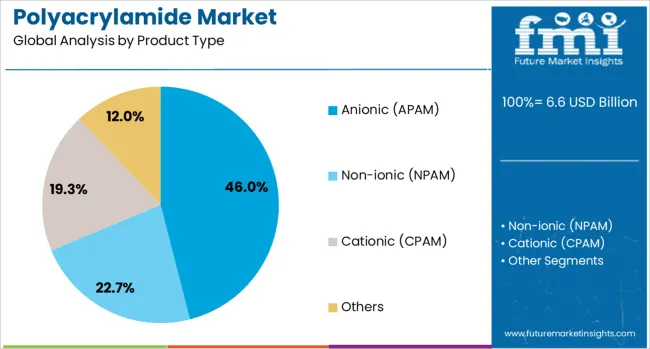
| Leading Product Segment | Anionic Polyacrylamide (46.0%) |
| Dominant Application | Water Treatment (54.0%) |
| Top Growth Regions | Asia-Pacific, Europe, USA, Saudi Arabia |
Subscribe for Year-Round Insights → Stay ahead with quarterly and annual data updates: https://www.futuremarketinsights.com/reports/sample/rep-gb-23237
Asia-Pacific (APAC) Leads Global Adoption with Focus on Water Security and Industrial Efficiency
The Asia-Pacific region continues to dominate the polyacrylamide landscape, driven by industrial water reuse, urbanization, and oilfield recovery programs.
- China, the global growth leader with a CAGR of 8.1%, has integrated PAM into wastewater recycling and enhanced oil recovery (EOR) projects in mature fields such as Daqing and Xinjiang.
Government-backed environmental policies and domestic chemical production have made China a cornerstone of global supply and demand. - India follows closely with a CAGR of 7.5%, supported by expanding sewage treatment plants (STPs) and Smart City initiatives. Polyacrylamide is now widely deployed in industrial corridors and oilfields in Gujarat and Rajasthan for water purification and crude recovery.
Growing water scarcity, strict discharge norms, and new decentralized wastewater treatment projects across ASEAN countries further reinforce APAC’s leadership position.
Europe: Environmental Regulation and Technological Innovation Drive Growth
Europe remains a key market for high-purity and eco-compliant PAM formulations, driven by the region’s circular economy and water sustainability goals.
- Germany, with a CAGR of 6.9%, has integrated polyacrylamide into industrial closed-loop water systems and municipal sludge dewatering, aligning with EU Water Framework Directive (2000/60/EC) compliance.
Germany’s civil engineering sector also employs PAM in soil stabilization and tunneling projects. - The United Kingdom, growing at 5.7% CAGR, has expanded PAM use in municipal water treatment, rail infrastructure tunneling, and pulp & textile sectors, supported by modernized treatment facilities and national sustainability goals.
- France and Italy maintain steady demand through paper manufacturing and industrial effluent management, emphasizing high-performance, low-toxicity polymer grades.
Across Europe, regulatory scrutiny on residual monomer content is fostering innovation in bio-based and low-toxicity PAM variants, positioning the region as a leader in sustainable polymer chemistry.
United States: Efficiency and Sustainability in Industrial Applications
The United States maintains a steady growth trajectory with a CAGR of 5.1%, driven by its diverse industrial applications across oil recovery, municipal wastewater, and food processing.
- PAM plays a critical role in shale gas extraction, particularly in Texas, Pennsylvania, and North Dakota, where it enhances solid-liquid separation and friction reduction in drilling fluids.
- Municipal water treatment facilities are integrating high-efficiency flocculants to reduce operational costs and comply with EPA discharge regulations.
- The polymer’s use in petrochemicals, pulp mills, and chemical manufacturing continues to rise due to efficiency, safety, and improved solubility features.
Ongoing investments in dry and liquid polymer formulations tailored for high-performance industrial systems ensure that the U.S. remains a key driver of innovation in the global PAM market.
Saudi Arabia: Strategic Growth Under Vision 2030
In Saudi Arabia, the polyacrylamide market is expanding steadily as the Kingdom invests heavily in water conservation, oil recovery, and mining to diversify its industrial base under Vision 2030.
PAM is increasingly used in enhanced oil recovery (EOR) across mature fields, improving extraction efficiency while reducing water-to-oil ratios.
Additionally, desalination pre-treatment, municipal wastewater reuse, and industrial effluent recycling are creating robust demand for anionic and cationic PAM formulations.
The focus on hydrocarbon optimization and water security positions Saudi Arabia as the Middle East’s fastest-growing PAM market, supported by public-private partnerships and R&D investments in eco-friendly polymer technologies.
Need tailored insights? Request report customization to match your specific business objectives: https://www.futuremarketinsights.com/customization-available/rep-gb-23237
Segmental Insights
Product Type: Anionic Polyacrylamide (APAM) Dominates
Anionic PAM is projected to hold 46% of the global market share in 2025, attributed to its superior flocculation performance, cost-effectiveness, and wide applicability in neutral-to-alkaline conditions.
Its demand is particularly high in municipal and industrial wastewater systems, textile effluent treatment, and pulp & paper industries. APAM’s adaptability across sludge thickening, sedimentation, and clarification makes it a core component in large-scale purification frameworks.
Application: Water Treatment Remains the Prime Driver
The water treatment segment, accounting for 54% of market revenue in 2025, remains the primary growth engine.
With escalating global water stress, urban expansion, and Zero Liquid Discharge (ZLD) mandates, polyacrylamide serves as an indispensable solution for potable water clarification, sludge dewatering, and greywater recycling.
The growing trend toward sustainable water management systems ensures that PAM will remain central to global clean-water infrastructure.
Technological Advancements and Market Trends
The next decade will mark a transition from compliance to innovation, with market growth accelerating post-2030:
- Enhanced Oil Recovery (EOR): PAM-based flooding techniques are being optimized for low-permeability reservoirs, particularly in North America and the Middle East.
- Sustainable Chemistry: Emerging bio-based PAM formulations are addressing concerns over residual monomers and environmental persistence.
- Process Customization: Tailored polymer grades based on charge density, molecular weight, and viscosity control are providing precision solutions across mining, papermaking, and municipal treatment.
- Automation and Dosing Optimization: Integration of AI-based dosing systems is improving PAM utilization efficiency in water treatment plants.
About Future Market Insights (FMI)
Future Market Insights, Inc. (FMI) is an ESOMAR-certified, ISO 9001:2015 market research and consulting organization, trusted by Fortune 500 clients and global enterprises. With operations in the U.S., UK, India, and Dubai, FMI provides data-backed insights and strategic intelligence across 30+ industries and 1200 markets worldwide.
Why Choose FMI: Empowering Decisions that Drive Real-World Outcomes: https://www.futuremarketinsights.com/why-fmi