Future Market Insights (FMI) projects that the global5-Isopropyl-m-Xylene market will grow from USD 219.3 million in 2025 to USD 431.5 million by 2035, registering a robust 7.0% CAGR. This expansion is fueled by the compound’s rising use as a chemical intermediate in pharmaceuticals, agrochemicals, specialty polymers, and coatings, supported by escalating industrial and R&D investment across Asia-Pacific (APAC), Europe, the United States, and Saudi Arabia.
FMI’s analysis highlights that the compound’s structural versatility and controlled reactivity make it a vital feedstock in the production of terephthalic acid derivatives and high-purity aromatic chemicals, which are essential for polymer, coating, and life-science applications.
Market Overview and Growth Outlook
According to FMI, the market will expand steadily through the decade:
- USD 234.7 million (2026)
- USD 251.1 million (2027)
- USD 268.7 million (2028)
- USD 287.5 million (2029)
- USD 307.6 million (2030)
This consistent trajectory underscores stable demand from chemical and pharmaceutical industries seeking precision intermediates for polyester resins, active pharmaceutical ingredients (APIs), and high-performance coatings.
Rising investments in sustainable synthesis and advanced chemical processing technologies are enabling higher yield, purity, and efficiency, positioning 5-Isopropyl-m-Xylene as a preferred choice for precision industrial chemistry worldwide.
Subscribe for Year-Round Insights → Stay ahead with quarterly and annual data updates: https://www.futuremarketinsights.com/reports/sample/rep-gb-23134
Segmental Analysis: Terephthalic Acid and Derivatives Lead
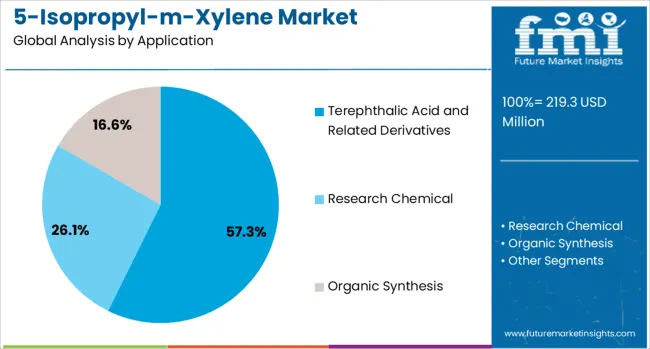
FMI identifies the Terephthalic Acid and Related Derivatives segment as the dominant application area, projected to hold 57.3% of total market share in 2025. The compound’s suitability as an oxidation-stable intermediate supports efficient polyester manufacturing.
Growing global demand for recyclable polyester fibers and resins, particularly within textiles and packaging, has reinforced segmental leadership. Industry data show continued upgrades in oxidation and distillation processes that enhance conversion yield while lowering byproduct formation, strengthening long-term competitiveness.
Additional segments — including Research Chemicals and Organic Synthesis — also demonstrate solid expansion as research laboratories and fine-chemical producers increase usage in catalytic coupling and material-science synthesis pathways.
Regional Insights: Cross-Market Expansion Across Four Growth Engines
Asia-Pacific (APAC): Industrial Scale-Up and Feedstock Security
APAC remains the largest and fastest-growing regional market, driven by China (9.5% CAGR) and India (8.8%).
- In China, demand is concentrated in perfume bases, agrochemical carriers, and solvent blends, backed by rising export-grade purification capacity.
- In India, consumption is expanding in fragrance, resin, and specialty coatings manufacturing, supported by enhanced separation units and logistics infrastructure.
Investments in high-purity distillation systems, contract blending, and export-oriented processing hubs continue to fortify regional output, positioning APAC as a global supply center for isomer-specific aromatic intermediates.
Europe: Precision Chemistry and High-Purity Formulations
Germany (8.1% CAGR) and the United Kingdom (6.7%) drive Europe’s performance. Germany’s strong fine-chemical sector integrates 5-Isopropyl-m-Xylene into adhesives, polymers, and advanced coatings, emphasizing low-impurity production.
Chemical parks in North Rhine-Westphalia and Baden-Württemberg have expanded feedstock adaptability to ensure continuous supply amid evolving EU regulatory frameworks.
In the U.K., growing research applications and solvent-recovery projects have increased uptake across ink and coating lines, while university labs and toll manufacturers are stimulating niche-scale demand for analytical-grade compounds.
United States: Purity Standards and Process Innovation
The U.S. market shows a steady 6.0% CAGR, underpinned by strict purity and safety standards for industrial chemicals.
Usage is concentrated in high-purity solvents, custom lubricants, and metal-treatment formulations, particularly within Gulf Coast and Midwestern facilities.
Upgraded batch monitoring systems and rail logistics have improved compliance and cost efficiency, while OEMs in paints and adhesives are leveraging the compound for enhanced drying and blend performance.
Saudi Arabia: Diversification Through Chemical Innovation
Under Vision 2030, Saudi Arabia is strengthening downstream chemical diversification. Expansion in specialty chemical synthesis and industrial coatings has increased 5-Isopropyl-m-Xylene demand within industrial parks and free zones.
The compound’s thermal stability and solvent compatibility make it suitable for energy, coating, and manufacturing applications, supporting Saudi Arabia’s strategy to develop self-reliant, export-driven chemical value chains.
Market Dynamics: Drivers, Challenges, and Trends
Key Growth Drivers
- Widening end-use base across pharmaceuticals, coatings, and polymers.
- Precision synthesis demand in high-purity intermediates and organic reagents.
- Rising adoption of advanced oxidation and catalytic systems for yield improvement.
- Investments in sustainable and cleaner chemical synthesis aligned with ESG goals.
Challenges
- Feedstock volatility due to benzene-derived input dependency affects cost stability.
- Regulatory fragmentation across Europe, North America, and Asia adds compliance overhead, delaying market entry for smaller suppliers.
Emerging Trends
- Digitalized production controls ensuring purity consistency across batches.
- Collaborative R&D partnerships between producers and downstream users for custom grades.
- Automation and AI-driven process monitoring improving throughput efficiency.
- Substitution-resistant demand in regulated pharmaceutical and specialty coating sectors due to unique reactivity profile.
Competitive Landscape
The 5-Isopropyl-m-Xylene market remains moderately consolidated with a focus on purity assurance, supply reliability, and documentation traceability.
Leading participants maintain extensive portfolios across research and industrial chemistry.
Companies are intensifying their investment in AI-enabled synthesis optimization, process automation, and green chemistry compliance. Producers that can scale custom synthesis while meeting pharma-grade documentation are expected to achieve long-term differentiation.
FMI notes that global suppliers are diversifying regional presence to strengthen resilience against feedstock price volatility and logistics constraints. Strategic emphasis on custom formulation services and technical collaboration will continue to define competitive positioning over the forecast horizon.
Future Outlook
FMI anticipates sustained demand growth through 2035, with the market surpassing USD 430 million as emerging economies strengthen local chemical production. Innovation in low-energy catalytic routes, high-purity distillation systems, and digital quality control will reduce production costs and environmental impact.
With APAC leading supply, Europe advancing regulatory-compliant purity standards, the U.S. driving technology integration, and Saudi Arabia expanding industrial diversification, the 5-Isopropyl-m-Xylene market represents a globally interconnected growth opportunity.
About Future Market Insights (FMI)
Future Market Insights, Inc. (FMI) is an ESOMAR-certified, ISO 9001:2015 market research and consulting organization, trusted by Fortune 500 clients and global enterprises. With operations in the U.S., UK, India, and Dubai, FMI provides data-backed insights and strategic intelligence across 30+ industries and 1200 markets worldwide.
Why Choose FMI: Empowering Decisions that Drive Real-World Outcomes: https://www.futuremarketinsights.com/why-fmi