Future Market Insights (FMI) reports that the global Zinc Citrate Market is poised for sustained expansion, projected to rise from USD 2.1 billion in 2025 to USD 4.3 billion by 2035, growing at a CAGR of 7.4%. Backed by rising demand for dietary supplements, fortified foods, and pharmaceutical-grade minerals, the market will generate an incremental gain of USD 2.2 billion over the next decade.
The first growth phase (2025–2030) will contribute USD 0.9 billion, led by early adoption in nutraceutical and oral health sectors. The latter half (2030–2035) will accelerate sharply, adding USD 1.3 billion as preventive healthcare, fortified foods, and clean-label formulations become global norms.
Zinc Citrate: The Rising Star in Preventive Nutrition and Oral Health
Zinc citrate—a bioavailable form of zinc with superior absorption and digestive tolerance—has become essential in immune health, bone support, and oral care formulations. With its dual functionality as a nutritional and therapeutic mineral, zinc citrate is increasingly preferred over traditional zinc salts across both consumer and clinical segments.
FMI’s data reveals that zinc citrate dihydrate will hold 48.6% of the total market share in 2025, dominating the segment due to its high elemental zinc content, solubility, and formulation versatility.
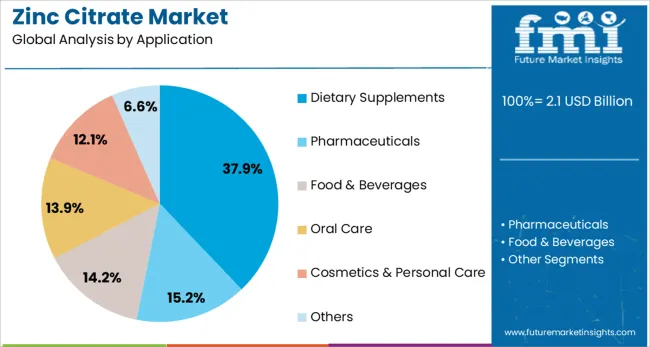
The dietary supplements segment will contribute 37.9% of total revenue, propelled by consumer preference for immune-boosting, vegan-friendly, and clinically validated formulations. Meanwhile, the oral care category—including toothpaste, mouth rinses, and sugar-free gum—will expand rapidly, supported by zinc citrate’s ability to prevent plaque buildup and strengthen enamel.
Subscribe for Year-Round Insights → Stay ahead with quarterly and annual data updates: https://www.futuremarketinsights.com/reports/sample/rep-gb-22976
Regional Outlook: APAC, Europe, USA, and Saudi Arabia Lead Global Momentum
Asia-Pacific: Fastest Growing Market (China, India, Japan, ASEAN)
Asia-Pacific will dominate global growth, with China (10.0% CAGR) and India (9.3% CAGR) leading due to expanding nutraceutical industries and government-backed nutrition programs.
- China: Growth driven by fortified functional foods, pediatric nutrition programs, and rising exports of pharmaceutical-grade zinc compounds.
- India: Demand powered by public health initiatives, fortified dairy and cereal products, and affordable supplement formulations targeting micronutrient deficiencies.
Together, these markets will account for nearly one-third of global incremental demand through 2035, supported by local manufacturing strength and export competitiveness.
Europe: Clean Label and Clinical Validation Drive Uptake (Germany, France, UK)
Europe’s zinc citrate market is characterized by stringent purity standards and innovation in supplement delivery systems.
- Germany (8.5% CAGR): Growth underpinned by clinically validated dietary supplements and EU-compliant pharmaceutical formulations.
- France (7.8% CAGR): Strong adoption in oral hygiene products and fortified cereals, supported by expanding e-commerce distribution.
- United Kingdom (7.0% CAGR): Market driven by premium supplement brands, vegan zinc formulations, and subscription-based nutrition models.
European consumers’ growing preference for traceable, science-backed mineral supplements will sustain long-term demand.
United States: Mature Market Embracing Functional Nutrition
The U.S. market will grow at 6.3% CAGR, maintaining steady progress as personalized nutrition and clean-label health products dominate consumer choices.
Key drivers include:
- Increased demand for over-the-counter immune supplements and fortified beverages.
- Expanding use of zinc citrate in pediatric and geriatric formulations.
- Product innovation in effervescent tablets, lozenges, and gummies to improve compliance and palatability.
Saudi Arabia: Strategic Growth Hub for Nutraceutical and Pharma Diversification
Under Vision 2030, Saudi Arabia is fast emerging as a regional hub for nutraceutical and pharmaceutical manufacturing. The country’s focus on local production of mineral-based supplements, coupled with rising preventive health awareness, positions it as a high-potential market within the GCC.
Zinc citrate demand is supported by the shift toward bio-based, halal-certified formulations and government initiatives promoting nutritional sufficiency.
Market Drivers: Health Awareness and Clean Label Innovation
FMI identifies five key macro-drivers accelerating global demand for zinc citrate:
- Preventive Healthcare Adoption: Growing awareness of zinc’s role in immunity, growth, and cellular repair is fueling supplement consumption globally.
- Fortified Food Expansion: Manufacturers are incorporating zinc citrate in cereals, dairy, and beverages to enhance nutritional value.
- Oral Care Applications: Proven efficacy in tartar control and enamel protection has led to its widespread use in premium toothpaste formulations.
- Clean Label & Transparency: Consumers prefer plant-compatible, allergen-free, and non-GMO zinc citrate products with validated safety profiles.
- Technological Advancements: Encapsulation and microgranulation technologies are improving solubility, taste masking, and formulation stability.
Challenges and Opportunities
Despite its growth potential, market expansion faces challenges related to regulatory compliance, taste masking, and solubility optimization. FMI notes that variations in permissible zinc intake limits across regions require precise formulation strategies.
However, emerging opportunities in personalized supplements, e-commerce nutrition platforms, and functional beverage fortification are creating new sales channels. Private-label and digital-first supplement brands are leveraging zinc citrate’s scientific validation to gain consumer trust.
Competitive Landscape
The Zinc Citrate Market remains moderately fragmented, with competition centered on purity standards, innovation, and distribution reach.
According to FMI’s analysis, leading companies are expanding capacity, improving product consistency, and forming partnerships with nutraceutical and pharmaceutical manufacturers to strengthen supply security.
Key focus areas include:
- Bioavailability enhancement through advanced chelation processes.
- Microencapsulation to improve stability and taste.
- Backward integration for traceable and sustainable raw material sourcing.
The market is expected to witness strategic alliances among raw material suppliers, contract manufacturers, and supplement brands aiming to capture the rising demand for high-purity, pharma-grade zinc citrate.
FMI Forecast: A Decade of Health-Centric Growth
By 2035, the Zinc Citrate Market will solidify its position as a critical component in the global preventive nutrition and oral care ecosystem, surpassing USD 4.3 billion in value. The combined momentum from Asia-Pacific, Europe, the U.S., and Saudi Arabia will reshape supply chains and accelerate the shift toward functional, transparent, and clinically proven mineral formulations.
“Zinc citrate is becoming a cornerstone ingredient in the health economy—bridging immunity, nutrition, and oral wellness,” said an FMI senior analyst. “Its balanced absorption profile and compatibility with clean-label product design position it as a next-generation mineral for global wellness and therapeutic innovation.”
About Future Market Insights (FMI)
Future Market Insights, Inc. (FMI) is an ESOMAR-certified, ISO 9001:2015 market research and consulting organization, trusted by Fortune 500 clients and global enterprises. With operations in the U.S., UK, India, and Dubai, FMI provides data-backed insights and strategic intelligence across 30+ industries and 1200 markets worldwide.
Why Choose FMI: Empowering Decisions that Drive Real-World Outcomes: https://www.futuremarketinsights.com/why-fmi