The global piezoelectric polymers market is on a transformative trajectory, estimated at USD 1.8 billion in 2025 and projected to reach USD 2.9 billion by 2035, reflecting a robust CAGR of 4.8% during the forecast period, according to the latest insights from Future Market Insights (FMI). Growth is being catalyzed by accelerating adoption in wearable electronics, medical diagnostics, automotive sensors, and energy-harvesting systems—sectors that are converging toward lightweight, flexible, and energy-efficient solutions.
Steady Early Growth Followed by High-Value Acceleration Post-2030
From USD 1.4 billion in 2025 to USD 1.9 billion by 2030, the market’s early phase reflects steady year-over-year growth, driven primarily by established demand in acoustic transducers and sensors. After a brief plateau, FMI projects renewed expansion—culminating in a USD 1.0 billion increase between 2030 and 2035, as piezoelectric polymers become integral to biomedical microdevices, soft robotics, and self-powered IoT systems.
“Between 2030 and 2035, we expect a clear inflection point as these materials transition from niche science to mass-market engineering,” said an FMI analyst. “This transformation is being powered by advancements in PVDF-TrFE copolymers, flexible energy harvesters, and next-generation sensors that redefine how devices interact with their environments.”
Subscribe for Year-Round Insights → Stay ahead with quarterly and annual data updates: https://www.futuremarketinsights.com/reports/sample/rep-gb-22988
Regional Growth Landscape: APAC, Europe, USA, and Saudi Arabia at the Forefront
Asia-Pacific (APAC): China and India Lead Global Expansion
APAC remains the most dynamic region in the piezoelectric polymers market, led by China (CAGR 6.5%) and India (6.0%). In China, strong R&D investments in flexible electronics and robotics are fueling polymer innovation, with applications expanding across smart textiles, industrial automation, and energy harvesting modules. India’s progress is anchored in health diagnostics, structural monitoring, and agricultural sensors, with research parks and medtech startups accelerating commercialization.
“Both China and India are transitioning from material importers to technology creators, with increasing domestic capabilities in polymer processing and sensor integration,” FMI observed.
Europe: Technological Leadership from Germany, France, and the UK
In Europe, the piezoelectric polymers market is advancing steadily, with Germany (5.5%), France (5.0%), and the United Kingdom (4.6%) as the key growth engines. Germany’s high-precision manufacturing and sustainability-driven policies are promoting the use of piezoelectric films in automotive, wind turbine, and industrial monitoring applications. France is prioritizing biodegradable and aerospace-grade polymers, while the UK focuses on smart infrastructure, AR/VR haptics, and clean energy devices.
Europe’s maturity in regulatory compliance and additive manufacturing further strengthens its position as a center for innovation and standardization in flexible piezo materials.
United States: Advanced Electronics and Medical Integration
The United States remains a critical market with a CAGR of 4.1%, driven by rapid adoption in biomedical devices, defense applications, and next-gen consumer electronics. U.S. R&D institutions are investing in nano-structured PVDF composites to enhance device sensitivity while maintaining flexibility. The nation’s strong ecosystem of semiconductor, healthcare, and aerospace companies positions it as a hub for application-specific integration.
Saudi Arabia and GCC: Smart Manufacturing and Energy Diversification
In the Kingdom of Saudi Arabia, demand for piezoelectric polymers is growing in alignment with Vision 2030, as part of a broader push toward smart manufacturing, energy efficiency, and digital healthcare. The GCC region’s strategic shift to diversify beyond oil is fostering investments in automation, renewable energy, and smart infrastructure, creating fertile ground for flexible electronic components and self-powered sensors.
Market Structure and Key Application Insights
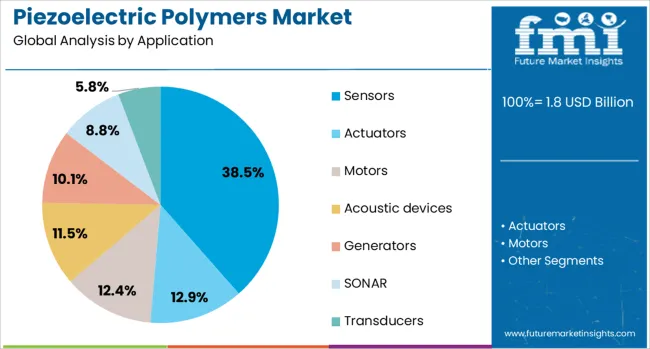
The sensors segment is projected to dominate with 38.5% of market share in 2025, as piezoelectric polymers enable miniaturized, flexible, and low-power devices. Their precision in converting mechanical stress into electrical signals makes them essential for wearables, automotive vibration systems, and structural health monitoring. FMI identifies healthcare (41.6%) as the largest end-use sector, followed by automotive and consumer electronics, collectively accounting for over 60% of total demand.
In the product landscape, polymer-based materials such as PVDF and PVDF-TrFE hold a commanding 52.4% revenue share, supported by superior processability and thermal stability compared to ceramics. These polymers are being extensively used in smart medical patches, haptic sensors, and flexible energy harvesters.
Drivers and Industry Trends
FMI’s analysis identifies several key factors shaping market evolution:
- Flexible Sensing & Energy Harvesting: PVDF-based materials are increasingly adopted in soft robotics, wearables, and IoT devices, where mechanical energy is converted into electrical signals—enabling battery-free operation.
- Composite Innovation: Emerging chitosan and nanocomposite elastomers are improving charge generation and stretchability, fostering scalable use in healthcare and aerospace.
- Circular Manufacturing: Subscription-based material supply and polymer regeneration programs are gaining traction in Europe and East Asia, enhancing sustainability.
- Processing Advancements: Improved film orientation, corona poling, and dip-coating precision ensure consistency in mass-produced sensors and actuators.
Key Countries by CAGR (2025–2035)
- China: 6.5%
- India: 6.0%
- Germany: 5.5%
- France: 5.0%
- United Kingdom: 4.6%
- USA: 4.1%
- Brazil: 3.6%
FMI Perspective: Market Poised for Next-Phase Commercialization
“Piezoelectric polymers are transitioning from scientific innovation to scalable commercial integration,” commented FMI’s lead analyst. “Between now and 2035, we anticipate high-value opportunities in self-powered IoT nodes, implantable sensors, and flexible medical imaging, especially in regions aligning with sustainability and smart infrastructure goals.”
The report highlights that collaboration between material innovators and device manufacturers is becoming the new competitive edge, particularly as energy-efficient, miniaturized, and recyclable materials reshape the global electronics value chain.
About Future Market Insights (FMI)
Future Market Insights, Inc. (FMI) is an ESOMAR-certified, ISO 9001:2015 market research and consulting organization, trusted by Fortune 500 clients and global enterprises. With operations in the U.S., UK, India, and Dubai, FMI provides data-backed insights and strategic intelligence across 30+ industries and 1200 markets worldwide.
Why Choose FMI: Empowering Decisions that Drive Real-World Outcomes: https://www.futuremarketinsights.com/why-fmi