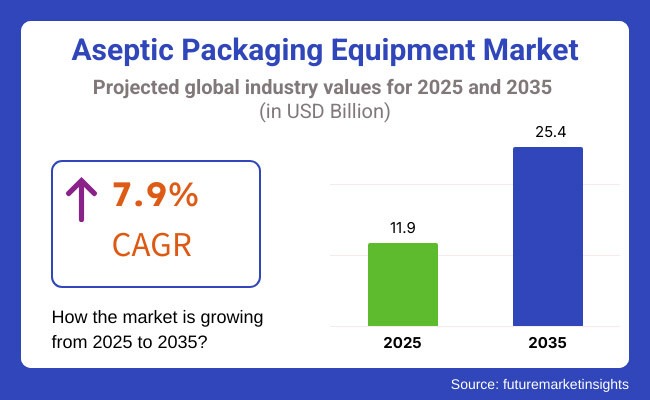
The global Aseptic Packaging Equipment Market is entering a decade of robust expansion driven by rising demand for longer product shelf life, enhanced food safety, and a strategic shift toward sustainable, contamination-free packaging solutions. According to latest market projections, the industry is expected to grow from USD 11.9 billion in 2025 to USD 25.4 billion by 2035, reflecting a strong 7.9% CAGR.
Across food & beverages, pharmaceuticals, and dairy sectors, companies are increasingly adopting advanced aseptic systems—high-speed filling lines, enhanced sterilization technologies, AI-enabled quality control, and smart monitoring systems—to ensure product integrity while reducing reliance on preservatives and refrigeration.
Growing consumer preferences for minimally processed, convenient, and clean-label products, coupled with stricter global regulations on food safety and packaging sustainability, continue to accelerate market adoption.
Subscribe for Year-Round Insights → Stay ahead with quarterly and annual data updates – https://www.futuremarketinsights.com/reports/sample/rep-gb-12524
Aseptic Packaging Equipment Market: Global Momentum and Key Drivers
The decade ahead will likely see a technological leap driven by:
- AI-driven quality control and robotics improving contamination prevention
- Green and recyclable packaging solutions aligning with sustainability mandates
- Automation and digital tracking technologies, including IoT-enabled monitoring
- Advanced sterilization processes boosting product integrity and operational efficiency
Supportive government frameworks, investments in digitalization, and cross-industry partnerships are helping manufacturers upgrade from traditional packaging to fully aseptic, high-efficiency systems.
Despite significant progress, the market faces challenges such as high upfront investments, complex technology integration, and stringent regulatory compliance—particularly for small and mid-sized enterprises. However, these obstacles continue to motivate innovation in modular equipment, energy-efficient systems, and predictive maintenance tools.
Regional Market Analysis: Aseptic Packaging Equipment Market
North America: Market Leader Driven by Technology and Regulation
North America continues to lead the global aseptic packaging equipment market, supported by the United States and Canada’s emphasis on stringent FDA food safety regulations and rising consumption of dairy, beverages, and pharmaceutical products. Companies are investing heavily in automation, high-speed filling machines, and contamination-free packaging lines to meet surging demand.
However, steep initial installation costs still challenge smaller manufacturers. Rising adoption of recyclable materials and sustainable packaging designs is expected to strengthen the region’s future growth trajectory.
Europe: Advanced Technologies and Strict Compliance Framework
Europe remains a high-value market due to rigorous EU food and pharmaceutical safety laws. Countries such as Germany, France, and the UK continue to pioneer aseptic packaging innovations, emphasizing:
- Energy-efficient filling machines
- Bio-based and recyclable barrier materials
- Digital monitoring and smart sterilization solutions
With sustainability at the center of EU policy reforms, manufacturers are increasingly prioritizing automation and carbon-neutral packaging innovations to remain competitive.
Asia-Pacific: Fastest-Growing Regional Market
Asia-Pacific is projected to outpace all other regions between 2025 and 2035, fueled by rapid industrial growth, rising urbanization, and soaring packaged food & pharmaceutical demand in China, India, Japan, and South Korea. Government investments in food safety, smart manufacturing, and pharmaceutical modernization contribute significantly to the region’s expansion.
Despite challenges such as high capital costs and inconsistent regulatory frameworks, the region’s shift toward cost-effective aseptic solutions, digitalization, and flexible packaging systems will drive future adoption.
Challenges and Opportunities
Key Challenge: High Capital Requirements and Regulatory Complexity
Aseptic systems require expensive sterilization infrastructure and compliance with strict global standards. Operational costs, skilled labor shortages, and complex technology integration remain barriers for new entrants.
Key Opportunity: Automation & Sustainable Packaging Materials
AI-powered inspection, IoT monitoring, and robotic filling solutions represent the next wave of growth, reducing contamination risk and operational downtime. Rising consumer demand for eco-friendly aseptic materials is also encouraging manufacturers to invest in recyclable, lightweight, and low-carbon packaging technologies.
Market Shifts: Looking Ahead from 2025 to 2035
The next decade will witness:
- AI-driven aseptic monitoring systems and predictive maintenance
- Blockchain-enabled traceability for real-time contamination control
- Expansion of aseptic applications into cosmetics and nutraceuticals
- Widespread adoption of biodegradable and recyclable aseptic materials
A clear shift towards smart, sustainable, and fully automated processing environments will define the competitive landscape.
Competitive Landscape: Leading Companies Strengthen Market Position
The aseptic packaging equipment market is dominated by key players including:
- Tetra Pak (20–25%) – Advanced aseptic filling systems and sustainable carton packaging
- SIG Combibloc (15–20%) – High-speed machines and digital packaging solutions
- Krones AG (12–16%) – Aseptic PET bottling and integrated automated lines
- GEA Group (10–14%) – Processing and filling solutions for dairy, beverages & pharma
- Robert Bosch GmbH (8–12%) – Pharmaceutical-grade sterilization and automated systems
Emerging innovators like Ecolean, Serac, Coesia Group, JBT Corporation, and Shibuya Corporation are reshaping industry standards with lightweight materials, robotics, and precision sterilization.
Why FMI: https://www.futuremarketinsights.com/why-fmi
About Future Market Insights (FMI)
Future Market Insights, Inc. (FMI) is an ESOMAR-certified, ISO 9001:2015 market research and consulting organization, trusted by Fortune 500 clients and global enterprises. With operations in the U.S., UK, India, and Dubai, FMI provides data-backed insights and strategic intelligence across 30+ industries and 1200 markets worldwide.
Contact Us:
Future Market Insights Inc.
Christiana Corporate, 200 Continental Drive,
Suite 401, Newark, Delaware – 19713, USA
T: +1-347-918-3531
For Sales Enquiries: sales@futuremarketinsights.com
Website: https://www.futuremarketinsights.com
LinkedIn| Twitter| Blogs | YouTube