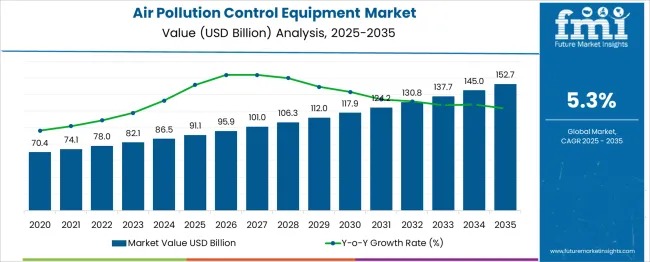
The global Air Pollution Control Equipment Market is entering a pivotal decade as industrial economies tighten emissions mandates and deploy advanced filtration technologies. Valued at USD 91.1 billion in 2025, the market is forecast to reach USD 152.7 billion by 2035, expanding at a 5.3% CAGR. Between 2029 and 2031, the industry experiences a critical inflection point—transitioning from linear to accelerated growth driven by regulatory thresholds, industrial retrofits, and the rapid adoption of electrostatic precipitators, FGD systems, and baghouse filters.
Subscribe for Year-Round Insights → Stay ahead with quarterly and annual data updates
https://www.futuremarketinsights.com/reports/sample/rep-gb-23548
From 2025 to 2029, the market adds USD 20.9 billion, while the following four years (2029–2033) contribute USD 26.6 billion—a 27.2% surge in incremental gains. This transition aligns closely with OECD, ASEAN, and emerging market policies that emphasize particulate control, SO₂ reductions, and VOC management. The final two years (2033–2035) alone deliver nearly USD 15 billion in market expansion, reflecting accelerated investments in advanced emission control for cement, steel, power, and waste-to-energy facilities.
Global demand is rising in response to persistent air quality concerns, urban pollution, and the need for industrial decarbonization. Power plants, automotive manufacturing, metals processing, and chemicals remain core contributors to equipment adoption. Companies are increasingly investing in high-efficiency separators, oxidizers, catalytic converters, and real-time monitoring systems to align with evolving emission caps.
Market Drivers: Regulation, Retrofits & Technology Advancements
A convergence of environmental policies and industrial modernization is fueling long-term growth. Governments across the U.S., Europe, China, and India are enforcing strict PM, NOx, SO₂, and VOC standards. Beyond compliance, industries are prioritizing system optimization, operational energy savings, and automation-driven monitoring.
Rapid urbanization and manufacturing expansion in Asia Pacific have further intensified demand for cost-efficient retrofits and turnkey emission control systems. Industries are increasingly adopting hybrid systems, sensor-enabled filters, and compact scrubbers designed for high particulate loads and tight space constraints.
Segmental Insights
Electrostatic precipitators lead the type segment, accounting for 26% of the 2025 revenue share, supported by high particulate removal efficiency and energy-efficient operations. Their integration into steel plants, cement kilns, and thermal power stations continues to expand as emission norms tighten globally.
In the automotive segment, which makes up 24% of market revenue, rising production of heavy-duty and commercial vehicles under advanced standards such as Euro VI and Bharat Stage VI is lifting demand for catalytic reduction systems and high-performance filtration.
The dominance of the direct sales channel (61% share in 2025) is driven by the need for tailored designs, engineering consultations, and end-to-end installation services. Large industrial buyers prefer direct OEM engagement to ensure system compatibility with site-specific emission profiles.
Regional Growth Dynamics
China leads the global landscape with a 7.2% CAGR, propelled by stringent emissions frameworks in high-density industrial regions such as Hebei and Shandong. Hybrid scrubbers, desulfurization units, and advanced dust collectors have seen installations surge across steel, cement, and waste-to-energy plants.
India, growing at 6.6%, continues to upgrade thermal power stations and refineries with flue gas desulfurization systems and high-efficiency baghouse filters. Smart city initiatives are also accelerating deployments of ambient air management solutions.
Germany posts a strong 6.1% CAGR, supported by EU directives mandating secondary filtration, advanced scrubbers, and carbon-capture-ready systems in power and metallurgical industries. AI-enabled monitoring platforms have gained traction across municipal waste facilities.
The United Kingdom, at 5.0% CAGR, is prioritizing low-emission retrofits in legacy plants and municipal waste systems. While London leads in adoption, regional disparities persist due to variable funding support.
In the United States (4.5% CAGR), adoption is strongest in industrial corridors of California, Texas, and the Midwest. Petrochemical hubs continue to deploy hybrid systems, scrubbers, and SCR units to align with evolving EPA enforcement.
Competitive Landscape
Key players such as Thermax, Donaldson, Durr, GEA Group, Lydall, MANN+HUMMEL, Mitsubishi Power, Siemens, Nederman, and Pall are reshaping the market with innovations in filtration media, automated diagnostics, and high-efficiency emission control modules. Strategies center on lifecycle cost reduction, regulatory compliance, and seamless integration with existing industrial infrastructure.
Get data that aligns with your strategic priorities — ask for report customization today:
https://www.futuremarketinsights.com/customization-available/rep-gb-23548
Related Reports
Stair Lift Motors Market- https://www.futuremarketinsights.com/reports/stair-lift-motors-market
Plate Heat Exchanger Market- https://www.futuremarketinsights.com/reports/plate-heat-exchanger-market
Solar Inverter Market- https://www.futuremarketinsights.com/reports/solar-inverter-market
Have a specific Requirements and Need Assistant on Report Pricing or Limited Budget please contact us – sales@futuremarketinsights.com
About Future Market Insights (FMI)
Future Market Insights, Inc. (FMI) is an ESOMAR-certified, ISO 9001:2015 market research and consulting organization, trusted by Fortune 500 clients and global enterprises. With operations in the U.S., UK, India, and Dubai, FMI provides data-backed insights and strategic intelligence across 30+ industries and 1200 markets worldwide.
Contact Us:
Future Market Insights Inc.
Christiana Corporate, 200 Continental Drive,
Suite 401, Newark, Delaware – 19713, USA
T: +1-347-918-3531
Why FMI: https://www.futuremarketinsights.com/why-fmi
Website: https://www.futuremarketinsights.com
LinkedIn| Twitter| Blogs | YouTube