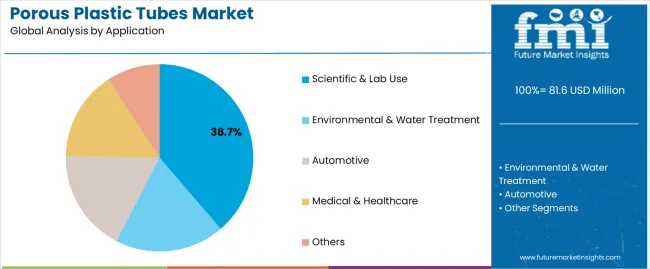
The global porous plastic tubes market is projected to advance steadily, rising from USD 81.6 million in 2025 to USD 127.9 million by 2035, registering a CAGR of 4.6%. Growing applications in laboratories, industrial systems, and environmental treatment technologies are fueling this momentum.
Across APAC, Europe, the USA, and Saudi Arabia, the adoption of porous plastic tubes is transforming how industries manage filtration, aeration, and separation efficiency. These tubes, known for their chemical resistance, consistent permeability, and customizable porosity, are increasingly used in scientific research, medical diagnostics, and environmental treatment processes.
Regional Outlook:
In Asia-Pacific, expanding laboratory automation and industrial modernization are driving adoption. Rising investments in microfluidics and medical device production—especially in China, Japan, and South Korea—are increasing demand for PE-type porous tubes, which command a 42.3% market share globally.
Europe is witnessing growing deployment in pharmaceutical and biotechnological laboratories. The region’s strict environmental regulations have accelerated the use of porous tubes for water treatment, gas diffusion, and fuel cell humidification systems. European manufacturers are prioritizing advanced PP formulations and bio-compatible designs that align with sustainable production goals.
The United States continues to lead innovation, integrating porous plastics in next-generation drug delivery and respiratory systems. High R&D investment and the rapid integration of modular filtration units in clinical and research facilities are propelling market growth.
Meanwhile, Saudi Arabia and the GCC countries are emerging as new growth hubs, emphasizing porous tube technology for desalination, wastewater recycling, and oil & gas processing. Government-led sustainability programs are encouraging the adoption of engineered plastic filtration solutions across industrial facilities.
Request the complete report to gain a clear understanding of regional growth patterns, innovation trends, and competitive intelligence! Request Sample Report: https://www.futuremarketinsights.com/reports/sample/rep-gb-27898
Market Drivers and Applications:
Porous plastic tubes provide controlled fluid and gas flow across precision-driven systems. Their consistent porosity and chemical resistance make them indispensable in laboratory automation, sample preparation, and reagent dosing. In environmental sectors, porous aeration and gas diffusion tubes are improving efficiency in aquaculture oxygenation, groundwater remediation, and wastewater treatment.
Industrial applications—particularly in pneumatic and fuel cell humidification systems—are also expanding. As industries move toward high-efficiency and low-maintenance systems, the demand for customizable porous tube solutions is expected to accelerate.
Segment Analysis:
- Material Type: PE (polyethylene) remains dominant with a 42.3% market share in 2025, offering cost efficiency and broad compatibility.
- Application: Scientific and laboratory use leads, holding 38.7% of global demand, followed by industrial and environmental applications.
- Growth Forecast: From 2025 to 2030, the market is expected to increase by USD 20.5 million, representing 44.3% of the decade’s total expansion.
Technology and Innovation Trends:
Manufacturers are focusing on customizable porosity grades, advanced polymer blends, and modular tube designs tailored to equipment OEMs. Automation and digital quality control systems are enhancing consistency and scalability.
Emerging PTFE and medical-grade variants are enabling new medical and automotive applications. Furthermore, the rise of additive manufacturing and precision extrusion techniques is enabling complex pore architectures and faster product turnaround times.
Competitive Landscape:
The industry is experiencing consolidation, with larger filtration manufacturers acquiring specialized porous plastic companies to strengthen their product portfolios. This trend underscores growing confidence in porous plastics as essential to modern separation and flow control systems.
Outlook by 2035:
The second half of the forecast period (2030–2035) is expected to generate USD 25.8 million in additional market value, supported by the expansion of environmental treatment infrastructure and laboratory modernization initiatives.
In North America and Europe, adoption will be driven by clean-tech investments and the integration of porous plastics into bioengineering and analytical platforms. Asia-Pacific will maintain a strong trajectory, with government-backed research funding and industrial digitization initiatives accelerating local manufacturing capabilities. The Middle East, particularly Saudi Arabia, will continue investing in water management and filtration technologies as part of its Vision 2030 objectives.
Key Market Insights:
- Market Size (2025): USD 81.6 Million
- Forecast (2035): USD 127.9 Million
- CAGR (2025–2035): 4.6%
- Top Material: PE (42.3% share)
- Top Application: Scientific & Laboratory Use (38.7%)
- Leading Regions: North America, Europe, APAC, and Saudi Arabia
Strategic Opportunities:
- Medical and Life Sciences: Porous tubes are being integrated into respiratory support, infusion systems, and diagnostic devices that demand consistent flow and biocompatibility.
- Industrial Automation: Integration in pneumatic systems and fuel cell humidifiers enables reliable fluid management and energy efficiency.
- Water & Environmental Systems: Sustainable water treatment and gas diffusion applications present new frontiers for expansion.
- OEM Collaborations: Partnerships with laboratory and industrial equipment manufacturers are driving product innovation and cross-sector adoption.
Future Outlook:
Between 2025 and 2035, demand will shift toward high-performance and modular designs that support advanced separation systems and compact process configurations. As industries transition to smart, automated filtration setups, porous plastic tubes will remain at the core of innovation—bridging precision, durability, and sustainability.
About Future Market Insights (FMI)
Future Market Insights, Inc. (FMI) is an ESOMAR-certified, ISO 9001:2015 market research and consulting organization, trusted by Fortune 500 clients and global enterprises. With operations in the U.S., UK, India, and Dubai, FMI provides data-backed insights and strategic intelligence across 30+ industries and 1200 markets worldwide.
Why Choose FMI: Empowering Decisions that Drive Real-World Outcomes: https://www.futuremarketinsights.com/why-fmi