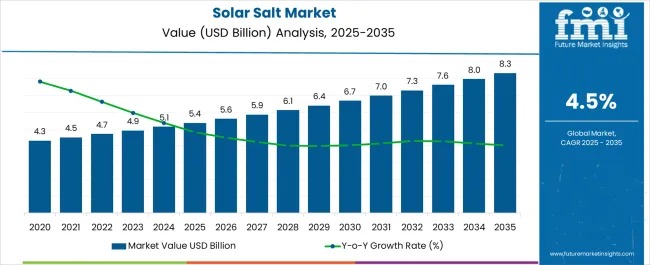
The global Solar Salt Market, characterized by eco-efficient salt extraction through solar evaporation, is set to witness steady growth. Market valuation is expected to rise from USD 5.4 billion in 2025 to USD 8.3 billion by 2035, reflecting a CAGR of 4.5% during the forecast period.
Industries are increasingly shifting toward cleaner, natural, and energy-efficient raw materials, propelling the adoption of solar salt. The market continues to gain traction across chemical processing, water treatment, and food processing segments due to its high purity and low environmental impact.
To Explore Detailed Market Data, Segment-Wise Forecasts, and Competitive Insights, Request Sample Report! https://www.futuremarketinsights.com/reports/sample/rep-gb-6078
Solar Salt Market Snapshot (2025–2035)
- Market Value (2025): USD 5.4 Billion
- Forecast Value (2035): USD 8.3 Billion
- Forecast CAGR: 4.5%
- Leading Source Segment (2025): Underground Brine — 54.2%
- Dominant Region: North America, Asia-Pacific, Europe
- Key Market Participants: Cargill Inc., AkzoNobel N.V., Tata Chemicals Limited, K+S AG, Compass Minerals, Cheetham Salt Ltd., Kensalt Ltd., Nirma Ltd., Dampier Salt.
Growth Drivers: Clean Extraction Meets High Industrial Purity
Solar salt production requires significantly less energy compared to mined salt, reducing carbon emissions and offering a cost-efficient purification process. Its high purity, particularly beneficial for chemical manufacturing, makes it an essential industrial input.
Technological advances in evaporation ponds and crystallization control are boosting yield, ensuring consistent supply, and expanding industrial applications. Government regulations favoring sustainable sourcing and increasing water treatment adoption are also contributing to strong market demand.
Segmental Highlights
Underground Brine Dominates Source Category
The underground brine segment is projected to account for 54.20% market share by 2025, supported by reliable availability and scalability. It offers lower extraction cost and stable quality, making it the most preferred raw material among large-scale manufacturers.
Pellet Form to Capture 47.60% Market Share
Pelletized solar salt is set to contribute 47.60% of global revenues by 2025. Its controlled dissolution, equipment-friendly texture, and easy handling position it as a superior option for industrial and household water conditioning systems.
Chemical Processing Leads Applications
The chemical processing segment is estimated to generate 42.80% of total revenue in 2025, led by solar salt usage in chlor-alkali production and other industrial chemical reactions requiring high purity.
Regional Outlook: Growth Momentum Across Continents
North America
North America remains a strong consumer base, fueled by expanding industrial production and cost-optimized water treatment facilities. Solar salt adoption is surging as industries seek to replace chemical-intensive alternatives.
Europe
Europe’s transition toward renewable energy and eco-efficient manufacturing has boosted investment into solar salt storage and scalable evaporation technologies. Favorable government policies further support adoption across industrial sectors.
Asia Pacific
Asia Pacific exhibits the fastest expansion, driven by industrialization, high population growth, and infrastructure investment in water treatment. Major players across China and Japan are investing heavily in high-efficiency solar salt production technologies.
Category Insights: Usage in Industrial Value Chains
- Oil & Gas: Used as a corrosion inhibitor, brine solution in purification, and antifouling agent in storage and transportation infrastructure.
- Water Treatment: Reduces microbial presence and heavy metal content; increasingly adopted in residential water softener systems.
- Food and Agriculture: Utilized in flavoring, preservative functions, and soil conditioning solutions.
Competitive Landscape
The market remains highly competitive, with global leaders such as Cargill Inc., AkzoNobel N.V., Tata Chemicals, K+S AG, and Compass Minerals dominating production capacity and product innovation. Regional players continue to gain traction with localized sourcing and cost-effectiveness. Companies are increasingly targeting technology-driven efficiency improvements, diversification in salt forms, and improved supply chain sustainability.
About the Study
This industry analysis evaluates market dynamics, growth indicators, regional trends, and competitive benchmarking for stakeholders in chemical production, food processing, water treatment, oil & gas, and household water conditioning sectors.