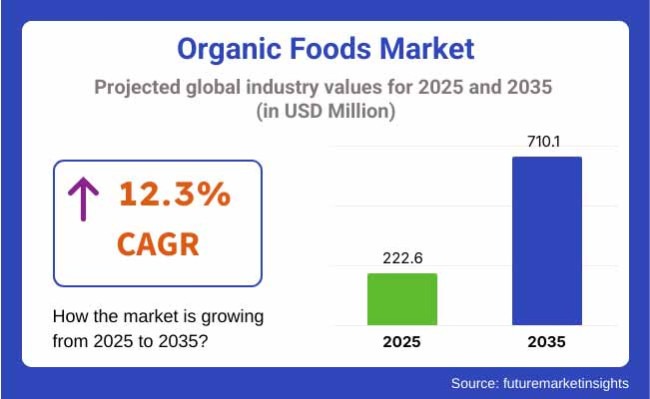
The organic foods market is gaining strong traction as consumers shift away from conventional products toward health-centric, sustainable, and pesticide-free alternatives. According to recent projections, the industry is estimated to be valued at USD 222.6 million in 2025 and is expected to reach USD 710.1 million by 2035, expanding at a robust CAGR of 12.3% from 2025 to 2035.
Rising health concerns, increased awareness of chemical-free foods, and growing demand for non-GMO and clean-label products are accelerating global adoption. Organic foods are increasingly preferred for their perceived advantages in digestion, allergy reduction, and overall quality of life. Categories witnessing the steepest growth include fresh produce, organic dairy, meat, beverages, baby foods, and minimally processed ready-to-eat meals.
To Explore Detailed Market Data, Segment-Wise Forecasts, and Competitive Insights, Request Sample Report! https://www.futuremarketinsights.com/reports/sample/rep-gb-16722
Consumers Lead the Push Toward Healthier Alternatives
The industry’s rapid growth is rooted in a strong consumer focus on nutrition-rich, ethically sourced, and chemical-free foods. Products such as organic fruits, vegetables, grains, meats, and protein alternatives are now mainstream demand drivers. Baby foods have emerged as a high-growth segment as new parents seek nutrient-dense, minimally processed, and pesticide-free food options for infants.
Key Drivers Boosting Market Growth
- Growing preference for clean-label and non-GMO products
- Rising awareness of health benefits linked to organic foods
- Increasing adoption of organic ingredients in restaurants, catering, and foodservice
- E-commerce and subscription delivery models accelerating accessibility
- Government incentives supporting sustainable farming and organic certifications
Technology Is Transforming the Organic Food Supply Chain
Scientific advancements in soil enrichment, organic pest control, and precision agriculture have significantly boosted crop productivity and quality. Technologies like blockchain traceability are further enabling transparency in ingredient sourcing, strengthening consumer trust in certified organic products.
Looking ahead, AI-enabled precision farming, lab-grown organic food, climate-smart agriculture, and hyper-local carbon-neutral production are expected to redefine industry standards. In the coming decade, regulatory agencies are projected to enforce stricter sustainability and environmental footprint criteria, pushing brands toward net-zero carbon organic agriculture.
Market Risks and Strategic Imperatives
Despite promising growth, the market faces challenges including high production costs, price sensitivity during economic slowdowns, and complex certification requirements. Climate-sensitive crops pose additional supply chain risks, which could trigger price volatility.
To navigate these challenges, industry participants must:
- Invest in transparent certifications and blockchain-based authenticity verification
- Expand private-label offerings and affordability initiatives
- Strengthen regenerative agriculture and resource-conserving farming models
Fake organic labeling remains a major threat to market credibility. Strategic collaboration with third-party certifiers and adoption of traceability technologies are essential to protect consumer trust.
Category Insights: Organic Dairy and Whole Grains Lead
In 2025, organic dairy is projected to hold the largest category share, led by products such as milk, cheese, yogurt, and butter. This preference is driven by rising demand for hormone-free and grass-fed dairy. Companies like Organic Valley, Danone, and Arla Foods are expanding pasture-raised dairy offerings and grass-fed product lines.
Organic whole grains are gaining dominance in cereals and grains due to the strong preference for high-fiber, clean-label food products. Leading brands such as Nature’s Path, Bob’s Red Mill, and Arrowhead Mills are launching regenerative and sustainably produced grain products.
Competitive Landscape
The organic foods sector continues to consolidate as global food giants acquire niche brands to expand their organic portfolios. Strategic sourcing, regenerative agriculture, and digital traceability are emerging as core differentiators.
Major Players Include:
- Danone S.A.
- Nestlé S.A.
- General Mills, Inc.
- Hain Celestial Group
- Organic Valley
- Hero Group
- B&G Foods
- Wilkin & Sons Ltd
- Bonne Maman
These companies are investing aggressively in plant-based offerings, sustainable packaging, organic dairy expansion, and regenerative farming.
About the Report
This press release is based on comprehensive market intelligence outlining forecast trends, category-wise adoption, technology evolution, competitive positioning, risk assessment, and country-level growth projections for the organic foods sector through 2035.