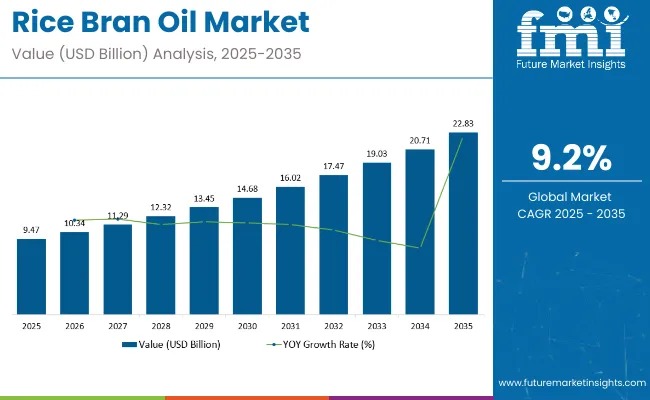
The global rice bran oil market is set to witness robust expansion, projected to rise from USD 9.47 billion in 2025 to USD 22.83 billion by 2035, registering an impressive 9.2% CAGR. The market’s rapid ascent reflects surging demand for oils offering cholesterol-lowering properties, cleaner labels, and multi-sector versatility.
Rice bran oil, extracted from the outer layer of rice grains, is increasingly embraced for its balanced fatty acid profile, antioxidant concentration, and exceptionally high smoke point. The presence of gamma-oryzanol, tocopherols, and tocotrienols is steering consumer preference away from heavily processed edible oils toward nutraceutical-grade oils that support cardiovascular wellness.
To Explore Detailed Market Data, Segment-Wise Forecasts, and Competitive Insights, Request Sample Report! https://www.futuremarketinsights.com/reports/sample/rep-gb-16708
Functional Benefits Drive Consumer Adoption
The growing interest in antioxidant-rich and functional ingredients is a primary growth driver. Its neutral flavor, light viscosity, and oxidative stability make it suitable for both household cooking and commercial food processing. Chefs and health-conscious consumers are choosing rice bran oil as a premium alternative to conventional vegetable oils, encouraged by its ability to support cholesterol reduction while meeting high-heat culinary needs.
The food processing industry has become a high-volume adopter, leveraging the oil for snack frying, bakery applications, and industrial food manufacturing. Meanwhile, the cosmetics and nutraceutical sectors are scaling usage due to its anti-inflammatory, anti-aging, moisturizing, and bioactive properties.
Trade Dynamics and International Demand
The export landscape is dominated by large rice-producing nations with strong refining capabilities, most notably India, Thailand, and Vietnam. Countries with rising health awareness, yet limited domestic production capacity—such as China, Japan, South Korea, the United States, and key European markets—remain leading importers.
Growing preferences for transparent labeling, natural ingredients, and functional fats continue to expand global trade routes. Demand is particularly strong in markets where consumers actively seek heart-healthy and antioxidant-rich alternative oils.
Shifting Consumer Spending and Applications
Per-capita spending on rice bran oil remains highest in health-aware regions of Asia and Europe. With expanding consumer education campaigns, spending is projected to accelerate in emerging markets, where the oil is increasingly positioned alongside organic, fortified, and plant-based lifestyle trends.
Its fast-rising adoption spans:
- Food & Beverages — the dominant segment, driven by quick-service restaurant use, high-temperature stability, and household transition toward cholesterol-friendly oils.
- Healthcare & Nutrition — fueled by the oil’s use in dietary supplements and cardiovascular wellness formulations.
- Cosmetics — tapping into demand for vitamin-E-rich, anti-aging, moisture-retaining ingredients.
Technology, Innovation, and Sustainability Trends
Industry players are rapidly shifting to solvent-free refining, enzymatic extraction, and cold-pressed processing, ensuring higher nutrient retention with sustainable output. Emerging production trends include carbon-neutral refineries, zero-waste manufacturing, and AI-led nutrient optimization.
Looking forward, AI-personalized blends fortified with Omega-3, plant sterols, and high-value antioxidants are expected to redefine product portfolios between 2025 and 2035, particularly as manufacturers target consumers with tailored health solutions.
Competitive Landscape
The market remains intensely competitive, split between multinational agribusinesses and specialized regional oil refiners. Key companies are expanding investments into organic certifications, premium branding, consumer education, and direct-to-consumer channels. Notable players include:
- Ricela Group of Companies, the global leader in physically refined oil
- Adani Wilmar Ltd., driving mass-market penetration with heart-health claims
- Emami Agrotech Ltd., leveraging branding and endorsements
- Cargill, Inc., dominating B2B supply for food processing
- BCL Industries Limited, specializing in cold-pressed, eco-focused premium oils
Market Risks and Opportunities
Supply chain vulnerabilities due to fluctuating rice production, climate impacts, and competitive pressure from other healthy oils challenge producers. However, opportunities lie in transparent labeling, fortified blends, sustainable packaging, and nutraceutical partnerships. Companies prioritizing responsible sourcing and consumer education will emerge as market leaders.