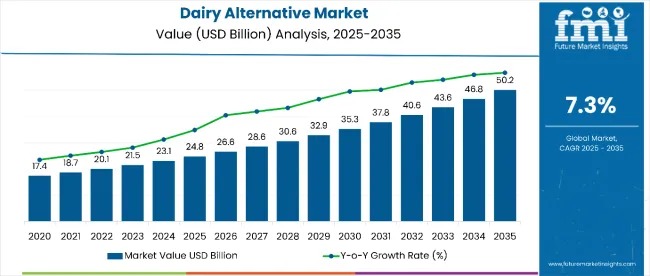
The global dairy alternatives market is set for rapid expansion, forecasted to grow from USD 24.8 billion in 2025 to USD 50.2 billion by 2035, registering a CAGR of 7.3% over the next decade. The surge is backed by growing health awareness, rising lactose intolerance, ethical food consumption patterns, and increasing interest in sustainable and cruelty-free nutrition systems.
To Explore Detailed Market Data, Segment-Wise Forecasts, and Competitive Insights, Request Sample Report! https://www.futuremarketinsights.com/reports/sample/rep-gb-4852
Snapshot of the Dairy Alternatives Market
- Current Market Size (2025): USD 24.8 billion
- Projected Value (2035): USD 50.2 billion
- Growth Rate: 7.3% CAGR
- Top Source Segment: Soy (52% of global share)
- Top Growth Region: Europe—led by Germany and the United Kingdom
- Leading Companies: The Hain Celestial Group, Inc., SunOpta Inc., Danone, Oatly, Vitasoy International Holdings Limited
Soy Holds 52% Share as Consumers Seek Protein-Dense Alternatives
Soy dominates global dairy alternative sourcing with a 52% market share, credited to its strong nutritional profile, high-quality protein composition, and expansive application versatility across milk, yogurt, cheese, butter, and even ice-cream substitutes. Its affordability, strong consumer acceptance, and lower environmental footprint further reinforce its lead.
Industry majors such as SunOpta Inc. and The Hain Celestial Group, Inc. continue to invest in flavor advancements, nutritional fortification, and textural improvements in soy-based beverages and spreads. As sustainability takes center stage, soy remains a critical driver of future plant-based dairy adoption.
Supermarkets and Hypermarkets Drive 35% of Global Sales
Large modern retail chains account for 35% of all dairy alternative sales due to wider assortments, competitive pricing, and stronger brand visibility. In-store promotional campaigns, refrigerator expansions, and dairy-free dedicated shelf zones have increased mainstream consumer exposure.
Brands like Danone and Oatly use these distribution channels to launch region-specific variants, promo bundles, and barista-grade formulations, deepening the consumption of plant-based beverages in both households and cafés.
Health and Lifestyle Shifts Fueling Product Adoption
Growing preference for vegan diets, low-carbon food options, and allergy-friendly nutrition are accelerating category growth. Dairy alternatives now contribute significantly to major food categories:
- 20–25% of the plant-based beverage market, powered by almond, soy, and oat milk.
- 15–20% of the non-dairy yogurt category, driven by demand for probiotic-rich, clean-label snack choices.
- 10–12% of non-dairy cheese, strengthened by texture and flavor innovation.
Plant-based milks fortified with calcium, vitamin D, and B12 are quickly replacing traditional dairy in coffee chains, school menus, and packaged beverages across emerging and developed markets alike.
Market Challenges: Raw Material Constraints and Allergen Restrictions
Shortages in crop yields—particularly soy, almonds, and rice—pose production risks due to climatic and seasonal dependencies. Increasing industrialization and deforestation make agricultural availability unpredictable. Furthermore, soy and nut-based allergens remain serious concerns globally, limiting adoption among sensitive consumer groups and influencing regulatory standards.
Regional Performance: Europe is the Fastest-Growing Market
Europe leads the market expansion, with Germany witnessing the highest growth due to rising health awareness and innovative soy-based drink formulations. The United Kingdom continues to embrace veganism at scale, supported by ethical food choices and environmental concerns.
In India, rising worries about antibiotics and hormones in cow’s milk are steering consumers toward fortified soy milk and premium almond blends, where brands like Sofit and Staeta are gaining prominence. Meanwhile, China’s demand is fueled by health concerns surrounding toxic additives in traditional dairy products and increasing lactose intolerance.
Competitive Landscape: Innovation Focus Shifts to Fortified and Allergen-Free Formulations
Global leaders such as Danone, Oatly, Vitasoy, Blue Diamond Growers, and SunOpta Inc. maintain strong portfolios through aggressive R&D, advanced emulsification technologies, and clean-label enhancements. Up-and-coming brands like Ripple Foods, CP Kelco, Nutriops, and Earth’s Own are disrupting the space with pea protein innovations, allergen-free formulas, and cost-effective organic alternatives.
Recent Market Highlights
- April 2025: Oat milk became the UK’s top-selling plant-based drink, commanding 40% market share, driven by affordable pricing and locally sourced ingredients.
- May 2025: U.S. dairy sales experienced a 3.5% rebound, while plant-based sales dipped 8.4%, reflecting rising demand for lactose-free dairy products—creating a new form of competitive coexistence rather than direct substitution.
Outlook
With precision fermentation, advanced fortification, and allergen-free breakthroughs reshaping the dairy landscape, the next decade promises a new era of ethical and sustainable dairy consumption. As Precision Fermentation leader Dr. Arik Ryvkin noted, “We now bring the last step in that line of evolution, helping dairy companies make the exact products consumers desire while helping cows live happier lives.”