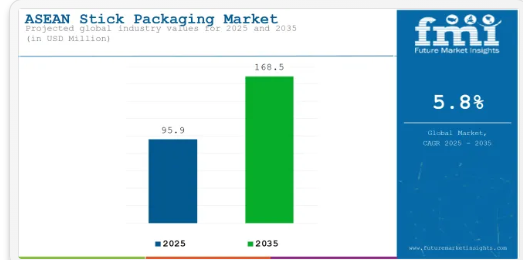
The ASEAN stick packaging market is set to soar over the next decade, presenting a powerful growth narrative for both well-established converters and agile new entrants. According to the latest Future Market Insights (FMI) report, the market valuation is projected to increase from USD 95.9 million in 2025 to USD 168.5 million by 2035, growing at a robust CAGR of 5.8%.
Stick packaging — those slim, single-serve sachets that are so familiar for powdered drinks, sauces, and instant mixes — continue to win over consumers in Southeast Asia. In a region characterized by hot, humid weather and fast-paced, on-the-go lifestyles, these tailored-format packs offer practical convenience without compromising on product freshness.
Convenience Meets Innovation: A Surge in Demand
The food and beverage industry dominates this packaging revolution in ASEAN, expected to maintain more than 62% market share by 2035. Whether it’s powdered coffee in Vietnam, nutritional supplements in Thailand, or single-serve sauce sachets in the Philippines, the versatility of stick packs is fueling adoption across the board.
What’s driving this growth?
- Online retail is booming across ASEAN. Lightweight, space-efficient stick packs are ideal for e-commerce logistics, making them a go-to format for brands selling direct-to-consumer.
- Urbanization continues at pace, and busy consumers increasingly favor single-serve, travel-friendly packaging.
- There’s a growing sustainability mindset. Both legacy and emerging packaging firms are investing in eco-friendly stick packs, such as recyclable films and bio-based materials, responding to consumer demand and regulatory pressures alike.
Legacy Manufacturers Double-Down, New Players Make Their Mark
The report highlights a multi-tiered competitive structure:
- Tier 1: Market leaders with broad ASEAN reach and deep production capacity, such as Thai Plastic Pack Co., Ltd., PT. Pura Barutama, Jindasiam Packaging Co., Ltd., and Asia Packaging Solutions, are expanding their footprints. These firms invest heavily in R&D to enhance barrier technologies, integrate recycling processes, and deliver next-gen flexible packaging.
- Tier 2: Mid-sized regional firms like Sunpack Corporation, PT. Packindo, InnoPack, and Tetra Pak Philippines are leveraging local insights and nimble operations. Their strength lies in adapting quickly to market trends and offering competitive, regulatory-compliant stick pack solutions.
- Tier 3: A vibrant ecosystem of smaller, niche players is emerging — often with specialized expertise. These companies, though limited in reach, serve hyperlocal or specialized needs, such as premium sauces, niche nutraceuticals, or limited-edition products.
New Technologies: Smart, Green, and Custom
Innovation is no longer optional: it’s the backbone of the stick packaging surge.
- Eco-conscious materials – Manufacturers are pioneering bio-plastics, recyclable monolayer films, and even paper-based laminates that reduce environmental impact without sacrificing performance.
- Smart packaging – Some players are embedding QR codes, track-and-trace features, and other smart solutions into stick packs, increasing transparency and consumer engagement.
- Innovative formats – Demand is growing for compact capacities (especially 6 ml to 10 ml packs), but manufacturers are also developing novel shapes, barrier enhancements, and design customizations to boost brand appeal and customer experience.
These technological shifts are not just being led by industry giants. Emerging stick pack converters are carving a niche by offering tailored, low-volume yet highly innovative packaging that meets the needs of small brands and startups.
Opportunities Across the Value Chain
- Established players are scaling up production, expanding plant networks across ASEAN, and investing in high-speed machines and barrier solutions.
- New entrants are well-positioned to disrupt niche markets — be it by offering green stick packs or partnering with novel beverage brands.
- Collaborations are on the rise. Companies are partnering with local startups, ingredient manufacturers, and e-commerce brands to co-create stick-pack formats tailored for ASEAN consumers.
- Sustainability strategies are gaining traction, with many players aligning with circular-economy goals and eco-friendly packaging mandates across the region.