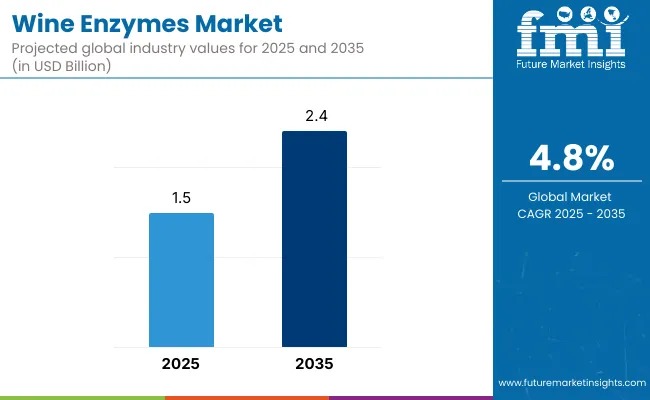
The global wine enzymes market is poised for robust growth, with an estimated valuation of USD 1.5 billion in 2025. The market is projected to reach USD 2.4 billion by 2035, registering a compound annual growth rate (CAGR) of 4.8% over the forecast period. This growth reflects an absolute dollar opportunity of USD 870 million, equivalent to a 1.56 times increase in market size.
The market’s expansion is being driven by rising demand for natural and synthetic enzymes in winemaking, enabling improved fermentation, enhanced aroma, stabilization, and higher quality wine production. By 2030, the market is expected to reach approximately USD 1.9 billion, with incremental growth skewed toward the latter half of the decade, as plant-based and non-animal-derived enzymes gain traction.
Major players, including DSM, Amano Enzyme, Chr. Hansen, Associated British Foods, and Kerry Group, are strengthening their positions through investment in enzyme research, innovative fermentation technologies, and scalable production. Sustainability-focused product development and compliance with international food safety standards are key factors supporting expansion across red, white, and sparkling wines, as well as craft winemaking applications.
Gain Preview Access to Methodology, Sample Charts, and Key Findings by Requesting Your Sample Report! https://www.futuremarketinsights.com/reports/sample/rep-gb-11652
Market Dynamics and Growth Drivers
The wine enzymes market represents a specialized segment within the broader enzyme and food ingredient landscape:
- Accounts for 5–6% of the global enzyme market.
- Holds ~3% of total enzyme-based additives in the food and beverage sector.
- Captures nearly 8% demand within alcoholic beverage processing, crucial for fermentation, clarification, and aroma enhancement.
The market is primarily fueled by:
- Rising consumer preference for premium, organic, and sustainably produced wines.
- Adoption of plant-based and vegan-friendly enzymes.
- Innovations in enzyme formulations, including multi-functional blends for flavor enhancement and stabilization.
- Automation, precision fermentation, and regulatory compliance in winemaking processes.
Segmental Analysis
By type, the fungi enzyme segment—including pectinases, lipases, glycosidases, and fungal proteases—dominates with a 45% market share in 2025. Fungal enzymes are widely used for:
- Improving juice extraction and color yield via pectinases.
- Enhancing aroma through lipases and glycosidases.
- Stabilizing proteins and preventing haze formation with fungal proteases.
By end use, red wine accounts for 40% of the market share. Longer maceration periods and higher tannin content in red wines make enzyme application critical for:
- Efficient clarification and stabilization.
- Color extraction and aroma complexity.
- Maintaining consistency and premium quality.
Other market segments include white, rosé, sweet, and sparkling wines, while functions span fermentation, aroma improvement, hydrolysis, stabilization, settling, clarification, and lysis. Distribution channels include specialty stores, supermarkets, online retail, and hypermarkets.
Regional Insights
Key growth regions include North America, Europe, and Asia-Pacific. The top five country markets are projected to grow as follows (CAGR 2025–2035):
- Japan: 5.5% – Driven by advanced fermentation technologies and premium wine production.
- United States: 5.2% – Supported by high demand for craft and premium wines.
- Germany: 4.6% – Focus on Riesling and Pinot Noir with EU-compliant enzyme applications.
- France: 4.3% – Enzyme adoption in Bordeaux, Burgundy, and Champagne regions.
- United Kingdom: 4.0% – Growth in boutique wineries emphasizing plant-based solutions.
Competitive Landscape
The global wine enzymes market is moderately consolidated, with leading multinational players:
- DSM (Netherlands) – Advanced fermentation and stabilization technologies.
- Novozymes (Denmark) – Broad portfolio including pectinases, proteases, and glycosidases.
- Chr. Hansen (Denmark) – Multi-functional enzyme blends for premium wines.
- Amano Enzyme (Japan) – High-purity plant-based enzymes for vegan-friendly wines.
- Associated British Foods (UK) – Specialty enzyme solutions for red, white, sparkling, and fortified wines.
Regional players differentiate through application-specific formulations and collaborations with wineries. Entry barriers remain high due to regulatory compliance, cold-chain logistics, and specialized production processes. Companies investing in R&D, sustainable sourcing, and innovative multi-functional enzymes are expected to maintain a strategic edge, particularly in premium wine markets across Europe, North America, and Japan.
Future Outlook
With increasing adoption of plant-based enzymes, multi-functional blends, and sustainable production methods, the wine enzymes market is expected to sustain steady growth through 2035. Continued innovation in fermentation technologies, enzyme stabilization, and precision dosing will drive operational efficiency and premiumization, positioning the market for strong expansion across both commercial and craft winemaking sectors globally.